











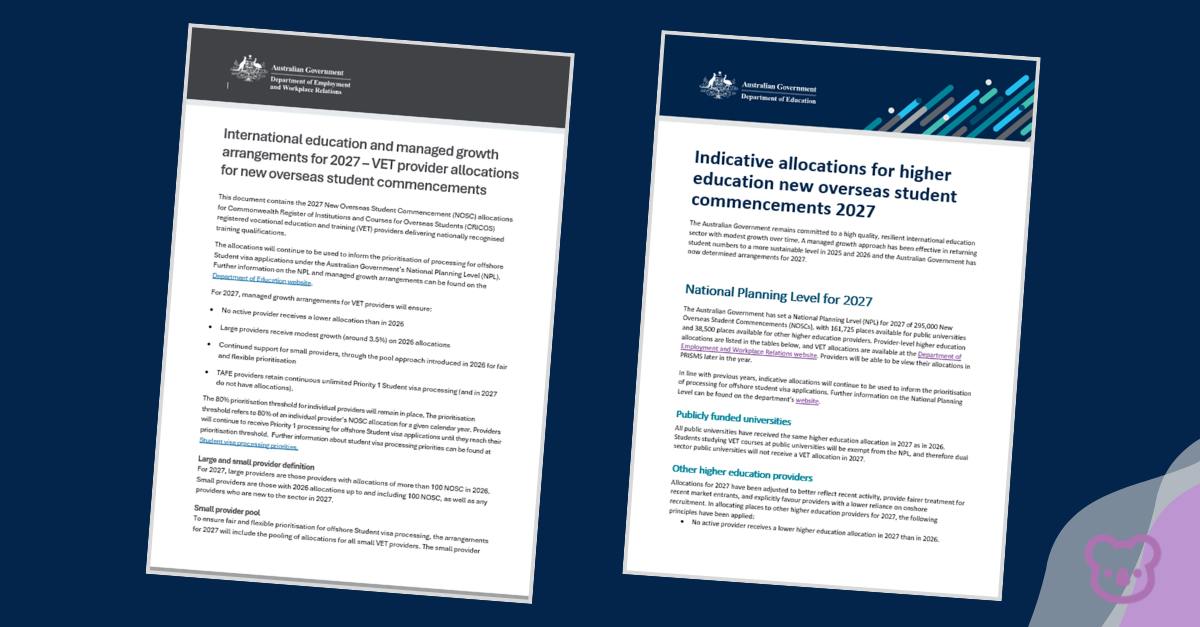
The Government released the provider-by-provider New Overseas Student Commencements (NOSC) for 2027 on Friday afternoon. For those familiar with government practice, a Friday afternoon release of significant information is a predictable occurrence.
The release of the allocations follows the Government’s announcement earlier this month of the policy settings that would underpin the 2027 managed growth arrangements.
Those settings retain the National Planning Level for international student commencements at 295,000, unchanged from 2026. They also mean that no provider will receive a lower NOSC allocation than in 2026 (continuing the approach taken for the 2026 allocations). Existing exemptions remain in place, with an additional exemption introduced for public vocational education and training (VET) providers from 2027.
The earlier release follows sustained lobbying by the sector for provider allocations to be published in time to support institutional planning. The 2026 allocations were not released until October 2025, leading to widespread criticism by education providers.
Higher education
Of the 295,000 NPL, 161,725 places are available for public universities. For other higher education providers, the total allocation is 38,500, with a minimum NOSC of 50. Where applicable, allocations were increased to reflect 90% of a provider’s 2025 HE NOSC activity, with offshore NOSCs counted in full and onshore NOSCs counted at half value.
While the overall higher education allocation has increased by 2.1 per cent, public university allocations remain unchanged from 2026, with the increase reflected in allocations to other higher education providers.
Earlier this year, public universities were invited to submit proposals for additional places. The 2027 allocations do not appear to reflect any increase arising from that process.
Visa prioritisation
No public universities are at Priority 3 status for visa prioritisation in 2026 and only six are at Priority 2. By comparison, more than one-third of other higher education providers are already at Priority 3.
The current visa prioritisation data also raises questions about the significance of the 2027 NOSC allocations. With the major second-semester intake now largely complete, 31 of 37 public universities remain at Priority 1. This suggests that, for most universities, the 2026 allocation has not been the primary constraint on recruitment.
Under Ministerial Direction 115, providers at Priority 3 receive the lowest priority for offshore student visa processing. The fact that more than one-third of non-university providers are already at that level, while no public university has reached it, highlights the different operating environments faced by the two parts of the sector.
If most public universities, the largest part of the international education sector, have not reached the thresholds that affect visa prioritisation in 2026, it is reasonable to ask what influence unchanged allocations for 2027 will have.
VET
In 2027, large providers (defined as those with allocations of more than 100 NOSCs in 2026) receive a ‘modest growth’ of around 3.5 per cent on 2026 allocations. The small provider pool put into place by the Department of Workplace Relations (DEWR) in 2026 will also continue in 2027.
When comparing 2026 and 2027 allocations, the total VET NOSC allocation has increased by just 1.2 per cent, while the number of providers sharing the allocation has grown by 5.3 per cent, resulting in a smaller average allocation per provider.
There are 862 providers who received a NOSC allocation in both the 2026 and 2027:
- 217 providers received an increase
- 645 providers received exactly the same allocation
The expansion of the 2027 provider list is overwhelmingly at the bottom end, with 106 providers newly appearing, and each receiving the minimum allocation of 20.
There are also 60 providers that appeared in 2026 but do not appear in the 2027 NOSC allocations. Together, they accounted for 3,534 places in 2026. This does not necessarily mean these providers have had their allocation removed. Some providers may no longer be recruiting international students, may have closed, or may otherwise no longer require a NOSC allocation.
Unlike the higher education sector, DEWR does not publish a visa prioritisation report.
The relevance of NOSC
Taken together, the allocations and the current visa prioritisation data raise questions about the ongoing relevance of NOSC allocations as the principal mechanism influencing international student commencements.
High visa refusal rates, slower visa processing and the increase ing the student visa application charge to $2,500 all affect a provider’s ability to convert offers into enrolments. At the same time, the visa prioritisation settings linked to NOSC allocations appear to have had limited practical effect for much of the higher education sector, with 31 of 37 public universities remaining at Priority 1 and only around one-third of other higher education providers at Priority 3.
ATEC
These developments also comes at a time when Parliament is considering a new framework for allocating international student places.
A Senate Committee is currently conducting an inquiry into the Universities Accord (Opening the Doors of Opportunity) Bill which establishes a legislative framework under which the Australian Tertiary Education Commission (ATEC) would allocate international student places. Submissions close on 31 July 2026 and a report is due on 3 September, in time for September Parliamentary sitting dates.
The 2027 allocations provide greater certainty for providers than was the case last year. Whether they remain the most significant influence on international student commencements is a different question altogether.