







There is a moment that still catches Faizan Atal by surprise.
After years of uncertainty, endless paperwork and waiting for decisions beyond his control, he stepped off a plane in Sydney expecting another interrogation. He had become accustomed to borders meaning questions, suspicion and delay.
Instead, an Australian Border Force officer smiled.
“Welcome.”
It was a single word. But after years spent as a refugee, wondering whether he would ever belong anywhere again, it was enough to change everything.
For many people working in international education, success is often measured in enrolments, partnerships or rankings. Yet every so often, a story comes along that reminds us what education can really mean. Sometimes it is not about building a career. Sometimes it is about rebuilding a life.
Faizan’s journey from Afghanistan to Australia is one of those stories.
It is also a story that demonstrates how organisations working together can achieve something meaningful. Through the support of the Duolingo English Test’s University Access Program and Australia’s Refugee Student Settlement Pathway, driven by Refugee Education Australia and Skill Path, and supported by Duolingo, a young man whose future had repeatedly been placed on hold has finally been given the opportunity to move forward.
But before Australia came years of uncertainty, loss and resilience.
Growing up in Kabul, education was never simply about getting good grades. It was a family value.
“My father always told us education comes first,” Faizan recalls.
His father had studied engineering. His mother was educated. His siblings excelled academically. Learning was never treated as a luxury but as something fundamental to building a better future.
That belief remained steadfast even as Afghanistan became increasingly unstable.
One memory still stands out. His older sister graduated as the valedictorian of her university. It should have been one of the proudest days of the family’s life.
Instead, it became one of the cruellest reminders of what conflict can steal.
Opportunities for women disappeared almost overnight. The schooling she had worked so hard to earn could no longer be used in the way she had imagined.
“It was heartbreaking,” Faizan says quietly.
The family watched as years of dedication suddenly counted for very little in a country whose rules had changed overnight.
Yet even then, they refused to abandon the importance of education.
Faizan himself had ambitions that stretched well beyond the classroom. He was fascinated by engineering and cybersecurity. Alongside his studies, he had become an accomplished Taekwondo athlete, earning a place on Afghanistan’s national team and representing his country internationally.
Life seemed to offer limitless possibilities.
Then everything changed.
When the security situation deteriorated, he and his brothers were forced to flee Afghanistan. Like millions of others, they became refugees, leaving behind not only their home but also the certainty that education would continue uninterrupted.
India became a place of safety for Faizan, and Germany for his brothers.
It also became a place of waiting.
Waiting for visas.
Waiting for interviews.
Waiting for decisions.
Waiting for someone, somewhere, to determine whether the next chapter of life could begin.
The waiting lasted years.
If there is a common stereotype about refugees, it is that life somehow pauses while they wait for permanent resettlement.
Faizan’s story challenges that assumption.
Instead of allowing the uncertainty to define him, he kept learning.
He continued studying whenever he could. He pursued opportunities online. He strengthened his English. He maintained his Taekwondo training despite having no certainty he would ever compete again.
His days developed their own rhythm. During the intense Indian summers, the heat made daytime almost unbearable, so he often rested during the day and studied through the night.
His circumstances had changed dramatically.
His determination had not.
Perhaps the greatest lesson from those years was that resilience rarely arrives dramatically. More often it is built quietly, one ordinary day at a time.
Education, after all, requires hope.
You study because you believe tomorrow will eventually arrive.
That belief was tested repeatedly.
Eventually, an extraordinary opportunity emerged.
After eighteen months of preparation, applications and interviews, Faizan was awarded a scholarship to one of four universities in the United States. He chose Georgetown University.
For any student, it would have been life-changing.
For a refugee who had spent years rebuilding his education from scratch, it represented validation that all those late nights, sacrifices and disappointments had meant something.
The future finally seemed within reach.
Then it disappeared.
Changes to the American visa policy meant the pathway suddenly closed.
The scholarship remained.
The possibility of travelling did not.
“It was devastating,” Faizan remembers.
Years of effort had once again ended in circumstances entirely beyond his control.
It would have been understandable if he had stopped believing that education really could change his future.
Instead, something remarkable happened.
The people who had supported his journey refused to give up.
One of the quiet strengths of international education is that it is filled with people who rarely accept the first obstacle as the final answer. Sometimes that determination changes individual lives in ways statistics can never capture.
Rather than treating the closed American pathway as the end of Faizan’s story, the team behind the Duolingo University Access Program began searching for another opportunity.
That search would eventually lead thousands of kilometres away to Australia.
It would also introduce Faizan to a new initiative designed specifically to unlock educational opportunities for refugee students who had the talent to succeed but lacked a pathway to get there.
The Australian Refugee Student Settlement Pathway was still in its infancy, bringing together universities, governments and organisations willing to think differently about refugee education.
For Faizan, it represented something he had almost stopped believing existed.
Another chance.
Even then, years of disappointment had taught him not to celebrate too early.
There is a Pashto saying he often quotes.
‘Someone who has been bitten by a snake becomes frightened even by a rope.’
After everything that had happened, hope came cautiously.
He had learned that dreams could disappear overnight.
He had learned that paperwork did not always lead to visas.
He had learned that scholarships did not always become flights.
So, when Australia finally became a real possibility, he carried excitement and disbelief in equal measure.
Only when the aircraft touched down in Sydney would he finally allow himself to think that perhaps, after years of waiting, this journey might actually be beginning.
The journey to Australia should have felt like the finish line.
Instead, for Faizan, it felt almost unreal.
Even after the visa had been granted and the flights booked, a small part of him remained convinced something would go wrong. Years of uncertainty had conditioned him to expect setbacks just when life seemed ready to move forward.
Only after landing in Sydney to attend Western Sydney University (WSU) did the weight of those years finally begin to lift.
That simple greeting from the Border Force officer, “Welcome,” was followed by another unexpected experience. Staff from WSU were waiting to meet him. It was late at night. They had travelled to the airport simply to make sure he arrived safely.
For someone who had spent years navigating life alone, the gesture was almost overwhelming.
“It was the first time I really felt that someone was expecting me,” he says.
There is a tendency to think of refugee pathways in terms of visas and legal processes. Those are essential, but they are only part of the story. The transition from surviving to belonging often happens through much smaller acts of kindness. A welcome at an airport. Someone waiting with a smile. A university staff member who knows your name before you arrive.
Those moments cannot erase years of hardship, but they do something equally important. They allow hope to become tangible.
The Australian Refugee Student Settlement Pathway was designed with exactly this philosophy in mind.
Rather than seeing refugee students as recipients of charity, the program recognises them as talented individuals whose education has been interrupted by circumstances beyond their control. By bringing together universities, governments and partners including Duolingo, the pathway creates opportunities that would otherwise remain inaccessible.
In Faizan’s case, it became the bridge between potential and possibility.
The Duolingo English Test’s University Access Program had already invested in his future long before Australia entered the picture. When his original pathway collapsed, they did not simply close his file and move on to the next student. Instead, they continued searching for universities and countries willing to recognise his talent.
That persistence changed everything.
International education often celebrates partnerships through memorandums of understanding, strategic plans and institutional agreements. Those documents matter. But occasionally the real value of a partnership is measured in something far simpler.
One student.
One opportunity.
One life redirected.
Faizan quickly discovered that Australia was different in ways both large and small.
Some were practical.
He found himself fascinated by Sydney’s public transport system, learning train lines and bus routes with the same determination he had once applied to mastering engineering concepts. His first visits to Kmart became minor adventures, exploring shelves filled with everyday items that represented the beginning of an independent life.
Others were more profound.
For the first time in years, he could plan beyond next month.
He could think about completing his degree rather than wondering whether he would be forced to move again.
He could imagine a career.
He could imagine permanence.
That sense of stability is something many domestic and international students understandably take for granted. Refugee students rarely have that luxury.
For years, every important decision in Faizan’s life had depended upon governments, immigration systems and international events over which he had absolutely no influence.
Now, success would depend largely on him.
It was exactly the kind of responsibility he had spent years hoping to earn.
At Western Sydney University he has immersed himself in study, determined to make the most of an opportunity that so many others had helped create.
He speaks with enormous gratitude about the support he has received from university staff, fellow students and the broader community. Yet there is another side to his character that becomes immediately apparent during conversation.
He wants to stand on his own feet.
Years spent navigating refugee life taught him self reliance. He laughs about insisting on finding his own way around campus and the city, sometimes declining offers of help simply because he wanted to prove to himself that he could manage independently.
This attitude quietly overturns many assumptions people hold about refugees.
His story is not one of dependency.
It is one of determination.
If anything, his experiences have strengthened his desire to contribute.
He talks enthusiastically about using his education to solve problems, particularly in cybersecurity and technology. Like many students, he dreams of building a meaningful career. Unlike many students, he also understands exactly how fragile opportunity can be.
Perhaps that is why education remains central to everything he says.
Not because a degree guarantees success.
But because education creates choices.
For his family, that belief has never wavered.
His sister’s achievements continue to inspire him despite the barriers she has faced. His parents’ insistence that education should always come first has become the compass guiding his own life.
Conflict displaced them.
Education continues to define them.
There is another lesson hidden within Faizan’s story, one that reaches well beyond refugee education.
Australia’s international education sector frequently speaks about attracting talented students from around the world. Usually, those conversations revolve around competitiveness, market share and economic contribution.
Those conversations are important.
But stories like this remind us that talent does not always arrive through traditional pathways.
Sometimes, extraordinary students are found in refugee communities.
Sometimes leadership has been forged not through privilege but through perseverance.
Sometimes the next engineer, researcher, entrepreneur or community leader is simply waiting for someone to recognise potential that circumstances have temporarily concealed.
Programs such as the Refugee Student Settlement Pathway (RSSP) demonstrate that humanitarian commitments and educational excellence are not competing objectives. In many cases, they reinforce one another.
When universities invest in students like Faizan, they are not lowering standards.
They are recognising excellence that has survived against remarkable odds.
The ripple effects extend well beyond individual graduates.
Every successful student becomes an example for others still waiting.
Every graduate challenges assumptions about what refugees can achieve.
Every opportunity expands the conversation about what international education can become.
The Koala has long argued that Australia’s education sector is at its strongest when it remembers its human purpose. Rankings matter. Research matters. Export earnings matter.
People matter more.
It is easy to see Faizan’s story as exceptional, and in many ways it is.
Not everyone will represent their country in Taekwondo.
Not everyone will rebuild an academic career after being displaced across continents.
Not everyone will endure years of uncertainty while refusing to surrender their ambitions.
Yet perhaps the most remarkable aspect of his story is not his resilience.
It is his optimism.
Despite everything he has experienced, he still speaks with excitement about learning.
He still believes education changes lives.
He still sees possibilities where others might only see obstacles.
That optimism is contagious.
As Australia continues developing pathways for talented refugee students, stories like Faizan’s offer a glimpse of what is possible when institutions choose collaboration over bureaucracy and potential over circumstance.
The Duolingo English Test’s University Access Program opened a door that might otherwise have remained closed.
The Australian Refugee Student Settlement Pathway, supported by Duolingo, ensured there was another door waiting when the first one unexpectedly closed.
Together, they transformed a scholarship into a future.
Back in Sydney, life has settled into a routine that would once have seemed impossible.
There are lectures to attend, assignments to complete, new friends to meet and ambitions to pursue. They are the ordinary experiences of university life, yet for Faizan they carry extraordinary significance because they were once beyond reach.
That may be the greatest success of all.
Not that his story is extraordinary.
But that, at last, it is becoming wonderfully ordinary.
And perhaps that is the quiet promise of education at its very best.
It cannot rewrite the past.
It cannot erase conflict.
It cannot undo years of waiting.
But every so often, it gives someone the chance to write an entirely different future.
For Faizan, that future began with a single word spoken at an airport on the other side of the world.
“Welcome.”
Sometimes, that is all it takes for a new chapter to begin.
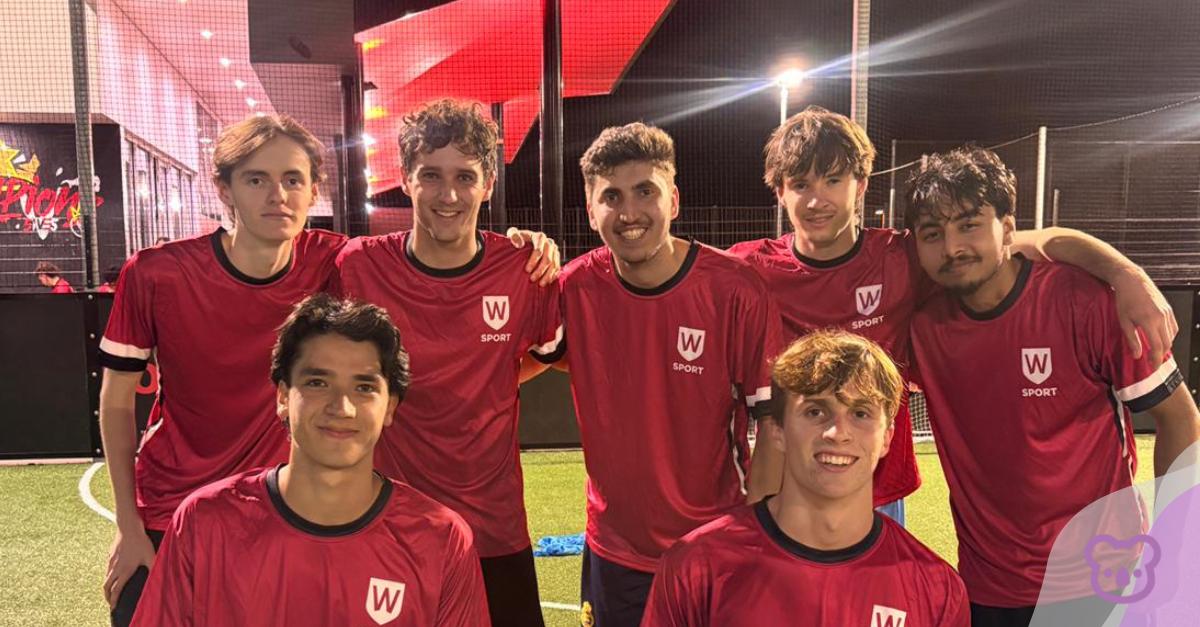
Picture: Faizan Atal (centre back row) playing soccer at Western Sydney University.