









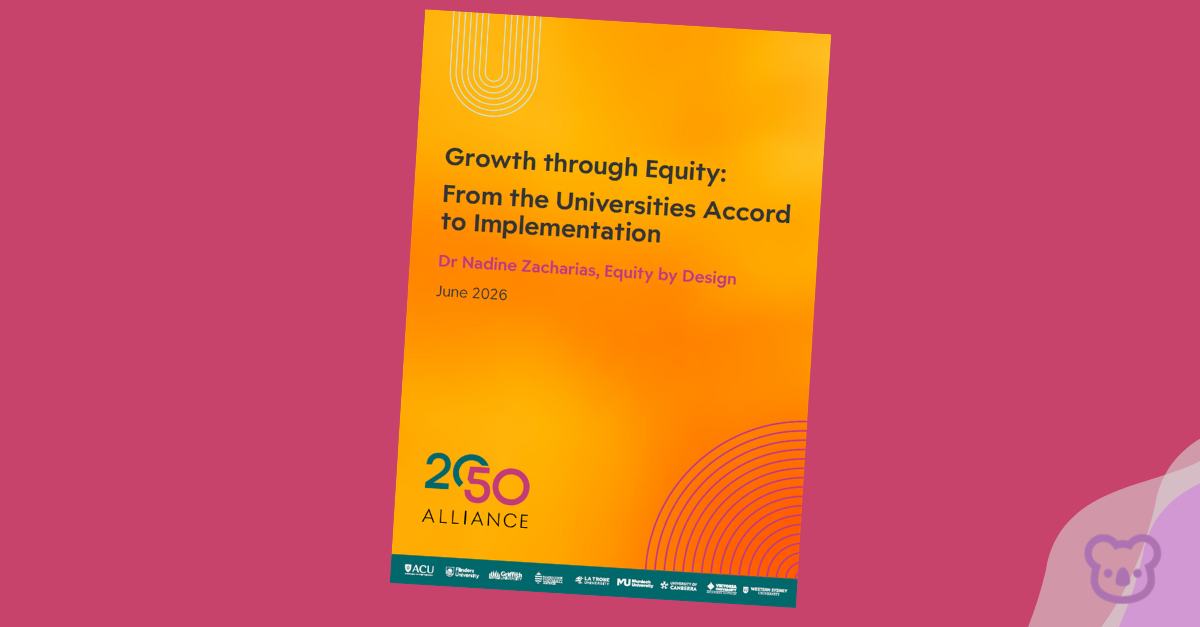
The Australian Government’s ambitious target of ensuring 80 per cent of working-age Australians hold a tertiary qualification by 2050 has become one of the defining goals of the Universities Accord. But according to a new discussion paper released by the 2050 Alliance, reaching that target will require far more than simply creating additional university places.
Instead, the paper argues Australia must fundamentally rethink how it supports students who have historically been locked out of higher education.
Authored by equity specialist Dr Nadine Zacharias, Growth Through Equity: From the Universities Accord to Implementation arrives at a critical moment, just days after the Federal Government introduced the Universities Accord (Opening the Doors of Opportunity) Bill into Parliament. The legislation establishes a new Managed Growth Funding System alongside Needs-Based Funding, reforms designed to increase participation by students from low socioeconomic backgrounds, regional and remote communities, First Nations backgrounds and those living with disability.
For the Koala, the timing of this report is significant. The Accord has generated widespread support across higher education, but the real challenge has never been agreeing on the destination. It has always been navigating the road to get there.
The paper’s central message is straightforward.
Australia will not achieve its workforce ambitions simply by asking universities to enrol more students. The students who remain underrepresented face barriers long before they submit a university application.
The report identifies five conditions that must be satisfied before participation can genuinely increase. Students must aspire to attend university, achieve the necessary academic preparation, have access to available places, be able to physically and academically access study, and crucially, be able to afford it.
That final point may prove the most politically challenging.
Throughout the report affordability emerges repeatedly as perhaps the greatest threat to achieving the Government’s ambitions. Rising living costs, concerns over student debt and declining perceptions of the value of a university degree are discouraging many potential students before they even begin considering higher education.
The Koala has consistently reported that cost of living pressures are increasingly shaping international and domestic student decision making alike. While policy discussions often focus on university funding formulas, students themselves remain primarily concerned with whether they can actually afford to study.
The discussion paper also challenges one assumption underpinning parts of the Accord reforms.
During the demand-driven university system introduced in the early 2010s, there was substantial unmet demand for university places. Today, however, that picture has changed considerably.
Applications from mature-age students have fallen sharply, while overall university demand has softened despite record-high offer rates. The report argues that Australia is no longer facing a shortage of places but rather a shortage of students who see university as an attractive option.
Perhaps the report’s strongest analysis comes when it distinguishes between availability and aspiration.
Simply guaranteeing Commonwealth Supported Places will not significantly increase participation if students from disadvantaged backgrounds never apply in the first place.
Students from low socioeconomic backgrounds make up roughly one quarter of Australia’s school population but represent only around 13 per cent of university applicants. The authors argue that this gap reflects deeper issues including school attainment, financial concerns, labour market perceptions and declining confidence that university offers sufficient return on investment.
For Koala, this may be one of the most important observations in the entire paper.
Higher education policy often concentrates on what universities do after students arrive. This report reminds policymakers that many of the most significant barriers exist years before prospective students ever submit an application.
Rather than simply increasing funded places, the report argues governments must invest in convincing disadvantaged students that university is both achievable and worthwhile.
The paper draws heavily on Australia’s own policy history to support its conclusions.
It points to the combination of demand-driven funding and the Higher Education Participation and Partnerships Program (HEPPP) during the Gillard Government as a period when participation by low socioeconomic students rose significantly. That success, Dr Zacharias argues, came not because universities simply enrolled more students, but because they simultaneously invested heavily in school outreach, aspiration building and student support.
Those historical lessons underpin one of the report’s biggest concerns with the new Accord implementation.
Under current arrangements, Outreach Funding will operate separately from Needs-Based Funding.
While this may appear administratively neat, the report warns it risks undermining universities’ flexibility to invest where their own students and communities need it most.
Many metropolitan universities have traditionally directed significant equity funding into outreach programs that encourage disadvantaged school students to consider university. The new arrangements could limit that flexibility and weaken the pipeline of future applicants.
Koala has observed throughout the Accord consultation process that universities consistently asked for flexibility rather than prescription. This paper reinforces that message, arguing local institutions generally understand the barriers facing their own communities better than a centrally designed funding model can.
The report ultimately presents four recommendations for implementation.
It calls for a student-centred system that allocates equity places through existing admissions mechanisms, stronger integration between outreach and needs-based funding, clearer accountability linking national participation targets with university Mission-Based Compacts, and urgent action on affordability through fairer student contributions and stronger income support.
2050 Alliance Chief Executive Paul Harris said these reforms represent an important opportunity but warned implementation will determine whether the ambitions become reality.
“These are much-needed policy reforms and it is critical that we get them right,” he said.
“If we are going to meet our national target, the allocation of student places in the new system must be carefully managed to prioritise long-term growth for under-represented communities.”
Dr Zacharias said Australia must ensure university is viewed as both desirable and achievable.
“We need to position university study as a desirable and achievable option for more students, ensuring that a university education is affordable and accessible,” she said.
“This means linking Needs-Based Funding with funding for widening participation outreach, providing universities with the flexibility to target programs to the areas of greatest need, to nurture aspiration and the pipeline for future tertiary success.”
Ultimately, the discussion paper suggests the Accord’s success will not be measured by how many additional funded places are announced.
It will be measured by whether more Australians who have traditionally viewed university as “not for people like me” begin seeing higher education as a realistic pathway.
That may prove to be the hardest reform of all. Building confidence, aspiration and belonging is considerably more complex than changing funding formulas. But if Australia’s 2050 target is to become more than an aspirational statistic, the report argues those cultural barriers deserve just as much attention as the financial ones.
The report can be downloaded here.