










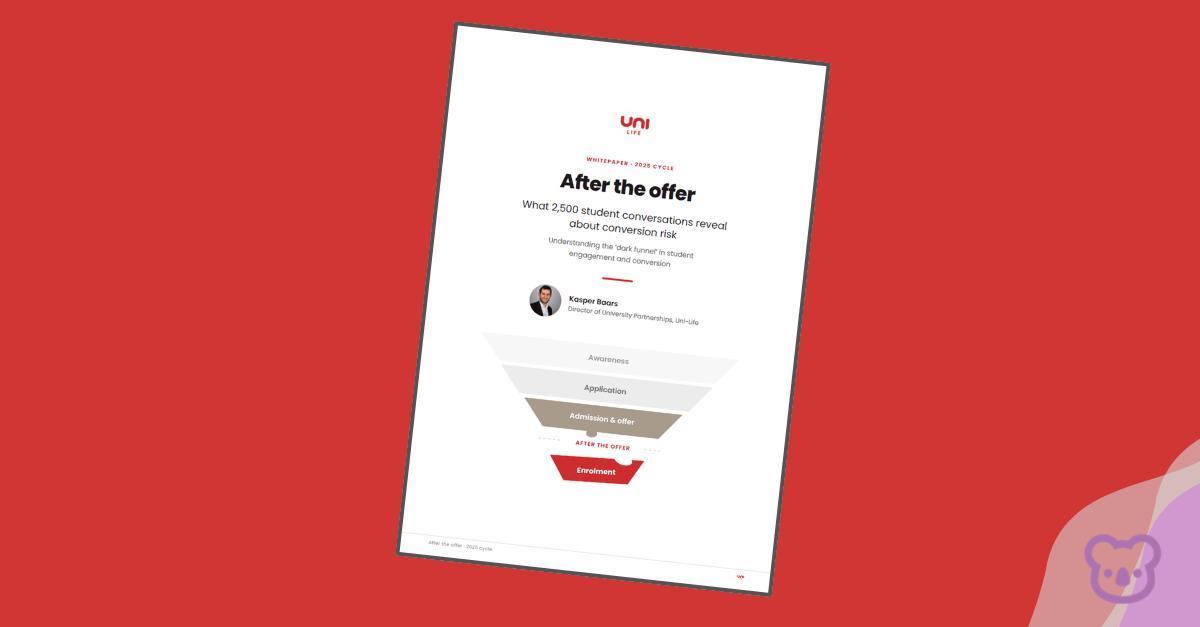
For decades, universities have treated the offer letter as a milestone of certainty. A student applies, receives an offer, and the recruitment journey moves into its final phase: provide some reassurance, send reminders, and wait for enrolment.
But new research by Uni-Life suggests that assumption is dangerously outdated.
An analysis of 2,426 real student conversations has found that receiving an offer is not the end of the decision-making process. In many cases, it is the point where the most important questions begin.
As the authors of the Uni-Life whitepaper put it: “Students do not apply because they have decided. They apply because they are still deciding.”
The research, which analysed public conversations from offer-holders across 17 universities and 107 nationalities between March and September, reveals a student journey driven less by rankings and course comparisons and more by a simple question:
“Can I actually make this work?”
That question dominated the conversation.
More than half of all discussions, 53 per cent, focused on feasibility issues including accommodation, visas, finances and the practical realities of moving overseas. The research challenges a long-held assumption across the sector that students are primarily comparing institutions once they receive an offer.
Instead, many are trying to solve immediate problems.
Housing was the biggest pressure point, accounting for almost half of all feasibility-related conversations. Students were not casually exploring accommodation options. They were searching for solutions, often turning to online communities to find rooms, roommates and reassurance.
One student’s post captured the urgency: “I’m currently looking for a room. Is anyone looking for a roommate…?”
Across thousands of conversations, the tone was less about choosing between universities and more about navigating uncertainty.
In the Netherlands, where student housing shortages have become one of the biggest challenges facing international students, Uni-Life and partner universities created dedicated housing communities supported by university staff. According to the whitepaper, these groups became among the most active student spaces, with offer-holders finding accommodation and connecting with potential roommates before they even arrived.
Visa uncertainty was another major factor. For Pakistani and Nigerian students, immigration questions represented almost one-fifth of all feasibility conversations.
In Canada, where international student policy settings have shifted rapidly, Queen’s University established an immigration updates group supported by a certified adviser. The objective was straightforward: provide trusted information quickly while allowing students to see others navigating the same challenges.
Because, increasingly, students are not just looking for answers. They are looking for confidence.
Once practical concerns begin to ease, the conversation changes. The next major driver becomes belonging.
Representing 31 per cent of all discussions, belonging conversations were about finding community before arrival. Students introduced themselves, searched for people from the same country, organised meetups and began building friendships months before stepping onto campus.
“Hi everyone, I am Daniel and I want to meet Polish people who are going to this university,” wrote one incoming student.
These conversations carried a very different emotional tone: excitement, anticipation and the first signs of connection.
At South East Technological University, 53 per cent of community members reported feeling more socially confident about starting their studies after joining the online community.
Interestingly, the research found little difference between undergraduate and postgraduate students. Despite the common assumption that postgraduate students are more independent and less reliant on support networks, both groups showed almost identical patterns.
As Uni-Life’s Kasper Baars noted during the webinar discussing the findings, “The overall decision drivers are actually very similar… very, very similar challenges.”
Perhaps the most surprising finding is what students are not talking about.
Academic fit and location, two areas where universities often invest significant communication effort, each accounted for only eight per cent of conversations.
These topics still matter, but they are not usually the deciding factors. By the time students are discussing course structures, career outcomes or city lifestyle, they have often already developed a preference.
They are looking for validation, not making the original decision.
Timing is also critical.
The research shows feasibility concerns peak around April and May, when students move from the excitement of receiving an offer into the reality of organising visas, accommodation and finances.
Belonging conversations then increase through June, July and August as students look to build their future social networks.
By September, all the major decision drivers come together. The report warns that while no new concerns typically emerge at this stage, unresolved issues become increasingly significant.
“At the end of the cycle, a single unresolved issue can collapse the decision,” it notes.
The message for universities is clear: more information is not necessarily the answer.
According to the whitepaper, 76 per cent of students receive university communications, yet only seven per cent feel fully prepared.
The gap is not access to information. The gap is uncertainty.
Students need practical support at the moment they need it. They need peer connections, not just institutional messages. They need universities to understand the emotional and logistical journey behind the offer decision.
For international education leaders, the lesson is simple: the recruitment funnel many institutions rely on does not reflect how students actually make decisions.
The journey does not end when the offer is accepted.
In many ways, that is when the real decision begins.
Download the whitepaper here.