









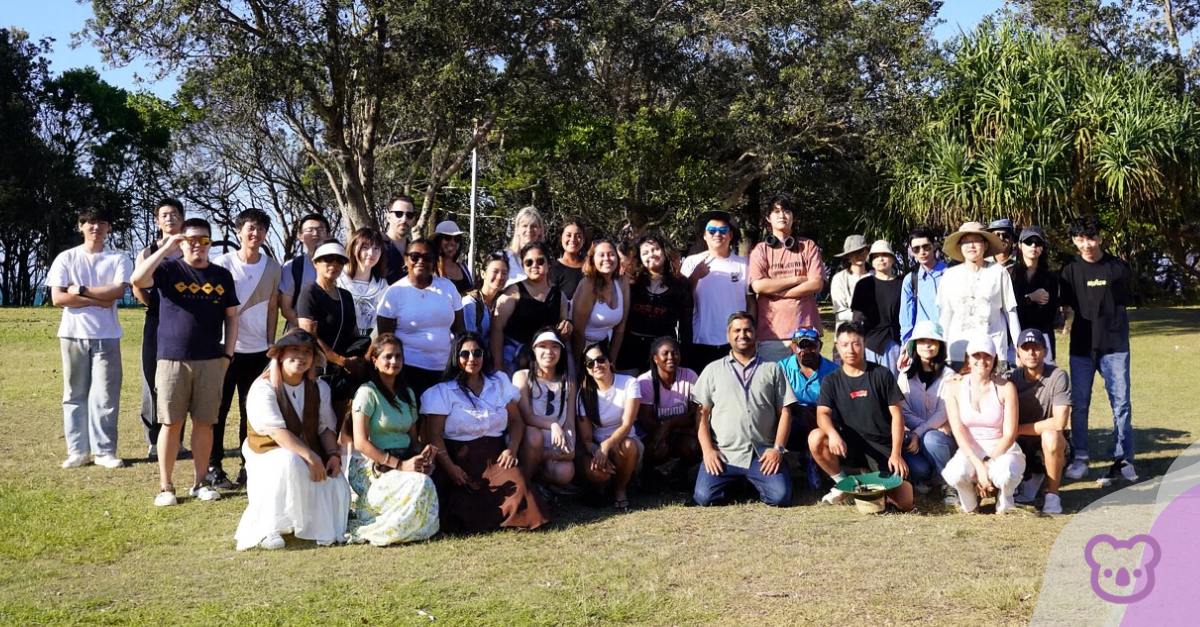
While much of the international education sector slowed for Christmas and New Year, international students across Australia were anything but idle. In early December, a group of students from Charlton Brown College in Brisbane spent a day beyond the classroom, combining regional exploration with hands-on environmental volunteering across the Gold Coast and northern New South Wales.
Around 50 international students took part in the excursion on 6 December 2025, travelling from the Gold Coast hinterland to Byron Bay. The initiative was designed to expose students to Australia’s natural environment while also giving them an opportunity to contribute meaningfully to local communities and national environmental projects.
According to Charlton Brown College Head of Faculty Niral Joshi, the excursion reflected a growing focus on experiential learning and community engagement within international education.
“We organised this excursion to give students a chance to learn outside the classroom while contributing to the local community,” Mr Joshi said. “By combining hands-on environmental learning with volunteering, students not only explore the region but also see the positive impact they can make.”
The day began at the Gold Coast Regional Botanic Gardens, where students participated in a ClimateWatch citizen science activity. The program, developed by Earthwatch Australia in partnership with the Bureau of Meteorology and the University of Melbourne, invites members of the public to record seasonal changes in plants and wildlife to help scientists understand how ecosystems are responding to climate change.
Students recorded observations of flowering, fruiting and leaf growth, contributing data to a national dataset tracking how seasonal cycles shift in response to changing temperatures and rainfall patterns. They also learned about native wildlife and the complex relationships between birds, marsupials and plant species within the local ecosystem.
For many students, it was their first exposure to citizen science and environmental data collection in Australia. The activity highlighted how everyday observations can contribute to long-term scientific research and inform environmental decision-making.
After leaving the Botanic Gardens, the group travelled through the hinterland, stopping for lunch in Murwillumbah before continuing south to Byron Bay. There, students took part in a beach clean-up at Clarkes Beach in collaboration with the Tangaroa Blue Foundation and Byron Shire Council.
As part of the Australian Marine Debris Initiative (AMDI), students collected, categorised and recorded marine debris found along the shoreline. The majority of items collected were plastics, ranging from bottle caps and food packaging to small fragments that pose significant risks to marine life.
The data gathered during the clean-up feeds into a national database used to identify pollution sources, assess environmental impacts and support evidence-based policy development, including initiatives to reduce single-use plastics. For students, the activity provided a practical insight into Australia’s waste challenges and the cumulative impact of everyday consumer behaviour.
Even the smallest fragments of plastic proved instructive, reinforcing the ongoing threat marine debris poses to coastal ecosystems and wildlife. Organisers said the experience helped students connect environmental theory with real-world outcomes in a tangible way.
The excursion concluded at Cape Byron Lighthouse, where students gathered to watch the sunset over the Pacific Ocean. A spontaneous guitar session created a relaxed atmosphere, bringing the day to a close on a reflective note.
Students described the experience as both inspiring and rewarding. From recording plant and wildlife data at the Botanic Gardens to collecting and categorising plastics on the beach, participants contributed directly to ongoing scientific research and local environmental initiatives.
The outing also reflected a broader trend within international education, where providers are increasingly encouraging students to engage with local communities and environments beyond formal study. As the summer period continues, such activities highlight how international students are not only discovering Australia’s landscapes and regions, but also giving back to the country that hosts them, even while the sector itself may have taken a seasonal pause.