












Marty Zweig, an American investor, is apparently credited with the quote, “The trend is your friend”.
How right he is.
The latest international commencement and enrolment data from the Australian government as at YTD March has just been released and is shown in the chart below.
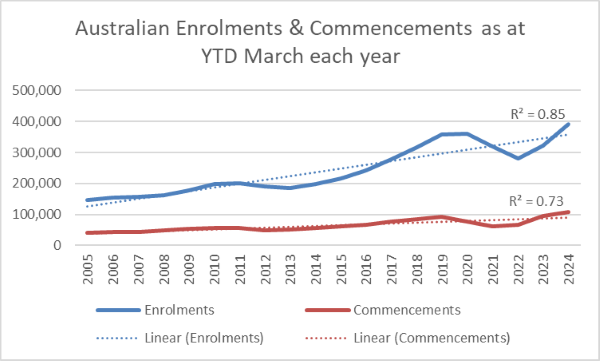
Source: AEI Pivot tables March 2024
There was the boom until 2009 when the perfect storm hit; attacks on Indian students, college closures and so on causing a sudden dip. From 2012, commencements and enrolments started to recover and produce a growth cycle until COVID at the beginning of 2020. Since the Australian border reopened at the end of 2021, pent-up demand has flowed through.
If we fit a simple linear trend line in 2 scenarios:
- From 2005 (as shown) enrolments and commencements would be slightly lower than actual
- From 2012 when the growth cycle started, enrolments would be about 460,000, and commencements about 120,000; significantly higher than now.
- The actuals are between these 2 forecast estimates.
Since 2005, YTD March has represented an average of 80.9% of enrolments and 53.6% of commencements for the full year. Both were slightly lower, 76% and 46% respectively, in the post COVID recovery. Assuming visa processing isn’t slowed, we would expect about 485,000 enrolments and 210,000 commencements for the full year 2024, slightly higher than 2023.
International education, as a sector in Australia while being the 4th largest export and the largest service export, remains an unknown quantity amongst the broad community. To combat this the industry called for a social licence to be created so that local communities could understand and benefit from international students. Unfortunately, this remains to be the case.
States, such as Victoria, where international education is the largest contributor to its economy, is reportedly broke and the local economy requires the continuation of the economic benefit to survive. This a major challenge with current visa regimes and contractionary federal policies being rolled out.
If policy makers in Canberra had adopted Marty Zweig’s philosophy and understood the trend better, they could have planned for post-covid activity in a more structured manner and not been surprised about the current high levels of student flows into the net overseas migration figures.
We must avoid a knee-jerk policy reaction that appears to be front and centre at present that will harm Australia’s wonderful universities and the economies they serve.