













The Victorian Government has launched a new international education strategy centred on student experience, employability and global engagement, reinforcing the state’s commitment to one of its most valuable export industries.
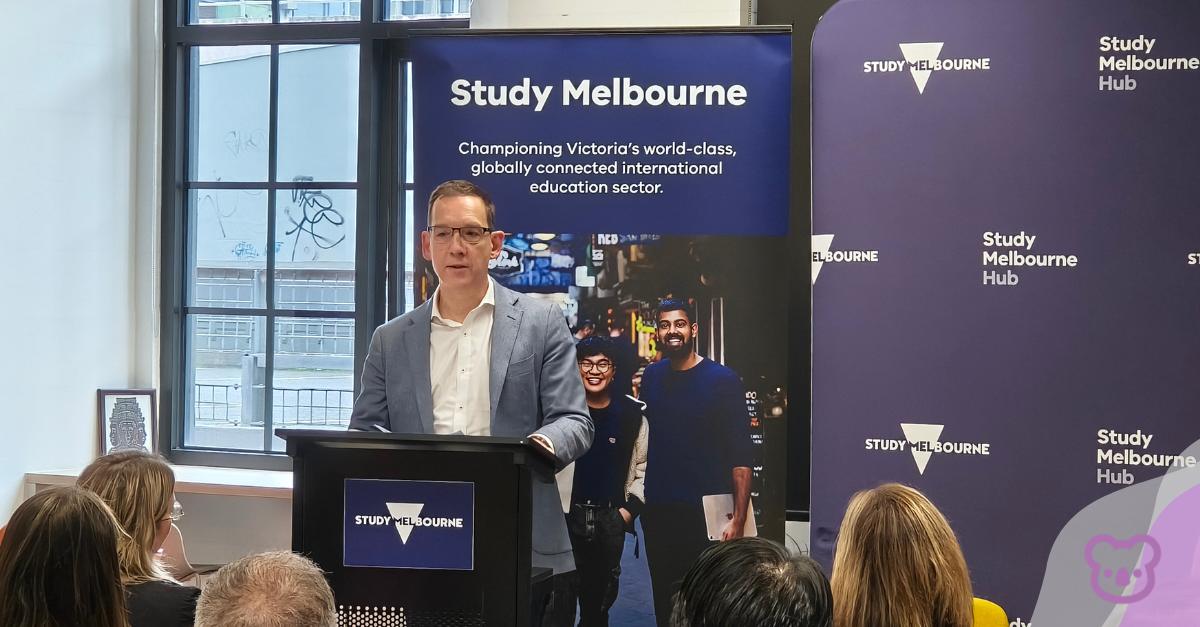
Unveiled yesterday by Victorian Minister for Economic Growth and Jobs, and Minister for Sport and Major Events Steve Dimopoulos MP at the Study Melbourne Hub, the Study with Victoria strategy sets out a vision for Victoria to be recognised globally for education quality, innovation and inclusion.
The Koala found it refreshing to hear a politician unequivocally back international education, declaring Victoria open to international students and committed to ensuring they experience both Melbourne and Victorian education, whether onshore or offshore.
The strategy focuses on making Victoria a destination where students thrive from enrolment to graduation. It is built around five pillars: student experience, employability and alumni, promotion of Victoria’s education offering, global partnerships and stronger sector collaboration.
Key initiatives include continued investment in the Study Melbourne Hub, free legal support for employment and accommodation issues, continuation of the International Student Travel Pass, enhanced employability and entrepreneurship programs, stronger alumni engagement and greater promotion of post-study pathways. The government will also continue to promote the Study Melbourne brand, showcase regional Victoria, expand transnational education and advocate to the Commonwealth on behalf of the sector.
While there are no major funding announcements or headline policy reforms, the strategy reinforces what Victoria has long done well. Rather than reinventing the wheel, the government is building on established programs that have earned Study Melbourne a reputation as one of Australia’s leading student support models.
That approach comes as the sector continues to grapple with visa changes, higher student visa application charges and ongoing uncertainty over international student policy. Instead of entering the national debate over student numbers, Victoria is concentrating on the areas it can control: student wellbeing, graduate outcomes, industry connections and its global reputation.
Employability is a recurring theme throughout the strategy. Greater emphasis is placed on entrepreneurship, leadership development through the Study Melbourne Ambassadors program and stronger alumni networks, reflecting growing demand from students for clear career outcomes alongside academic qualifications.
Equally important is the strategy’s emphasis on collaboration. The government has committed to working more closely with industry, students, the City of Melbourne and education providers, recognising that delivering a world-class student experience requires a whole-of-sector effort.
Perhaps the most striking aspect of the strategy is what it leaves unsaid. There are no bold enrolment ambitions or commentary on the federal government’s migration settings. Instead, Victoria is signalling confidence that a strong student experience and a quality education offering remain its best competitive advantage.
Whether that is enough will ultimately depend as much on decisions made in Canberra as those made in Spring Street. But in an environment where much of the national conversation has focused on limiting international education, Victoria has delivered a clear and welcome message that it remains firmly open for business.











