











STUDYMOVE, the international education data specialists, have recently released their Key Data Update (Vol 7, 23) and their last for 2023.
The update, as usual, is an extremely valuable insight into the sector’s health.
Visa Issuance
Data from Home Affairs shows that in June of 2023, we returned to pre-covid visa numbers. In June, there were 618,349 visas issued, compared to March 2020, there were 611,077. In August of 2023, these numbers had risen to 645,516, becoming an all-time high.
Higher Ed and VET have fuelled this. In August 2023, HE had 389,131 compared to 375,031 in March of 2020. VET in August of 2023 had 163,352, while in March 2020, there were 150,927.
Independent ELICOS has also performed extremely well, albeit from a lower base.
By state, WA continues to be the state that has performed the best post-COVID. This is followed by SA. VIC appears to still be under March 2020 levels.

Higher Ed Drives Growth in 2023
Higher Education grew significantly in 2023. YTD September figures showing commencers were at 197,770 up from 165,079 at the same time in 2019. According to STUDYMOVE estimations, this puts it on track for an end-of-year (YTD Dec) number of 208,179. This is up from 177,138 in 2019 (YTD Dec), or 18 per cent growth.
Key points on HE commencements include:
- 66 per cent average growth across the top 25 markets
- 23 of 25 of the top markets continued to grow commencements.
- Only South Korea (-3 per cent) and the United States (-2 per cent) declined.
- China was up 21 per cent.
- India up 98 per cent
- Pakistan is up 293 per cent
- Bhutan up 443 per cent
While commencement has grown significantly, enrolments remain steady, slightly behind 2019 levels. Sept YTD shows 425,273 enrolments compared to 428,762 at the same time in 2019. Associated revenue is slightly up from YTD Sept 19 AU$9.98b in 2019 to an estimated $10.43b – this rise of 4.5 per cent and considers price rises.
2024 (notwithstanding policy reform)
Primary student visa lodgements (not issued) remain strong. From July to Oct, there were 82,961 student visas lodged, up from 64,339 in the same period in 2019. China appears to be coming back online in a major way, with its share of visa lodgement being 26,309 from July to Oct in 2023 compared to 24,244 in the same period of 2019. This represents an 8.5 per cent increase. India is 22 per cent higher than in the same period in 2019 and Nepal is 25 per cent higher for the same time period.

Grant rate tells a story, is it a good one?
Well and good that lodgements are up, indicating strong demand, but the granted visa rate is declining.
In India, the grant rate is 62 per cent for July to October 2023 compared to 81 per cent in the same period of 2019. Ironically, the grant rate was 97 per cent in 2020, 93 per cent in 2021, and 76 per cent in 2022.
In Nepal, it is a similar story. The 2023 grant rate for July to October is 54 per cent. For the corresponding period, in 2019, it was 86 per cent, in 2020, it was 99 per cent, in 2021, it was 96 per cent and in 2022, it was 67 per cent.
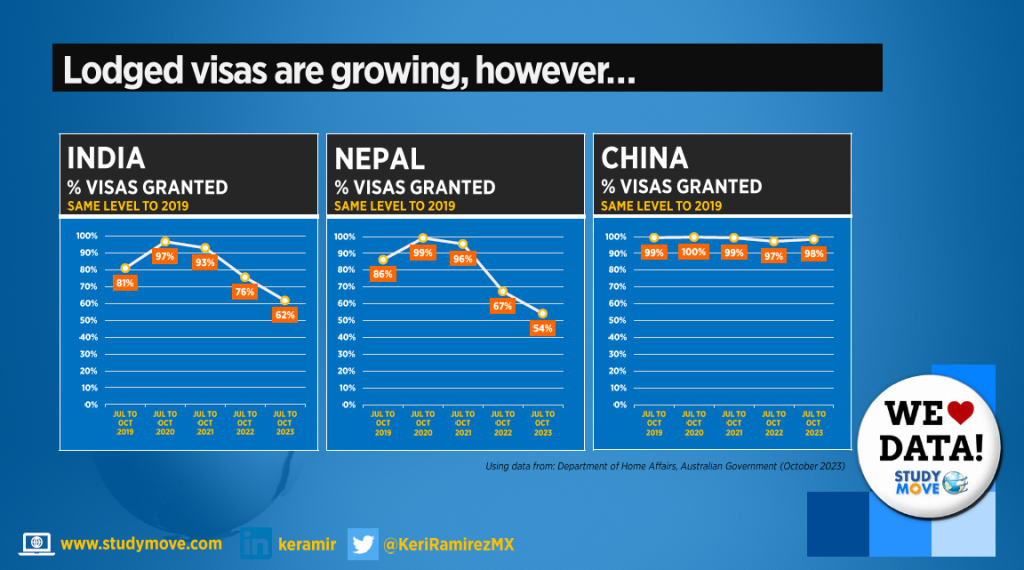
The Koala isn’t a data scientist, but it probably doesn’t need to be to point out that the trend on grant rate is almost exactly inverse to the number of lodgements. Having worked in the sector for many years, this little Koala is left scratching his head as to how the rate can change that much based on market forces.
This poses the question of whether the government is purposefully dampening high demand and maximising opportunity in periods of low demand.
Well and good if it is; however, if reforms come in and affect stakeholders’ (providers and agents) ability to operate based on Visa assessment outcomes as proposed, one may expect serious challenges in the court of law around the objectivity of visa assessment.
The Koala extends its thanks to Keri Ramirez from STUDYMOVE for sharing its data.