











There are 78 days left in 2024. That’s 78 days until the proposed Education Services for Overseas Students Amendment (Quality and Integrity) Bill 2024 will come into effect, and enrolment limits will be imposed on new international students in the higher education and vocational education and training sectors. And yet, the Bill has not yet been debated in the Senate, and will not be until at least 18 November, the next parliamentary sitting period.
What might these next 78 days hold for Australia’s international education sector? And what political moves might be made, particularly by the two major parties?
Australian International Education Conference (AIEC) 2024
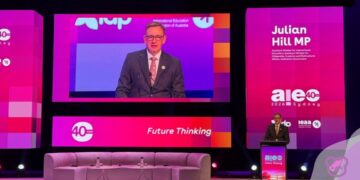
The Minister for Education, Jason Clare, has been announced as a keynote speaker at the AIEC on Wednesday (although the online program doesn’t have him listed just yet).
As a former public servant, when a Minister is due to speak at a major event you are desperate to come up with an “announceable” for the speech (yes, it’s a made-up word). But with the ESOS Bill delay, I am left wondering if the Minister will be left to deliver a normal stump speech, written by his Department, repeating the messages we have heard so far this year?
If so, we may as well use the speech to play word bingo: shonks, crooks, quality, integrity, social licence, reputation, better and fairer education system, returning migration to pre-pandemic levels. There’ll also be something in there about Ministerial Direction 107 ‘throttling’ the system.
I assume the Minister will also cover what is happening with the International Education and Skills Strategic Framework (I note that there’s also a session on the Framework at AIEC on Wednesday afternoon, and I’ll be interested in an update, as someone who put in a submission in July but has heard nothing since).
Is there any chance at the AIEC that the Minister will provide the sector with a genuine update about the Government’s intention over the next, by then, less than 70 days?
The passage of the Bill
Following the Report of the Senate Education and Employment Legislation Committee inquiry into the ESOS Amendment Bill recommending that the Bill be passed, there’s an assumption that the Bill will be passed in the Senate in November, with the only question being what amendments will be agreed.
In his update to International Education Association of Australia (IEAA) members at the start of the month, and prior to the Senate Committee report being tabled, CEO Phil Honeywood, said that peak bodies have been advocating that the Minister move his own amendments to the Bill (House Amendments) and that this “is surely preferable to having others move amendments against him”.
If the Government does this, it will change the passage of the legislation but will not necessarily cause any more delays than already exist, as the House of Representatives sits for four days from 4 November. So, there’s a possibility that the Bill is recalled by the House, amendments made, then it goes back to the Senate for debate sometime from 18 November. But if the Government only intends to agree to amendments proposed by the Senate Committee, then would they see this as necessary.
Another question is, if the Senate does not debate the Bill until at least 18 November, will the Government delay its introduction from 1 January 2025?
And then there’s the Coalition
Liberal Senator, Sarah Henderson, told the AFR that the Coalition was “not in favour of passing the legislation as it was currently drafted”. The Coalition Senators’ additional comments in the Senate Committee Report were highly critical of the Labor Government and the Bill, but recommendations were notably absent.
“Most disappointing, however, was surely the Opposition who made all sorts of cooing noises to providers but, after a great deal of data gathering at Committee hearings, have not flagged any of their own amendments in their Minority Report”, said Phil Honeywood, CEO, International Education Association of Australia (IEAA) at the time.
Disappointing, yes. But also, clearly political. The Coalition is not showing its hand to the Government or the sector what amendments it will make or support.
Indeed, they appear to still be in ‘fact-finding’ mode. As previously reported (TKN 131024), Henderson sought additional information on visa data, net overseas migration and Treasury’s current internal working calculations of the NOM the day before the Senate Committee Report was tabled.
Perhaps this means there’s still a question mark for the Coalition about exactly how far it pushes amending the Bill, and what it introduces if it wins the election, including that the Coalition will reduce “the excessive numbers of foreign students studying at metropolitan universities to relieve the stress on rental markets”, according to Henderson.
She also said that the Coalition will introduce a “tiered approach to increasing the student visa application fee and applying it to foreign students who change providers”.
The indications are there that the Coalition will not support the Bill in its current form, but we must remember that they have consistently supported enrolment caps and intend to reduce migration if elected next year.
Greens
We already know to expect the Greens to oppose the Bill. Senator Mehreen Faruqi has been clear about her views throughout the inquiry, and she said in parliament on the day the Senate Committee Report was tabled, “But I can tell you this: the Greens will not stop doing every single thing we can to make sure that this bill never sees the light of day, because it is going to be damaging for Australia’s reputation as a destination for international education, damaging for the sector and damaging for international students. It should be scrapped”.
Why the legislation was postponed
The Senate was not informed why the legislation was deferred, according to Henderson.
One possible explanation that I put forward, is that it was a short sitting period, and Clare was focused on two other bills in the lower house on Thursday 10 October, the last sitting day. The Government and the Minister would have wanted these bills to be the focus of the media cycle, and not be overshadowed by the negative response that the ESOS Amendment Bill will most certainly receive.
(For interest, the bills were, the first reading of the Better and Fairer Schools (Funding and Reform) Bill 2024 which he says will increase funding for public schools and the third reading of the Universities Accord (Student Support and Other Measures) Bill 2024 which will reduce student loan debt by $3bn.)
I also wonder if there is a bigger political play at work from the Government; to use the delayed bill in its favour. It wants to get the most mileage it can before the election that it is working to reduce migration, and with every delay, there is more media that there will be a reduction in the number of international students coming into Australia. While the sector thinks this is a bad thing, there are a lot of people in the community that don’t share our view.
Evidence Level changes
We also know that no changes will be made to the Evidence Levels of education providers or countries until the ESOS legislation is passed and Ministerial Direction 107 is removed or replaced. As reported by The Koala (TKN 041024), the Minister for Home Affairs, Tony Burke, announced a pause in making any changes earlier this month, receiving a mixed response from the sector.
This is welcome news for the 162 providers who would have been worse off if the Evidence Levels had been updated in September as previously planned. And The Koala understands that several universities were caught up in the move EL2 to EL3 which pre-empted the decision to pause the scheduled implementation at the end of last month.
However, not everyone has welcomed the decision to pause Evidence Levels, with Swinburne University of Technology’s Vice-Chancellor and President, Professor Pascale Quester, saying “This is another blow for the sector and will fracture us even further, creating more uncertainty for prospective students in an anti-competitive landscape of ‘haves and have-nots'”.
“We had so much hope with the Universities Accord; we were excited about the potential for unity and progress,” said Professor Quester. “Instead, we are now faced with knee-jerk decisions, black-box decision-making processes and unprecedented levels of uncertainty. The rationale provided for this freeze is to create more certainty, but it will instead foster division and delays.”
For now, those providers who had hoped to improve their Evidence Level in September (clearly Swinburne was one of them), will continue to be impacted by Ministerial Direction 107 and the priority order of their student visa processing.
Ministerial Direction 107
The actual idea for “78 days” came from a Universities Australia media release last week, that the next parliamentary sitting period was 38 days away, and Ministerial Direction 107 would continue to be in place until then. (TKN 111024)
The Government has previously said that it will revoke MD107 when the ESOS Amendment Bill receives royal assent. However, a Department of Home Affairs official told the Senate Committee on the third day of hearings that it had not been asked to provide any proposals about what would replace it (TKN 080924).
What will replace MD107? Will there be changes to the SSVF? How soon after the Bill passes will the ‘pause’ be reviewed? The Government has provided no hints about this.
Urgency motion
On the day the report was tabled in Parliament, Senator David Pocock moved an urgency motion, “That, in the opinion of the Senate, the following is a matter of urgency: The need for the Australian Government to implement a national housing and population plan that manages international student growth based on consultation and without unintended consequences for the economy or Australian students”.
During the motion, Senator Malcolm Roberts, Pauline Hanson’s One Nation, said “Hundreds of thousands of people on temporary student visas end up illegally working fulltime hours and sending the money back to their home country”.
Roberts went on to say, “A particular lie is being peddled in this debate. That lie is that international students are one of Australia’s largest exports, at $40 billion a year… In reality most students end up working here for the money to support themselves and sending the remainder back home. The claim that international students are one of our biggest exports is simply not true because it is does not align with reality”.
Those in the sector know that the evidence doesn’t back Roberts statements up, but it would be wrong to dismiss Roberts’ views as being ‘on the fringe’.
No clarity
Group of Eight Chief Executive, Vicki Thomson, said that the Senate Committee Report “provides no clarity”. No clarity is also what currently lies ahead for the next 78 days for Australia’s international education sector.












