










In 2001, I paid $95 USD to study in the United States: a $45 F1 visa fee and a $50 fingerprint charge, roughly $190 AUD at the time. Against the total cost of the years ahead, tuition, accommodation, flights, a life rebuilt on the other side of the world, it barely registered. I chose Miami over Melbourne knowing full well the visa fee was the smallest line item in a commitment I was ready to make for several years.
I arrived at Florida International University just weeks before September 11. What followed was a hardening of American attitudes toward outsiders, and an uncertainty no fee could have predicted. The fee was never the barrier. Twenty-five years on, as Australia’s student visa cost climbs past $2,500, I find myself asking whether we’ve correctly identified what influences international student choice, and what erodes trust in the systems meant to welcome them.
A Fee That Won’t Move the Needle
The US F1 student visa fee has roughly doubled since 2000, from $95 to $185. Canada’s student permit fee has barely moved, from $125 CAD to $150 CAD. Australia’s Student visa (subclass 500), by contrast, has risen around 600% over the same period, most sharply in just the last few months.
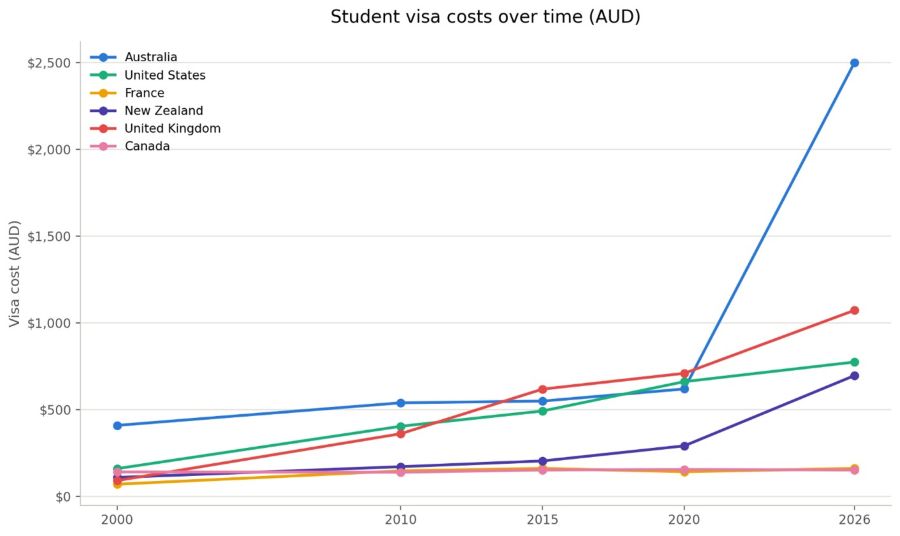
It’s a striking number, and the sector’s alarm is understandable. But price sensitivity to a single fee is only one input into a complex decision. In my decade working with international students, I’ve found them resourceful and pragmatic, weighing course quality, brand, post-study work rights, and long-term pathways far more heavily than a one-off cost. The increase is real, but unlikely to meaningfully suppress application volumes on its own.
Comparing these figures to the cost of tuition over the same period, we can see a globally consistent increase. There have been some flatter periods for some institutes, but the overall trend is reliable. [I’ve used the annual tuition fee for an international student for a Bachelor of Commerce and have selected comparable global institutions. For any sticklers, I’ve used Rouen data for the NOEMA figures prior to the merger in 2013.]

The Trust Problem
What the student visa increase does do, and does badly, is signal something about how government treats this cohort. It arrived with no notice and no sector engagement. At a moment when trust in institutions is already fragile (the 2026 Edelman trust barometer for Australia paints a gloomy picture), an abrupt, unexplained cost rise reinforces the perception that international students are a revenue lever, not a cohort worth partnering with.
This matters beyond optics. The past five or six years have been difficult for international students here: pandemic lockdowns, mandatory hotel quarantine, rising racism and discrimination (as documented in the Australian Human Rights Commission’s Respect at Uni study), and ongoing uncertainty about post-study work rights. A poorly communicated fee hike doesn’t need to be financially significant to deepen a sense that the settings keep shifting.
Government may be betting that higher fees provide a drop in volume of applicants. My concern is that if the market doesn’t shift, this may be the first of several increases, not a one-off correction.
Posture, Not Policy
Here’s the question worth sitting with: is the visa fee hike a deterrent, or a posture? A few thousand dollars is a rounding error next to what students already pay in tuition, housing, and living costs, and government knows this. If the modelling behind the increase never seriously expected a meaningful drop in applications, then the fee isn’t really a demand-management tool at all. It’s a signal, dressed up as a policy lever, aimed less at prospective students than at a domestic audience watching migration numbers.
That distinction matters. A genuine attempt to manage demand would come with modelling, consultation, and a stated target. What’s happened instead looks more like a government reaching for the one lever that’s visible, cheap to pull, and easy to announce, regardless of whether it does what it claims to do. If the fee was never really about volume, then the sector’s alarm about deterrence is answering the wrong question. The more useful one is what it says about how this cohort is regarded when a number can be raised six-fold with no engagement and no real expectation that anything will change as a result.
Dr. Tim Weir is the founder and principal of Teton Advisory Group; a boutique consulting firm focused on supporting governance and compliance in the tertiary sector. Tim holds degrees in business, education and music and has more than 20 years’ experience as an academic leader in both public and private higher education institutions.