












Australia’s international education industry is facing a range of challenges, where the government is seeking to reign in international student numbers through measures to increase visa integrity and also visa fee increases to reduce demand.
Nonetheless, the latest student visa data released by Australia’s Department of Home Affairs shows 78,900 higher education visas were granted to primary applicants in the year-to-date May 2026. This is almost unchanged from the same period in 2025 (a decline of just 0.02%).
This may come as a surprise to some given a record low visa approval rate of just 59 per cent in March 2026. Such monthly rates are quite variable, but even the averaged rate over the January to May 2026 period was 72 per cent, the lowest figure seen in the last 20 years for this period.
However, that is just the approval rate for applicants from outside Australia. The approval rate for higher education visa applicants already in Australia remains around 90 per cent, remembering these are people who have already been approved to enter the country.
Student visas granted to applicants already in the country has always been a feature of Australia’s international education landscape and its data. It is also a feature of other countries that allow applicants to apply for a student visa from inside the country (e.g. the UK and Canada). However, this is not routinely made visible within other countries’ published data.
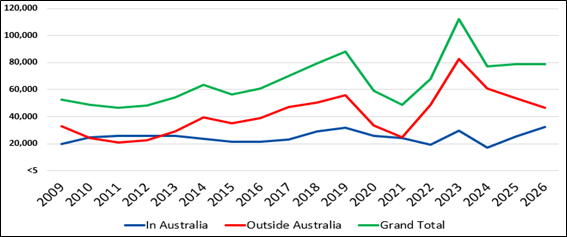
As seen in the chart below, in the year-to-date May 2026, 41 per cent of higher education student visas were granted to applicants who were already in Australia. This is a higher proportion than in 2025 (32 per cent), although back in 2011 it got as high as 55 per cent following a downturn in numbers of visa holders from outside Australia.
After the COVID-19 pandemic, the number of visas granted to higher education visa applicants from outside Australia reached a peak in 2023 and has been declining since. Conversely, the number of grants to applicants inside Australia began growing from 2024 and has reached a record high in 2026. Indeed, 2026 grants for this cohort increased by 29 per cent on the same period in 2025, while grants to applicants outside Australia declined by 13 per cent.
Higher Education Visa Grants (primary only), Australia, January-May
Source: Australian Government Department of Home Affairs
The top two source countries for higher education visa grants in the year-to-date May 2026 were China followed by India, with both countries showing declines in grants to applicants from outside Australia and increases to those inside Australia. For other countries in the top five (Nepal, Vietnam and Bangladesh), only Vietnam had growth in grants to applicants from outside Australia, while Nepal was the only country in the top five not seeing growth from applicants in Australia.
It is likely that for as long as the applicant population inside Australia sustains the overall population, restrictions on new arrivals will continue. The increase in student visa fees announced on 1 July 2026 seems likely to have more impact on those considering coming to Australia than those who are already here, given the latter group are already invested in being here and may hold down jobs. Perhaps the secret to managed growth in Australia is to recognise there are two different international student populations who will respond differently to different incentives, as well as disincentives.
Dr Steve Nerlich is a data analyst and communicator with particular expertise in Australia’s international student data sources. He completed a PhD on international student mobility at the Australian National University in 2020.











