












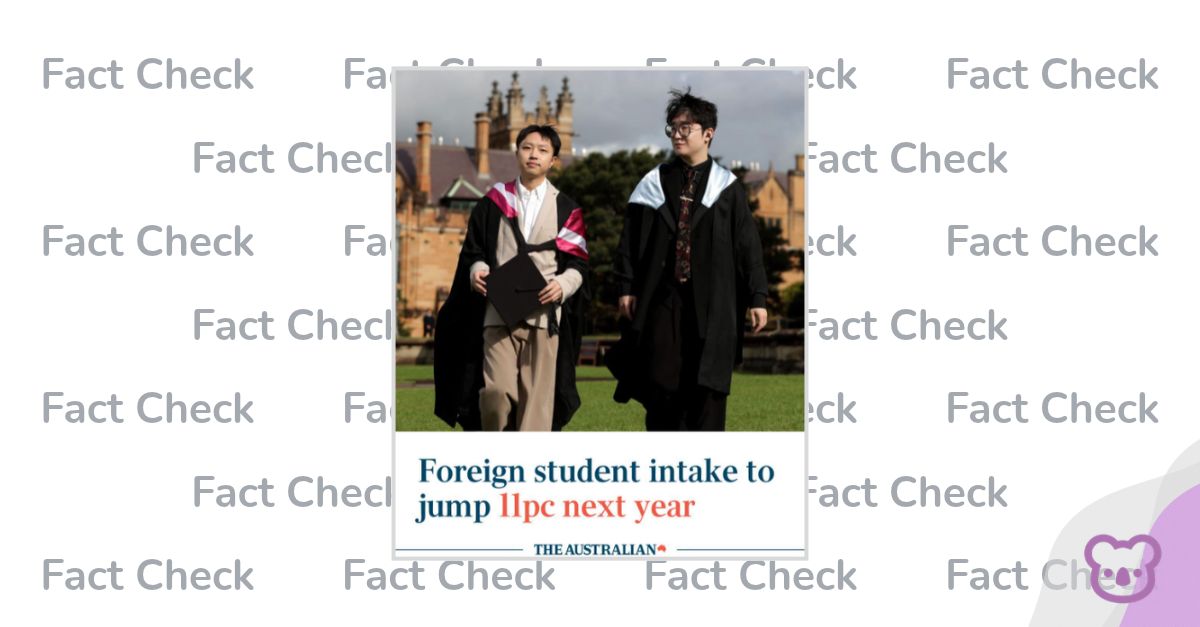
On Friday, I called out an article in The Australian for its disingenuous title and content, with the headline Foreign uni student intake to leap 11pc, and inflammatory phrases such as “RMIT’s intake will soar” and “Monash University’s numbers will jump”. At the time, I took the figures at face value and called out what I thought was disingenuous reporting.
It was my view that the article failed to acknowledge the significant challenges education providers have faced in recruiting international students in 2026. This includes the national offshore student visa grant rate falling from 89 per cent in the seven months to July 2025 to just 71 per cent in the corresponding period in 2026.
I was so annoyed by the article that over the weekend I did some fact checking, and the article gets it wrong in multiple ways. Below I correct the record.
Sorting fact from fiction
The article was published on 13 November, and appears to be prompted by the release of the Australian Tertiary Education Commission’s (ATEC) Outcomes Report and mission based compacts (more on that in a separate article). However, the 2027 New Overseas Student Commencements (NOSC) allocations for universities were published on 24 July 2026.
CLAIM: “The Albanese government has given cash-strapped universities the green light to bring in 11 per cent more international students next year…”
FACT or FICTION: Fiction. The 11 per cent increase was in indicative allocations between 2025 and 2026, not between 2026 and 2027. The total indicative allocation for public universities has remained unchanged for 2027. More importantly, indicative allocations are not actual student commencements, a distinction the article repeatedly fails to make.
CLAIM: The article states that “Universities have been told they can enrol 161,725 new international students in 2027”.
FACT or FICTION: That’s a fact, but it’s not new news. This was announced in late July when the indicative allocations for 2027 for higher education new overseas student commencements was published.
CLAIM: This is “16,535 more than they recruited this year”.
FACT or FICTION: This is factually incorrect in two ways.
First, throughout the article, the journalist appears to have confused 2025 NOSC allocation data with 2026 data. The total NOSC allocation for 2026 was the same as 2027, but it is 16,535 more than 2025.
Second, an indicative allocation is not the same as the number of students recruited. According to the Department of Education’s 6 November 2026 progress report, public universities had recorded 108,900 current and future new overseas student commencements against a total indicative allocation of 161,300. That’s just 67.5 per cent of the allocation, with most of the 2026 academic year already over.
Only five of the 37 public universities had reached Priority 2 allocation status, meaning that the overwhelming majority had yet to reach 80 per cent of their 2026 indicative allocations.
CLAIM: “RMIT’s intake will soar 16.6 per cent to 7700”, “Monash University’s numbers will jump 8.7 per cent to 11,300”.
FACT or FICTION: Fiction. It’s this emotive language about individual universities that really got up my nose. RMIT’s published NOSC for 2026 in October 2025 was already 7,700, and Monash’s was also already 11,300. There is no ‘soaring’ or ‘jumping’. More on this below.
The same problem runs through the other university comparisons in the article.
CLAIM: “Proof that universities are recruiting even more international students came as ATEC released its first list of domestic student enrolment targets for universities next year.”
FACT or FICTION: Fiction. The ATEC announcement was about domestic Commonwealth supported places, not international student recruitment. It provides no evidence that universities are recruiting more international students. The international student indicative allocations for 2027 had already been published in July. And quite how the release of domestic student enrolment targets constitutes proof of increased international student recruitment is anyone’s guess.
CLAIM: The article goes on to claim that “Foreign students will be lured to Melbourne” with increased allocations for Victoria’s other public providers.
FACT or FICTION: There’s some fact in this, because Melbourne is an alluring place to be (this author may be biased because this is currently home). But, again, the journalist has got the allocation data mixed up between 2025 and 2026.
What is particularly frustrating is that articles like this reach audiences who may have little understanding of how international education actually operates. The figures are wrong, the comparisons are misleading, and the result is a story that reinforces an already negative narrative about international students and universities.
The sector is facing enough challenges without having to contend with headlines based on incorrect figures and a fundamental misunderstanding of what those figures represent. Surely getting the numbers right is not too much to ask.
Sources:
Indicative allocations for higher education new overseas student commencements 2025
Indicative Allocations for Higher Education New Overseas Students Commencements 2027










