












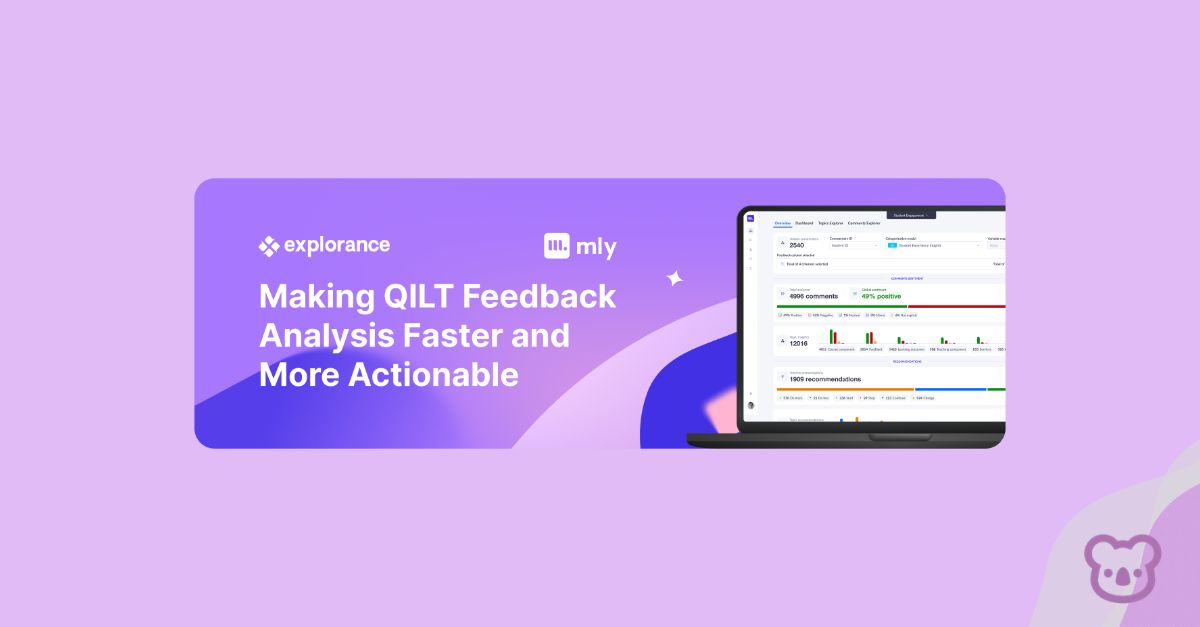
Australian universities will have a new tool to help them make sense of thousands of student comments, with feedback analytics company Explorance launching a qualitative analysis model aligned with the Quality Indicators for Learning and Teaching (QILT) framework.
The MLY QILT Model has been developed specifically for Australian higher education and is designed to help institutions extract more meaningful insights from open-ended student feedback collected through the Student Experience Survey (SES).
Developed in collaboration with four Australian universities, the model brings together sector expertise from Australian Catholic University, Deakin University, the University of Newcastle and the University of Western Australia.
The new model builds on Explorance’s existing MLY platform, which uses machine learning to analyse qualitative feedback from multiple sources. It categorises comments into relevant topics, identifies sentiment, redacts sensitive information, highlights recommendations and flags critical issues.
By mapping student comments against categories aligned with the QILT framework, the model aims to help universities identify recurring themes and better understand the experiences sitting behind their survey results.
The proposition is straightforward: rather than relying on staff to manually code and categorise thousands of individual comments, universities can use machine learning to identify patterns across much larger volumes of feedback, freeing up time to focus on interpreting results and identifying opportunities for improvement.
Tim Brennan, General Manager, APAC at Explorance, said the model had been developed in consultation with the Australian higher education sector to address the challenges institutions face when analysing large volumes of qualitative feedback.
“Analysing thousands of open-ended comments can be time-consuming, making it difficult to identify key themes and opportunities for improvement,” Brennan said.
“The MLY QILT Model helps universities turn qualitative feedback into QILT-aligned insights at speed, supporting a deeper understanding of the student experiences and strengthening informed decision-making.”
The involvement of ACU, Deakin, Newcastle and UWA provides a degree of sector-specific grounding to the model, with the four institutions contributing to its development and alignment with the realities of Australian higher education.
However, as with any analytics platform, the value will ultimately depend on how institutions interpret and act on the insights generated. Identifying recurring themes in student feedback is one thing. Translating those findings into meaningful improvements in teaching, learning and the broader student experience is another. This is, however, one step in making that easier.
The model will be available from 8 December 2026 to all Explorance customers subscribed to MLY in Australia via a scheduled upgrade wuth customer support.
For more information, see here.