







There is a quiet line in the federal ledger that is beginning to speak a little louder.
In the wake of last year’s changes to international student visa settings, new analysis suggests the Australian Government is now collecting revenue at a scale that places student mobility firmly alongside some of the nation’s more established funding streams. The shift has not come from enrolment growth alone, but from a sharp increase in the cost of entry.
In July 2024, the student visa application fee was lifted to $2000, a move that at the time drew a mix of concern and cautious acceptance across the sector. Less than a year on, the financial implications are becoming clearer.
Keri Ramirez of Studymove has been tracking the numbers closely. “Our analysis is based on the number of student visas lodged and refused since 2018,” he notes, pointing to a dataset that captures both demand and denial across multiple cycles of policy change.
What emerges is a picture of significant revenue uplift.
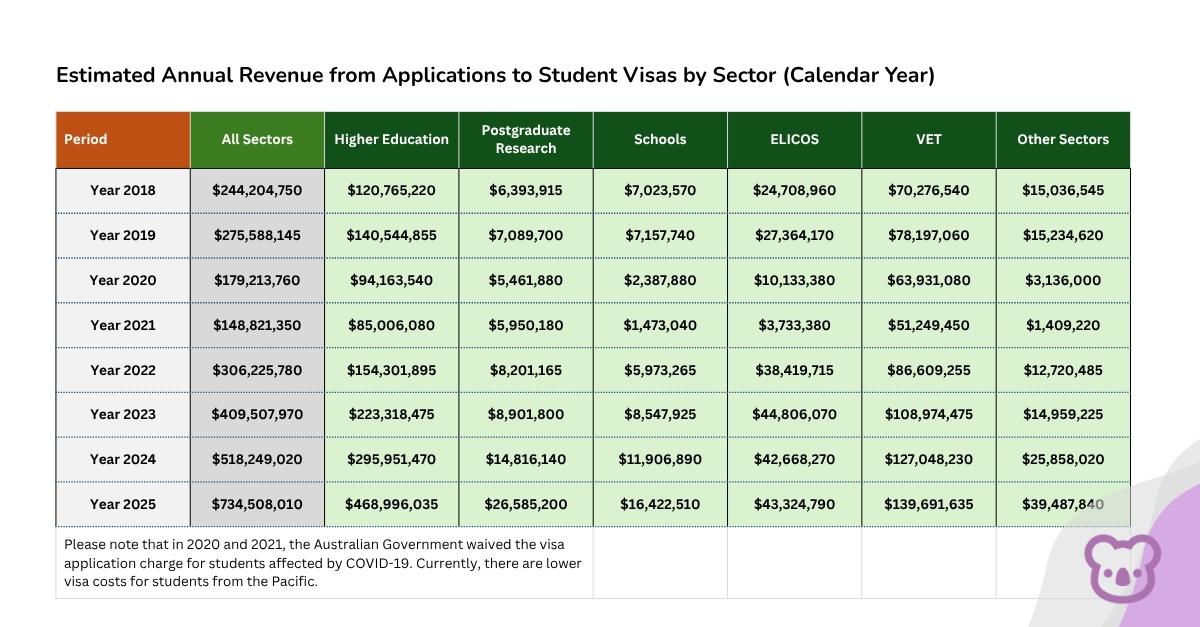
“Following the rise in student visa application fees introduced in July 2024, there has been a substantial increase in Government revenue,” Ramirez says. “Based on estimated revenue from visas lodged in 2025, the Government received approximately $735 million, which is substantially higher than in previous years.”
Estimated revenue from student visa application fees, 2018 to 2025
| Period | Estimated Revenue |
| Year 2018 | $244,204,750 |
| Year 2019 | $275,588,145 |
| Year 2020 | $179,213,760 |
| Year 2021 | $148,821,350 |
| Year 2022 | $306,225,780 |
| Year 2023 | $409,507,970 |
| Year 2024 | $518,249,020 |
| Year 2025 | $734,508,010 |
| Please note that in 2020 and 2021, the Australian Government waived the visa application charge for students affected by COVID-19. Currently, there are lower visa costs for students from the Pacific. | |
To put that figure in context is to understand the scale. The revenue generated from student visa applications alone now exceeds the annual budget of the Australian Bureau of Statistics, which sits at $712.1 million. It is well above the funding allocated to Austrade, and also surpasses that of the Bureau of Meteorology.
It is, in other words, no longer a marginal line item.
There is also a parallel story in the portion of applications that do not proceed.
“In terms of revenue from refused student visas, the figures are also significant,” Ramirez adds. “In 2025, the Government received an estimated $141.8 million from visa applications that were refused.”
Revenue generated from refused student visa applications, 2018 to 2025
| Period | Estimated Revenue (Visas Refused) |
| Year 2018 | $23,238,315 |
| Year 2019 | $26,703,680 |
| Year 2020 | $8,308,300 |
| Year 2021 | $9,362,550 |
| Year 2022 | $39,340,840 |
| Year 2023 | $61,880,800 |
| Year 2024 | $94,730,390 |
| Year 2025 | $141,873,885 |
| Please note that in 2020 and 2021, the Australian Government waived the visa application charge for students affected by COVID-19. Currently, there are lower visa costs for students from the Pacific. | |
For the ELICOS sector, the increase has landed in a more immediate and tangible way. As a price sensitive entry point to Australia’s education system, ELICOS providers have traditionally relied on shorter course durations and lower upfront costs to attract students who may later transition into vocational or higher education pathways. The jump to a $2000 visa fee has, in many cases, disrupted that equation.
Agents and providers report that the fee now represents a disproportionate share of the total cost of a short-term English program, prompting some students to defer, redirect to competitor markets, or bypass standalone English study altogether. In practical terms, this has translated into softer commencements in some cohorts and a recalibration of recruitment strategies, particularly in markets where currency pressure is already a factor.
There is also a structural effect beginning to emerge. With the cost of the visa now a fixed and significant upfront investment, students are increasingly seeking to bundle ELICOS with longer pathway programs to maximise value. While this may support conversion into other sectors over time, it places pressure on pure ELICOS offerings and shifts the role of English language study from a flexible entry point to a more tightly packaged component of a broader study plan.
Set against the revenue generated from refusals is a less visible cost, one that does not appear in budget papers. For many students and their families, a visa application represents months, sometimes years, of planning, saving and expectation. The financial outlay extends beyond the application fee to include deposits, documentation, medical checks and agent support, often drawn from household resources that are already stretched.
When an application is refused, the impact can be immediate and deeply personal. Families absorb not only the financial loss, but also the disruption of plans that were tied to education, mobility and future opportunity. In some cases, the decision carries a social dimension, where the inability to secure a visa is felt within extended family or community networks that had invested, emotionally and financially, in the student’s pathway.
These are not metrics that appear alongside revenue estimates, yet they sit closely beside them. As refusal related income reaches into the hundreds of millions, it invites a more balanced reflection on the broader consequences of the system’s settings.
Less visible, but equally important, is what happens to the revenue once it is collected. Visa application charges are consolidated into general government revenue, contributing to the broader federal budget managed by the Australian Government. From there, funds are distributed across a wide range of priorities including health, infrastructure, social services and defence, rather than being directly hypothecated back into international education or migration system improvements.
This raises a question that is increasingly surfacing across the sector. As revenue from student visas grows, is there a case for a more deliberate reinvestment into the ecosystem that generates it. That could take the form of targeted funding for compliance and integrity measures, student support services, destination marketing, or capacity building within sectors such as ELICOS that are feeling the sharpest edge of policy change.
The scale of the current intake suggests there is room for that conversation. When visa fees begin to rival the budgets of national agencies and major public projects, the link between contribution and reinvestment becomes harder to ignore. It may be time to consider whether a portion of this revenue could be repurposed to strengthen the very sector that underpins it.
For a system that relies on both global competitiveness and domestic confidence, the question is not simply how much is being collected, but how strategically it is being used.
For now, the signal is clear. International education continues to contribute in ways that extend beyond classrooms and campuses, and increasingly, into the core of government balance sheets.
A full sector wide breakdown of visa fees collected can be seen in the accompanying image (above).
The Koala thanks Keri Ramirez from Studymove for the data provided.