







The Coalition and the Greens have now publicly stated that they will not be supporting the Education Services for Overseas Students Amendment (Quality and Integrity) Bill 2024.
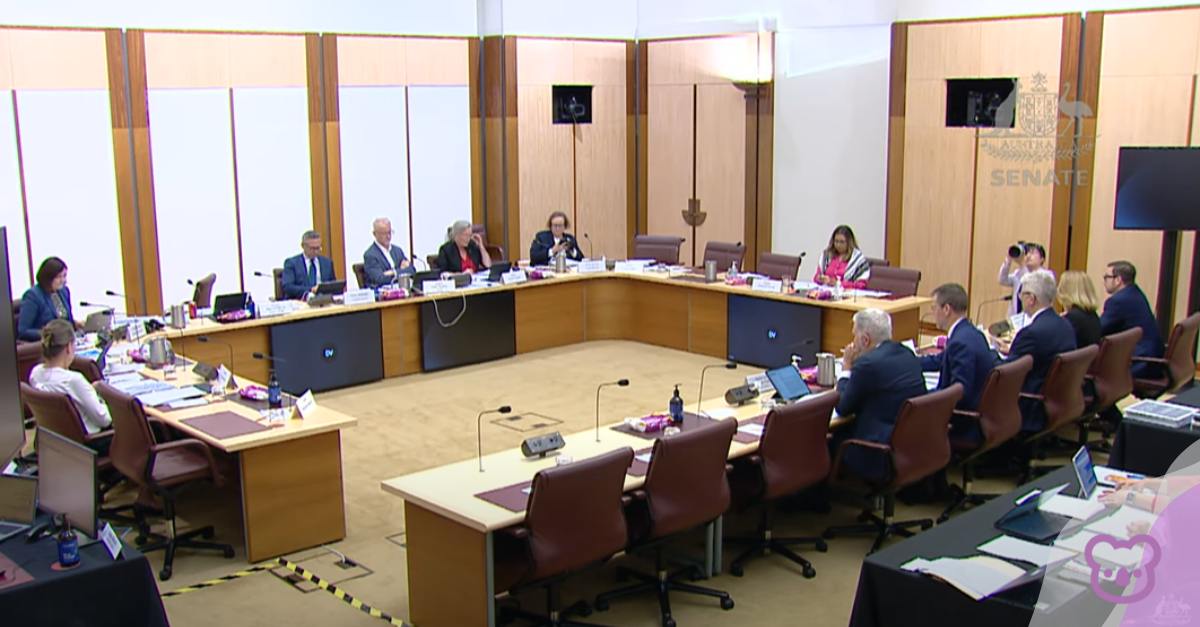
Prior to this week, Supplementary Budget Estimates 2024-25 (aka as Senate Estimates or just Estimates) was held during the week of 4 November and was the final opportunity for non-government Senators to quiz public servants about aspects of the ESOS Amendment Bill.
Below is a summary of the key points of interest from across the relevant agencies during the week. There seemed to be a delay in the Hansard transcript being released for the International Education hearing, with it only being released on Monday this week and as we know there’s been a bit on.
This delay led to finishing this summary and it’s interesting to read the transcripts knowing what we know now.
International Education
Senator Anthony Chisholm, Assistant Minister for Regional Development, Assistant Minister for Agriculture, Fisheries and Forestry and Assistant Minister for Education, represented the Minister for Education during this hearing, with the other relevant Department of Education staff being Secretary Tony Cook, Deputy Secretary Ben Rimmer and Karen Sandercock, First Assistant Secretary, International. A full copy of the Hansard transcript is available here.
In answer to questions by Independent Senator David Pocock we learned:
- Year-to-date to August 2024 there are 803,639 international students in Australia (that’s actual students, not enrolments or commencements, which is the usual way we report international student data)
- In 2023, August year-to-date there were about 265,000 new overseas student commencements, and the 2024 August year-to-date figure is 251,000.
- DoE is seeing no evidence of a falloff in university demand, despite possible enrolment caps, Ministerial Direction 107 and increased visa application fees. “This year, compared to last year, universities are about 10 per cent ahead of where they were at the same time last year,” said Rimmer.
Liberal Senator Sarah Henderson questioned the Department about providers enrolling above their notional cap in 2024, given that the legislation has not yet passed. Rimmer clarified that if a provider enrols above its cap prior to 2025, once 1 January 2025 rolls over, any student above the cap will be prevented from commencing (although the technicalities of how that would happen was not discussed).
Henderson also questioned the number of commencements that would occur in the exempt categories. Henderson used this information in the statement in the Senate on Monday night as part of the second reading debate of the ESOS Amendment Bill, critical that the new commencement figure is more likely to be around 400,000 students rather than 270,000. It’s worth noting that Cook clarified during Estimates that most ELICOS students do not count towards Net Overseas Migration numbers.
We also learned from Henderson’s questioning:
- Providers with multiple CRICOS registrations can redistribute their total allocation across their organisation, but in the case of separate entities that is not possible (such as private pathway providers who have contractual relationships with universities).
- Eight higher education institutions have had a change in notional caps to the ones originally provided.
Greens Senator Mehreen Faruqi, with interjections from Henderson, had an exchange with Chisholm about the impact of the ESOS Bill on job losses, but we didn’t learn anything new from this.
Home Affairs
At the end of October, an update from the Department of Home Affairs (DHA) sought to reassure providers that its caseload for offshore visa applications had reduced by more than half since June 2024 (TKN 011124). What we learned in Estimates is that the same cannot be said for the onshore visa caseload.
Liberal Senator Paul Scarr questioned the “explosion in the number of students on bridging visas”, to which Home Affairs’ Alison Garrod, Assistant Secretary, Temporary Visas replied, “At the moment, we do have a relatively large number of on-hand student visa applications in the onshore case load, and it’s that group who, while they are pending a visa decision, have a bridging visa in the meantime”.
Garrod also went on to confirm that the onshore student visa/students on a bridging visa caseload was about 109,000, saying, “We will be focusing on the offshore case load for the offshore peak to support the sector through the beginning of semester 1 and the transition to the National Planning Level scheme—so that’s the offshore case load. We will do what we can to support the onshore case load as well, but students who are onshore on a bridging visa can still study and attend their courses”.
Now we know that this will be in the context of the Government’s intention to continue with Ministerial Direction 107.
There was an interesting line of questioning from Scarr after this exchange about what happens to students who don’t get a place under a cap. What he was really getting at was that these students could be on track to add to the Administrative Review Tribunal and/or protection visa caseload. This is an issue that is obviously on the radar of the Liberal Party as it was raised by Senator Sarah Henderson in her statement during the second reading debate on the Bill (The Koala will be writing more on this soon, now the debate has stalled).
(As a final aside, in the DHA session, Labor Senator Murray Watt perfectly illustrated my explanation of Estimates below, telling Greens Senator David Shoebridge, “We heard your smartypants remark the first time”.)
Employment and Workplace Relations
There were no questions to the officials from Employment and Workplace Relations, or to the Australian Skills Quality Agency about enrolment caps or international students more broadly.
There was a line of questioning of the Fair Work Ombudsman (FWO) by Senator Faruqi about casualistion, underpayments and wage theft in Australia’s universities. Faruqi also asked if the FWO was concerned about financial pressures in universities due to enrolment caps and the possible impact on these issues. In response, Anna Booth, FWO, said it was not a matter that had been raised with her, and went on to say it was “not within our sphere to analyse the financial capability of organisations based on potential changes in their market environment”.
Treasury
The Treasury Portfolio appeared at Estimates the day before the international education portfolio.
Treasury Secretary, Dr Steven Kennedy confirmed in his opening statement that net overseas migration is likely to be higher in 2023-24 and 2024-25 than forecast at budget and this is due to lower than expected migrant departures. He said that many migrants have extended their stay by applying for new visas, rather than departing Australia.
Senator Pocock questioned Treasury officials about the impact of the ESOS Amendment Bill, with Treasury confirming much of the evidence that it had already provided during the ESOS Bill Senate Committee hearings.
When asked if Treasury had modelled the impact of the changes on GDP growth, Dr Adam Cagliarini, First Assistant Secretary, Macroeconomic Conditions and Population Division, responded that Treasury was in the process of doing this for its forecast for MYEFO. He reaffirmed Treasury’s position shared during the hearings, that “at this point we don’t anticipate a broader macroeconomic effect on the economy”.
The other things we learned from Pocock’s questioning were:
- Treasury still expects some growth in education exports, albeit slowing. They put the growth down to demand due to migration policies in other countries (such as Canada), existing enrolments, students who commence as part of the caps, as well as new students that are exempt from enrolment caps.
- The slowing of growth in education exports is reportedly due to a lower than average spend by students when they are in Australia, as well as less growth in the first half of this year than anticipated. According to Cagliarini, this was due in part to students from mainland China not returning post-COVID and “a range of factors in other countries, as well as obviously some policies here”.
- The international education sector has long argued that the spike in enrolments post-COVID was temporary and this was confirmed by Cagliarini:
“We would have expected a slowdown anyway. When we re-opened borders in 2022-23 there was 68 per cent growth in education exports. We wouldn’t have expected that to persist. The following year, so last financial year, it was 33½ per cent. They were just unsustainable rates of growth, and obviously that was coming off a very low base. We expect that to slow even further.”
Tertiary Education Quality and Standards Agency (TEQSA)
During the Senate Committee inquiry into the ESOS Amendment Bill Henderson criticised warning letters sent by TEQSA to providers about their financial viability, which failed to mention in the letter that the Bill was not yet legislated, leading TEQSA to subsequently apologise for the error.
Henderson returned to this issue, with TEQSA CEO Dr Mary Russell saying that less than ten such letters had been sent out. Russell also clarified that these providers had previously received warnings from DHA about student visa and student recruitment pattern concerns, which raised concerns for TEQSA in its regulatory role monitoring provider risk (among other things).
The Australian National University
In a side interest, as Australia’s only university to be established through an Act of Federal Parliament, The ANU appeared at Estimates for only the third time in its 73-year history, and for the second time this year. The rare call to appear is almost certainly due to recently announced 160 job cuts and a request for staff to forgo an agreed 2.5 per cent pay rise in December.
However, Senators are not limited in their lines of questioning and at this Estimates questions included whether there was “complicity in possible genocide” due to shares held in BAE Systems, whether ANU monitors social media of students involved in pro-Palestine advocacy on campus, outcomes of individual student disciplinary cases, and the office and staff for Chancellor Julie Bishop.
What is Senate Estimates?
Senate Estimates is an opportunity for senators to scrutinise the spending of Government. If you don’t know much about it, below is a summary.
During Estimates ‘hearings’, Senators ask Ministers (the relevant Minister if that Minister is also a Senator, or another Government Senator representing the Minister) and government department officials (Australian Public Servants), about government expenditure and the work of the government.
Budget Estimates hearings are held after the Budget is introduced in the House of Representatives in May (noting that next year’s Budget is likely to be in March, due to a likely May election). Additional Estimates are held in November and the following February, allowing senators to ask additional questions about government spending and actions of government departments.
Government portfolios are divided into eight Senate committees and these committees run the Estimates hearings. Each committee is made up of 6 senators – 3 from the government, 2 from the opposition and 1 minor party or independent senator, however, any senator can ask questions during Estimates, not just committee members.
While Estimates is an important part of the parliamentary process to keep the government accountable for its actions, it is often politicised, usually by non-government Senators as an opportunity to score points against the government. The Australian Public Service works for the government of the day, implementing its policies and programs, and will defend these at Estimates more than any other time.
Through the ESOS Amendment Bill inquiry, we became familiar with the Senate Education and Employment Legislation Committee. Indeed, the Senators’ treatment of government officials during the inquiry had Estimates vibes (TKN 080924).
As such, Estimates can be a time of dread for public servants. Either because they or their department have been on the receiving end of a blistering attack at Estimates or they know one is coming; or, because of the amount of time spent providing your department’s senior executive with copious amounts of briefing, while you anticipate what issues may or may not be on a senator’s radar.
During my time in the public service, international education was mostly not on the political radar and was heard separately to other parts of the Department. We would often be waiting in Parliament House until late in the evening and then be told that we didn’t need to appear.
This year was always going to be different.