









Australia’s higher education sector has a new alliance and a very clear political mission.
Nine universities from across metropolitan, outer suburban, regional and remote Australia have formally launched the 2050 Alliance, a new collective designed to push the nation towards the Federal Government’s target of having 80 per cent of working-age Australians holding a tertiary qualification by 2050. The new group replaces the Innovative Research Universities (IRU) organisation.
The group, launched earlier today by Education Minister Jason Clare, positions itself as both a policy voice and a reform partner at a time when universities are facing sweeping structural change following the Universities Accord process.
Its founding members are Australian Catholic University, Flinders University, Griffith University, James Cook University, La Trobe University, Murdoch University, University of Canberra, Victoria University and Western Sydney University. Together, the institutions educate more than 285,000 students across more than 65 campuses nationwide.
The Alliance arrives as universities continue adjusting to the policy direction emerging from the Accord, including the creation of the Australian Tertiary Education Commission and growing pressure on the sector to lift participation among students from under-represented communities.
In announcing the group, Clare framed the challenge as one of geography and equity.
“Almost one in two young people in their 20s and their 30s have a university degree today. But not everywhere. Not in our outer suburbs and not in regional Australia. The 2050 Alliance will help change that,” he said.
“The Universities Accord sets an ambitious target for 80% of the workforce to have a tertiary qualification by 2050.
“2050 Alliance Universities are going to do a lot of heavy lifting in getting us there.”
The Alliance says meeting that target could add $240 billion to the Australian economy by 2050, but argues the pathway to that outcome will require a significant expansion in higher education participation, stronger student support and a sharper focus on communities that have traditionally been under-served by universities.
The messaging also signals an attempt to reposition universities as civic institutions closely tied to national productivity and intergenerational equity, rather than simply providers competing for enrolments.
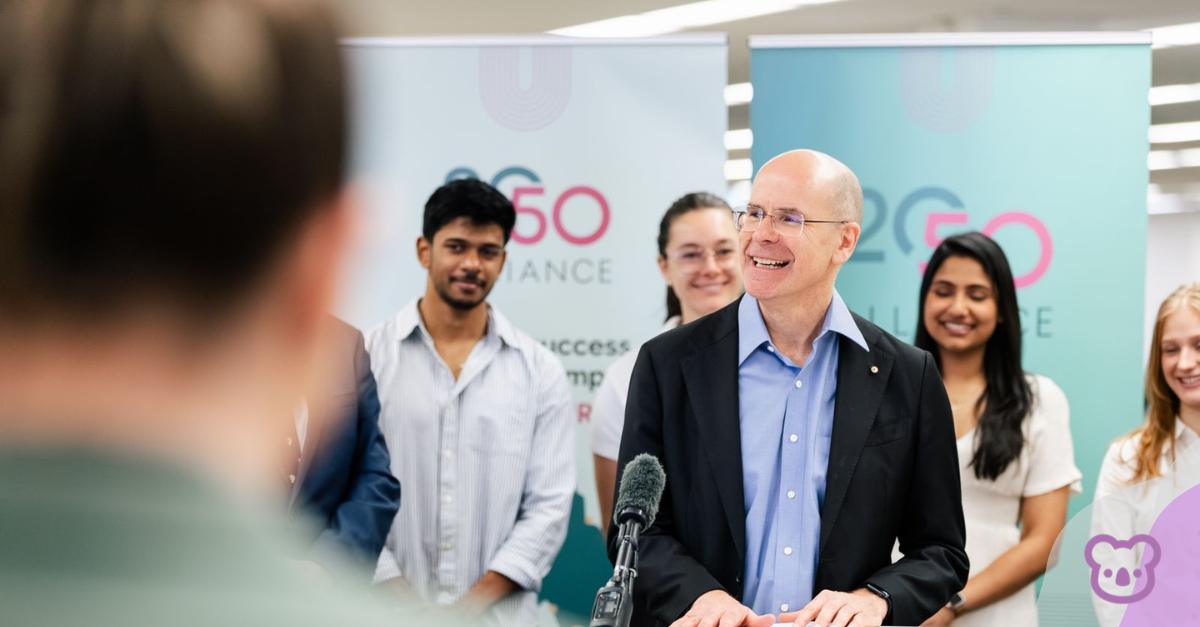
2050 Alliance Chair and Western Sydney University Vice-Chancellor Distinguished Professor George Williams AO described the current moment as the biggest period of higher education transformation since the 1980s.
“We are in the middle of the biggest transformation in our higher education system since the 1980s,” he said.
“There is no time to waste – the decisions we make today will determine whether we meet our 2050 goals. The time is right for universities to come together with a clear focus on the public good – serving our students and communities, and helping to deliver on major national priorities including intergenerational equity and productivity growth.”
Chief Executive Officer Paul Harris said the Alliance was already working with the new Australian Tertiary Education Commission and intended to position itself as a constructive policy partner.
“We are already working with the new Australian Tertiary Education Commission on our shared goal of a bigger and fairer university system that sets Australia up for the future,” he said. “Our Alliance will be a leading positive voice for higher education and research policy that benefits all Australians.”
Beyond the rhetoric, the formation of the Alliance is also notable for who is in the room. The membership heavily reflects universities with large outer metropolitan, regional and widening participation cohorts, institutions that have increasingly argued they carry much of the burden for achieving the government’s attainment ambitions while often operating with fewer resources and lower margins than the sandstone sector.
The Alliance’s founding statement repeatedly references “public purpose”, “community impact” and “student success”, language that suggests the group intends to differentiate itself from existing university peak bodies by focusing more directly on equity, participation and social mobility outcomes.
For more information see: https://www.2050alliance.edu.au/
Photo: 2050 Alliance Chair and Western Sydney University Vice-Chancellor Distinguished Professor George Williams AO. The Koala thanks 2050 Alliance and the University of Canberra for use.