











In a higher education market increasingly fond of broad creative degrees, the Australian Institute of Music (AIM) is taking the opposite approach.
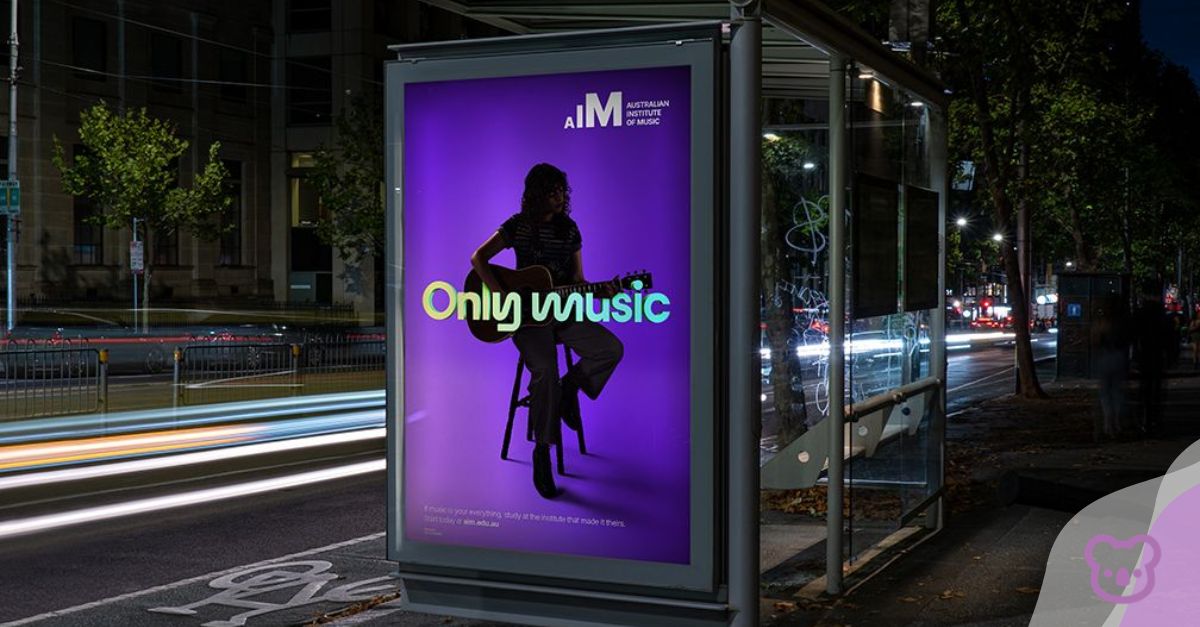
The specialist music institution has launched ‘Only Music’, a new brand platform built around a deliberately simple proposition: after almost 60 years of teaching music, AIM believes its point of difference is precisely that music is all it does.
The move comes as music education, like much of the creative arts, faces a more difficult operating environment. Funding pressures, changing student demand and the growing tendency for universities to bundle disciplines into broader creative offerings are reshaping the market.
Rather than broaden its proposition, AIM is doubling down on specialisation.
“Only Music is the clearest expression yet of what AIM has been building since 1968,” says AIM CEO Dr Ben O’Hara. “In a world full of creative generalist higher education providers, ‘Only Music’ highlights AIM’s clear point of difference.”
It is an interesting positioning strategy at a time when higher education institutions are increasingly talking about interdisciplinarity and transferable skills.
For students, however, there is a potentially powerful counterargument. Not everyone who wants a career in music is looking for a generalist creative education. For some, the attraction is precisely the opportunity to immerse themselves in a community where music is the central discipline rather than one subject among many.
AIM is betting that there is still a market for that level of commitment.
The institute’s Chief Academic Officer, Dr Suneeti Rekhari, says music requires a particular combination of personal and professional attributes.
“Music asks something different of people. It demands imagination, discipline, courage and an ability to communicate what cannot always be put into words,” she says.
That idea is at the heart of the new platform, which seeks to position music not simply as another creative field, but as an educational experience requiring a distinctive form of commitment.
There is also a broader challenge sitting behind the campaign. Creative education has increasingly had to justify its economic and employment value in a higher education environment where graduate outcomes, employability and industry relevance are under constant scrutiny.
AIM’s response is to focus on the craft.
Rekhari says the institution’s role is to help students transform their personal connection with music into “mastery of their craft” and the confidence to build a life around it.
That is a more ambitious proposition than simply preparing students to become performers. It suggests an education built around the wider music ecosystem, from performance and composition to recording, engineering, production and the commercial realities of building a career.
The campaign’s flagship film, Escape the Noise, puts that proposition into a more personal context.
The film follows AIM Bachelor of Music (Performance) student Elise Madgwick as she navigates the competing voices and expectations surrounding the decision to pursue a creative career. Shot from a first-person perspective, the film deliberately places the viewer inside that uncertainty before arriving at what AIM describes as the clarity found through music.
Reflecting AIM’s community of international students, Escape the Noise is also available with Chinese subtitles, ensuring the film’s message reaches prospective students and families across one of AIM’s key international markets. By translating the film, AIM hopes to share that the pull toward music, and the courage it takes to pursue it, is something students recognise regardless of where they’re studying from.
The creative concept is perhaps particularly relevant to today’s prospective students.
Choosing a creative career can involve a familiar chorus of questions: Is it practical? Will it lead to a job? Is music something that should be pursued professionally or kept as a passion?
AIM’s answer is essentially to stop apologising for the choice.
Importantly, AIM has also made the campaign a showcase for its own community. The film features current students, staff and academics across performance, recording, engineering, mixing and mastering, while Academic Lecturer Dr Bonnie Green composed the original score and contributed to the sound design.
That gives the campaign a useful degree of authenticity. Rather than simply telling prospective students that AIM is a specialist music institution, the production demonstrates the breadth of expertise contained within that specialisation.
“It’s written in our DNA, our history, and our future,” says AIM Chief Marketing Officer Chris Parkes.
And that may be the most interesting aspect of the campaign.
For much of higher education, branding is increasingly about explaining how institutions can offer students more: more disciplines, more pathways, more flexibility and more connections across fields.
AIM is selling the opposite idea.
It is saying that sometimes more focused can mean more valuable.
Whether that proposition resonates with the next generation of music students will depend on whether they see specialisation as an advantage in a labour market that increasingly rewards adaptability. But AIM is clearly betting that students who know they want music do not necessarily want a diluted version of it.
After nearly six decades, the institute appears to have decided that the strongest statement it can make about its future is to remind prospective students what it has always been about.
Only Music.