












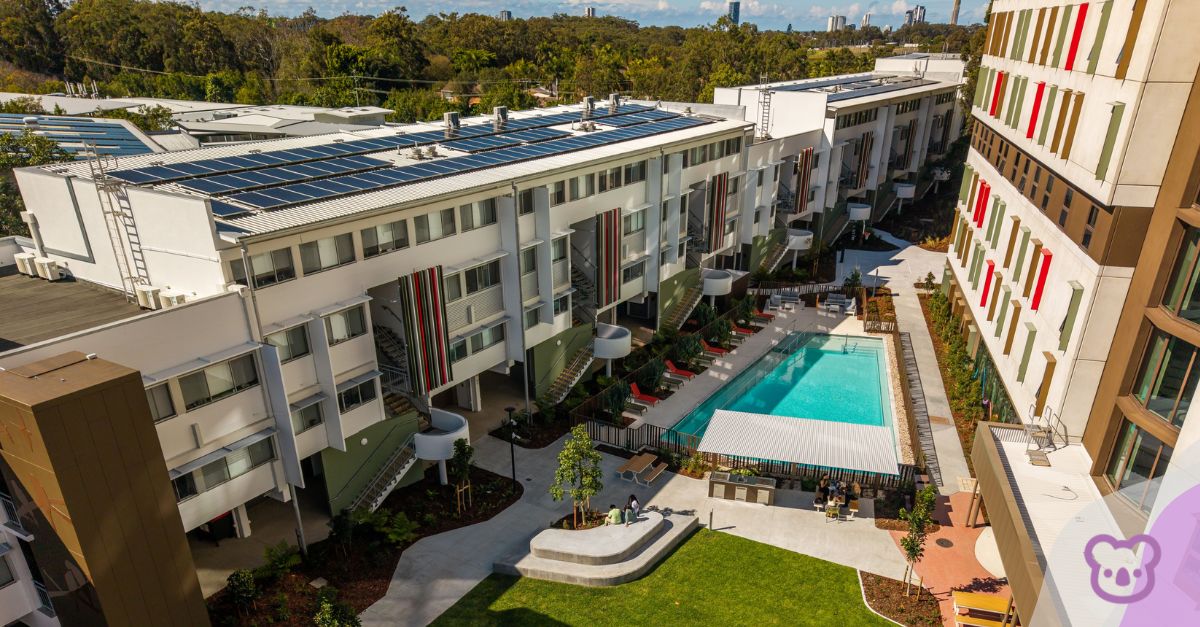
Campus Living Villages (CLV) has officially opened a major expansion of Griffith University Village on the Gold Coast, adding 460 purpose-built student accommodation beds and nearly doubling the size of the existing village.
Developed in partnership with Griffith University, the new accommodation tower takes the village to around 1,000 beds, providing a significant boost to on-campus housing at a time when finding somewhere affordable and suitable to live has become an increasingly important part of the international student experience.
And that is the bigger story here.
Student accommodation is no longer simply a nice-to-have amenity attached to a university campus. In Australia, providing access to somewhere to live is becoming part of the infrastructure required to sustain international education. Universities can recruit students from around the world, but if those students arrive and cannot find a room, the entire proposition starts to unravel.
The Gold Coast is a particularly interesting case. The city has experienced strong population growth, rising housing costs and growing demand for accommodation across multiple sectors. Increasing on campus housing allows students to be on campus while young professionals, families and workers attracted to one of Australia’s fastest-growing regions compete in the local market.
Against that backdrop, 460 additional beds is more than a construction project. It is an attempt to put some certainty back into the student experience.
The new Griffith University Village tower includes studios, two-bedroom apartments and accessible accommodation, alongside a substantial collection of shared facilities. Students have access to a swimming pool and zen pool, gym and yoga studio, collaborative study areas, cinema and recreation room, landscaped green spaces, a yarning circle, laundry facilities and communal cooking and dining areas.
That list might sound like a developer’s amenities brochure, but it reflects an important shift in how student accommodation is being designed.
The modern student residence is increasingly expected to provide an environment rather than simply a bedroom.
For international students in particular, that is important. Arriving in a new country can mean navigating unfamiliar transport systems, financial pressures, cultural differences and the challenge of building a social network from scratch. A residence that creates opportunities for students to meet, study, cook and socialise can become an important part of that transition.
CLV has also invested close to $3 million in renovating and upgrading the existing village. That is importanr because the project is not simply about adding new beds. It is about creating a more integrated village across the old and new accommodation.
CLV Group Managing Director and CEO John Schroder described the expansion as an extension of the organisation’s long-standing relationship with Griffith University, saying the partnership had supported thousands of students and that the new development was intended to foster “belonging, wellbeing and connection”.
Those are familiar words in the PBSA sector, but they are becoming increasingly important as universities compete for students in a more challenging market.
For years, the Australian international education sector largely focused on the availability of courses, the reputation of institutions and the strength of Australia’s post-study work proposition. Housing sat somewhere further down the list.
That is changing.
The housing experience is increasingly becoming part of the international student value proposition. A student who can secure accommodation before arriving in Australia has something that is difficult to put a price on: certainty.
If Australia wants international education to remain a major export industry, it will need more than visa places. It will need places for students to live.












