











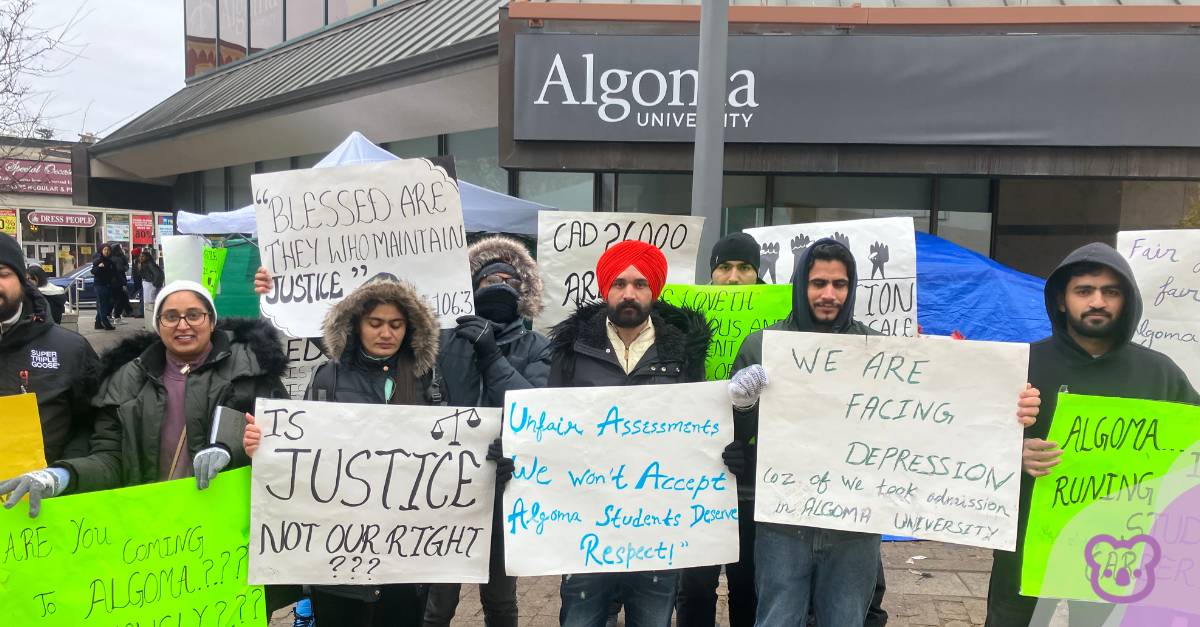
Well over a hundred Indian students gathered to protest on 3 January at Algoma University’s Brampton Campus. Why? They were notified on New Years Day they had failed a unit of study COSC 3707 (Techniques Systems Analysis). Some of them had failed it for the first time a year ago.
After coordinating via WhatsApp, some students travelled 700 KMs to the college’s main campus in Sault Ste Marie (a cold, remote part of Ontario), to visit – to speak in-person with the Dean and their professor, who turned out to be not available due to holidays.
According to the students, most of the course had been delivered through pre-recorded online lectures with the adjunct professor teaching the course, who never physically set foot in the classroom with the students (at the Brampton Camps). Students claim the professor did host occasional, brief online meetings during which he complained of being overburdened “having to teach 400 students.” Listen to student concerns about the program.
The students say all other courses went well, except this one. They are blaming the teacher, complaining their concerns were not taken seriously, and alleging exploitation. New students, nearly all from the same region as the protestors, (and now taking the same programs), walked through the protesters encampment on the way to their first day of classes. Reading signs like “You chose Algoma?? Seriously??”
After a week of mid-winter outdoor protests, students report, a solution has been proposed by the university’s senior administration. Some students who have failed the exam will be allowed to pass, and those who remain failed will be re-tested.
Raises questions, highlights existing concerns.
This situation raises questions about academic integrity. If not before the re-test, definitely after. It is highly unusual for a high proportion of an entire class to fail a subject, and it is more unusual still to have that decision overturned by senior administration – in a week flat, at a public university.
Social media posts pointed blame in all directions. One post challenged international students’ lack of focus on studies, as compared to pursuit of work priorities while another singled out colleges for low academic standards.

What is clear from these posts and others, is that the public impression of international students and confidence in the international education sector has been negatively impacted, by conditions students themselves are in no way responsible for creating. And while the government of Canada, schools and industry lobby groups have warned against making students the scapegoat for complex issues like housing shortages, the same entities continue to produce an environment where negative impressions of international students are likely to be a result.
To date, Canadian community colleges have taken the most criticism for their industry conduct, however there are increasing examples of universities engaged in practices of similar concerns. Algoma University for example, has come under the spotlight for imbalanced international enrollment with 76% of tuition revenue being dependent on international students, about 85% of them being from a single source country (India).
Like many community colleges engaged on private -partnership agreements, Algoma has similarly established a satellite campus in Brampton (nearer the Greater Toronto area) where student enrollments approach a 3 to 1 disparity compared to its main campus. Recent government reports have highlighted concerns about how facilities and student supports can compare poorly at subsidiary campuses.
Recruitment and admissions strategies at Algoma also seem to bear more resemblance to concerning trends among community colleges, as opposed to other public universities. Recruitment strategies have included “on the spot admissions” at overseas study fairs hosted by aggregator recruitment platforms and an international admissions approval rate that has approached 99%. Perhaps by consequence, prospective students planning to attend Algoma have endured visa refusal rate hovering close to a 50% , one of the highest rates of visa refusal experienced by any public college in Canada. There have been other issues as well. Last year students and education agents complained Algoma circulating multiple versions of student refund policies, including a non-refundable version, which seemed at odds with its own internal policy if not provincially set guidelines.
An Algoma spokesperson clarified the institution’s position on some of the above concerns via email. With regard to on the spot offers, “It is Algoma University staff, not agents, who are offering on the spot admissions. We are able to do this by cross-training recruitment staff in admissions (admissions is 20% of their job description)…All of our admission requirements are set by the university senate and enforced by the Registrar’s Office who has the final say on admissibility. The International Admissions Team simply handles the application processing, not setting the requirements or determining eligibility…Our high acceptance rate is a result of sound agent training and lack of seat caps in most programs.”
Ironically, the university’s website highlights caps for class sizes leading to “a small class atmosphere” as an Algoma U advantage. “Algoma U is the only university in Ontario that caps classes at 75 students. You’ll never be in a class with hundreds of other students in a big lecture hall; instead, you’ll find most classes have no more than 35 students in them.”
Where do we go from here?
Program integrity concerns with Canada’s International Study Program have been mainstream news in recent times. More recently, the volume of new arrivals, including a surge in international students, exacerbating impact on housing shortages has incited government action. Further details related to the Canadian government’s proposed “Recognized Institution Framework” – a system aimed at improving industry standards amenable to a “legitimate international student experience”, and likely limiting overall intake volumes, through stronger Federal control, are due out in the Spring.
In the meantime, the Minister of Immigration, Refugee and Citizenship Canada (IRCC) Marc Miller has been singling out the government of Ontario as an example of a non-cooperative partner. Recently Minister Miller pointed to Ontario’s lack of progress in addressing recommendations for the province’s post secondary sector by a 2021 Auditor General report. Ontario is the destination province for more than half of in-bound international students to Canada.












