











Four major reviews have been conducted impacting International Education. Eyes now turn to how these will be brought down logically, sequentially and in an integrated way.
For a sector that in recent months relates to the word “review” with a big “R”, one thing has become clear: if ever there is going to be an Australian Government international education portfolio, it is now or never.
What the reviews tell us
There have been four reviews in recent months that have and will significantly impact international education. The cross-over of these tells us that international education has grown to be a sector where multiple nodes of government each directly impacting it.
To demonstrate this point, the koala has looked at each review and compiled a list of key references:
Australian Universities Accord (interim report)
- 26 references to international education
- 27 references to global
- 49 references to international students
- 155 references to international
A Migration System for Australia’s Future
- 17 references to International Education
- 21 references to English Language
- 133 references to education
- 154 references to students
- 262 references to student
Rapid Review into the Exploitation of Australia’s Visa System
- 26 references to VET
- 37 references to student
- 79 references to education
Inquiry into Australia’s Tourism and International Education Sectors interim report
- 27 references to English Language
- 107 references to Tourism
- 142 references to migration
- 269 references to visa
- 782 references to students
- 1343 references to student
The above demonstrates that International Education is a complex sector that crosses multiple federal portfolios. These multiple portfolios and policy changes that may occur within them have a direct influence on the health of international education as a sector.
The Inquiry into Australia’s Tourism and International Education Sectors interim report cites this well via their “team Australia” views and recommendations and is supported by DFAT (Pages vii, xvii, 22, 27, 40, 41, and 42).
“We believe the international education sector will be well-served by adopting a ‘Team Australia’ approach to marketing and branding. It should aim to build awareness of Australia as an education destination and prioritise diversification into new and emerging geographic markets.” (Page vii).
The following portfolios have influence:
- Minister for Home Affairs – The Hon Claire O’Neil MP
- Minister for Immigration – The Hon Andrew Giles MP
- Minister for Education – The Hon Jason Clare MP
- Minister for Trade and Tourism – Senator the Hon Don Farrell
- Minister for Skills and Training – The Hon Brendan O’Connor MP
- Minister for Foreign Affairs – Senator the Hon Penny Wong
The Koala ponders what the conversation around the cabinet table is like regarding “Team Australia” and wonders who is the champion of the sector interests in these discussions.
The Koala will come back to “who”.
Too Commercial
“The Review sees international education less as an industry and more as a crucial element of Australia’s soft diplomacy, regional prosperity and development. This makes the quality of the education we provide even more important. ~ Australian Universities Accord Interim Report Page 7.
This is a headline quote.
Australia has long held a reputation for commercialising education and is clearly the most commercial operator amongst its peers on the global stage.
For those that have been around for some time, the date was 1 July 2010. The then Rudd/Gillard government shifted Education promotion from Australian Education International via The Department of Education to the Trade promotion agency Austrade, which has remained since.
If, as the above headline quote suggests and the commercial pressures that other reviews allude to are true and relevant, perhaps now is the time to rethink Education promotion as an export trade and re-focus it to an agency with a similar outlook, such as the British Council whose objective is:
“The British Council, established in 1934, is the United Kingdom’s international organisation for cultural relations and educational opportunities. It is a charity governed by Royal Charter and a UK public body. It has 12,000 staff across 100 locations around the world. In FY 21/22 the British Council spent £175 million (approx. AUD $335 million) on encouraging educational cooperation and promotion the advancement of education.” Inquiry into Australia’s Tourism and International Education Sectors interim report (page 23).
Furthermore, by realigning external-facing functions into a new portfolio it facilitates a single entry to point to Australian education by stakeholders. Currently, this isn’t so, with major stakeholders having multiple contact points across AEI (Dept of Ed – Policy, Education Standards, and Research), Austrade (promotion) and Foreign Affairs (New Colombo plan).
It would also be easier to align enhanced alumni functions (recommendation 1.151 of the Inquiry into Australia’s Tourism and International Education Sectors interim report) within a new focused agency. Imagine where an enhanced alumni function may sit now. A new ‘Education Australia’ or similar body would be a natural fit and can hone the soft power generated by Australian graduates offshore.
Having a single focal point would also add weight to corralling and focusing the sector around messaging. The Study Australia partnership becomes a significant highlight, and uni lobbies have a renewed license to contribute to Team Australia.
Too big, too important
International education is a cottage industry no more. The impact of the sector is enormous. It’s enormous on job creation, labour supply and the nation’s economic prosperity.
Alan Olsen, former Australian Universities Director Forum (AUIDF) benchmarking guru from and Director of Strategy, Policy, and Research in Education (SPRE) has looked at Education as an export for Australia. He says:
Education in calendar year 2022 was Australia’s fourth largest export behind Coal, Iron Ore and Natural Gas, more valuable than Gold.
In 2019, prior to the pandemic, from the Reserve Bank of Australia:
“Australia’s education exports totalled $40 billion in 2019. This included $17 billion in tuition fees paid by international students and $23 billion in international students’ living expenses while they studied in Australia. China has accounted for one third of Australia’s education exports over the past few years.”
In March 2020, Australia closed its borders to non-citizens and non-residents in order to limit the spread of COVID-19 into Australia. It was not until December 2021 that fully vaccinated international students were able to enter Australia.
From February 2022, Australia reopened its borders. The value of Education as an export for Australia nearly halved, from $40.068 billion in 2019 to $22.023 billion in 2021, then recovered to $26.590 billion in 2022.
In those same years, the value of Tourism as an export for Australia fell more sharply, from $22.6 billion in 2019 to $5.1 billion in 2020 and $0.4 billion in 2021, then $7.0 billion in 2022.
It is the largest export that isn’t dug up, and its contribution to the economy at a time when the country really needs increases in export income can’t be underplayed.
It’s too big and too important to Australia’s national economic interest.
Leading a portfolio
One shortcoming within the government has been that its personnel may not have the knowledge to manage an international portfolio – it’s not a traditional portfolio.
The only attempt at international education entering the ministry was back in 2015/16 when the then liberal Senator Richard Colbeck was the Minister for Tourism and International Education for all of 302 days.
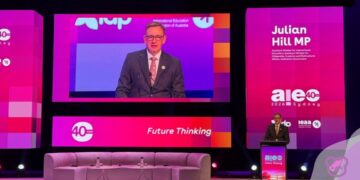
Enter The Hon Julian Hill MP.
The member for Bruce in Victoria ticks this box and then some. He currently resides on the back bench, meaning moving up as junior minister would validate his work to date.
He has held several executive-level positions within the Victorian Public Service, working in international education, migration, economic development, employment, community development, urban planning and local government. He gets it.
He is respected within government and by the sector, including the lobby groups. A perfect example of a federal politician who could lead a newly established portfolio.
The Chair of the Inquiry into Australia’s Tourism and International Education Sectors interim report (and Trade Subcommittee), Senator Deborah O’Neill, even made special mention of Hill’s contributions and expertise through the deliberations of the committee to get to the stage of the interim report being issued, saying, “Special mention must also be made of Mr Julian Hill MP whose personal experience in the sector was of particular relevance in guiding the committee and its deliberations.”
If ever there was a time and a case for an international education portfolio within the federal government, it’s now.












