













It’s been a tense few months in Canada’s International Education sector; things just got a lot worse.
Speculation about market decline began in August, with former Immigration Minister Sean Frazer (now Minister of Housing et al.) floating the idea of a “cap” on overall international student numbers. Then, shortly after, new Immigration Minister Marc Miller emphasized wider integrity problems to be dealt with urgently.
Canada’s international education lobby dug in their heels in an attempt to debate whether changes could be made – without a significant industry slowdown occurring. Quebec (and others) floated legal arguments regarding the primacy of provincial jurisdiction over education matters.
Then, on September 20th, four Canadian Senators issued a report to Parliament outlining the urgent need to address widespread problems in Canada’s Edu-export industry, with recommendations for all levels of government. The report represented a laundry list of 12 recommendations to the urgent attention of Parliament, clearly labelled as a “fix now” problem.
The very next day, Canadian PM Justin Trudeau stood in the centre of the House of Commons and tied the government of India to the extra-judicial killing of Canadian citizen Hardeep Singh Nijjar. India alone accounts for more than 40% of Canada’s edu-export market.
So, this should end the debate about what trajectory Canada’s international education industry is on.
House of Cards: The Potential for Market Collapse
The numbers, in raw data form, outline the stark potential impact of what happens should the Indian (or more unlikely the Canadian) government act towards limiting education trade:
| 2015 | 2016 | 2017 | 2018 | 2019 | 2020 | 2021 | 2022 | |
|---|---|---|---|---|---|---|---|---|
| % of study permits issued (India) | 14.60% | 19.90% | 26.30% | 30.20% | 34.60% | 31.64% | 38.10% | 41.10% |
| Volume of study permits issued (India) | 31,920 | 52,625 | 82,935 | 107,020 | 138,600 | 80,880 | 169,350 | 225,940 |
| All Study Permits Issued | 219,035 | 264,285 | 314,990 | 354,285 | 400,600 | 255,610 | 443,810 | 549,260 |
A decade ago (2012, 2014), the government of Canada did still favour increasing Indian student volume in Canada. But concerns about overreliance started soon thereafter.
By 2018, the government of Ontario (the province with the highest volumes of international and Indian students) launched the newest version of its International Education Strategy which focused on expanding recruitment efforts to “intensify diversity and sustainability” recognizing “it benefits Ontario to draw international students from the widest range of countries”. In 2019 the Federal government followed suit with Canada’s International Education Strategy Plan 2, which also emphasized the need to diversify exports and warned (specifically) about an overdependence on India.
By mid-2021, StatsCanada had issued a report cautioning that “the majority of foreign students are coming from the same countries (mainly India) concentrating in particular sectors (mainly community colleges), school programs (business related) and provinces (mainly Ontario), and that lack of diversification could spell trouble for Canada’s international education sector.
In December of 2021, the Auditor General of Ontario published a scathing report related to overreliance on India as a source country. The report ominously urged public institutions to “mitigate the risks of public colleges relying….(on) students from [India] and to… proactively plan for related circumstances that are not within their control.”
By this time, 62% of international students at public colleges in Ontario were coming from India, 15 of 22 of Ontario’s English language public colleges had enrollment figures of Indian students at over 50%, with five public colleges at 90% Indian international enrollment. It is not uncommon for smaller private colleges to be at or nearly at 100% Indian enrollment, many with no domestic students whatsoever.
A Symptom of Industry Integrity Problems (that will also limit growth)
Despite several years of warnings and policy recommendations, little progress has been made in terms of market diversification. Tension with India immediately shifts diversification priorities from a best practice suggestion to financial sustainability calculations. This is, arguably, yet another consequence of the lack of oversight imposed on Designated Learning Institutions (DLIs) in Canada – including no regulations on international student recruitment.
Since the Auditor General’s dire warning, now a full year recruitment cycle later, an increase of 17 of 22 of Ontario’s English language public colleges are recruiting the majority of their students from India, five public colleges are still at 90%. It remains common for smaller private colleges to be at or nearly at 100% Indian recruitment, but the number of these schools has mushroomed in many cases – still no domestic students whatsoever.
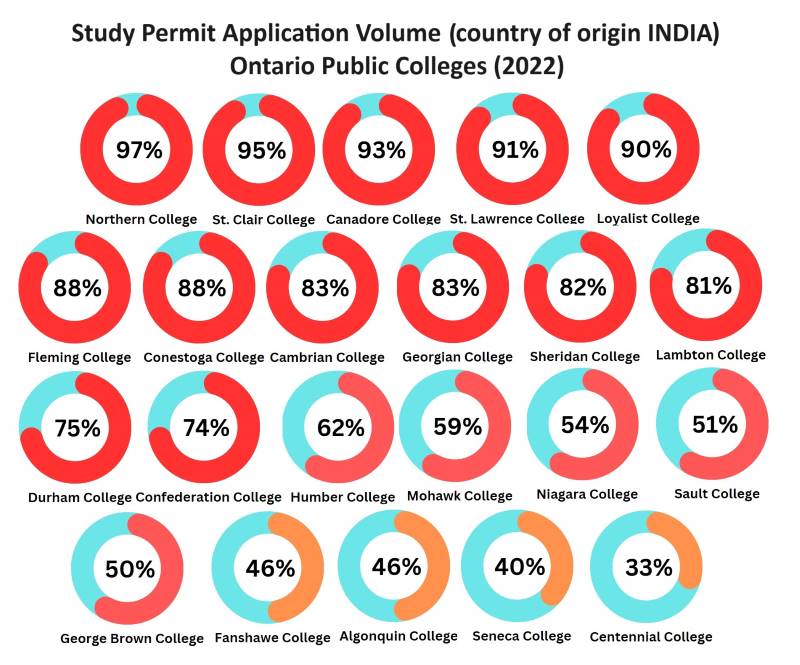
In the context detailed above, it is clear that the diversification agenda outlined in government policy, has been largely ignored by community colleges in particular. Since 2012 international student growth at community colleges (as opposed to universities) have been the main growth component of Canada’s International Study program, primarily due to lower costs and shorter programs available, making colleges an ideal marketing scheme for overseas education agents selling student to permanent resident schemes.
The failure to diversify is one symptom of community colleges (in particular, but not exclusively) failing to achieve goals and priorities associated with government policy. In fact, post-secondary institutions have managed a list of failures or disregard that far outstretches their accomplishments (which are primarily related to intake volumes).
There are plenty of reasons for parents, especially Indian parents, to second guess investment in Canada’s Edu-export industry. But factors like poor permanent resident transition rates, poor graduate employment outcomes, and faltering standards of quality controls are a lot more intangible (especially when balanced with local marketing misdirection) than is a national, dangerous political feud.
Collectively, this begs the question: How long is the government of Canada prepared to allow Canadian DLI’s to disregard national interests in favour of short-term personal gain?