












Recent immigration policies in Australia, Canada and the United Kingdom are quickly changing student behaviour, according to two recent studies.
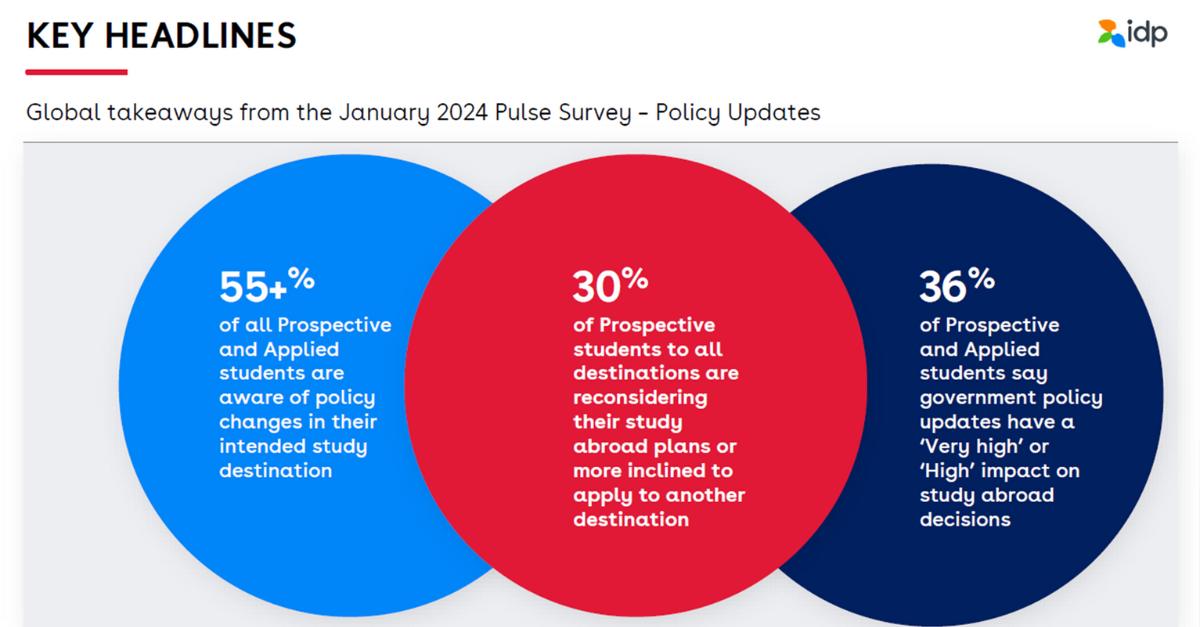
IDP Education’s January 2024 study, “The Voice of the International Student”, found that demand for the US has grown at the expense of the three Commonwealth nations. Meanwhile, Studyportals research found that both the US, and to a lesser extent Netherlands and Italy, are growing in popularity, and that Canada is particularly flagging.
All types of incoming students are being affected ranging from masters students to short term students.
“The opportunity for post-secondary students in the US is at an all-time high,” said Antonio Aragon, Vice President of Business Development at Bayswater. Aragon added the growth in the Canadian ESL sector is now predominantly reliant on short-term programs of less than six months due to government imposed caps.
“Canada’s caps on study permits have the potential to be devastating for long-term ESL students,” said Aragon. “This shift may affect program costs and will hinder the growth of the ESL industry over the next two years.”
Students studying in Australia were found to be most aware of the recent policy announcements and 31 per cent said the announcements will have a high or very high impact on their study abroad plans.
“For a prospective international student, choosing to study overseas is one of the most important decisions of their lives and they want certainty when making these decisions,” Simon Emmett, IDP Connect Chief Executive Officer said via news release. “Our latest survey has identified that changing policy, regulations and restrictions are impacting the dynamics of student movement.”
Over the last few months, governments in the UK, Canada and Australia have all been hanging out “no vacancies” signs, with all three looking to control immigration, seen by many prospective voters as out of control with pressures on housing and public services increasing across the board.
“The government’s view is that all higher education providers have had enough runway to get their houses in order,” said Louise Nicol, the founder of Asia Careers Group SDN BHD and alsocan. “Governments now have their way and it’s about more sticks than carrots when it comes to international education.”
International student revenue has been the primary lever for increasing revenue into tertiary education and now that the governments are reducing that lucrative revenue stream, institutions will be left scrambling looking for other ways to remain viable, she said.
“It is challenging as institutions are facing rising inflation, plateauing or falling domestic student numbers and governments in each jurisdiction who are unwilling to provide additional funding,” said Nicol.
Nicol said global higher education most definitely made hay while the sun was shining and missed out on using some of that of money to reinvest and to future proof their international student recruitment. For instance, she said in the UK international revenue amounted to about £40 billion in additional International student tuition fees, some of which could have been used to access graduate outcome data that showed many students were successfully returning home and averting the current changes being driven by a lot of misinformation.
The students who are already in the Commonwealth nations are expected to encounter bumpy roads ahead in achieving their dreams.
“It will be significantly harder for all international students to gain permanent residency in their country of study,” says Nicol. “As governments and parties of all colours consider serious restrictions on immigration, the price will inevitably be paid by non-voting international students.”
Nicol also believes that the growth in the United States may be short-lived. She points to the upcoming American election and indicates immigration is a key point of differentiation between Trump and Biden. If elected in November, it is likely Trump would again reduce interest in the US as a study destination for international students. For those in the States, they share concerns that the bump may not last.
“While the US remains the top study destination for international students around the world, it has seen a dramatic decrease in total market share over the past decade,” said Amy VanSurksum, Senior Vice President for Business Development at Studyportals. “The recent policy changes among our top competitor nations may have students redirecting their interests at the moment, but the US must continue to address it’s own immigration policies if it is to keep a competitive edge.”
Nicol and VanSurksum both suggest that higher education institutions must foster a virtuous circle of learning, employment and sustained global economic growth. They suggests institutions should champion students’ successful transition to jobs back home, making international education immigration neutral. This would not only stem the significant brain drain from the Global South, it would build soft power overseas at a time of increased geopolitical tensions.
“International education and scholarly exchange are our best redresses toward empathy and shared values,” said VanSurksum. “We have to be in it for the long game and weather the storm.”











