












International students’ ratings of their educational experience reached record levels in 2025, following increases at both undergraduate and postgraduate coursework levels.
The 2025 Student Experience Survey International Report, released on 7 September, found 76.8 per cent of international undergraduates rated their Overall Educational Experience positively, up from 74.9 per cent in 2024. Among international postgraduate coursework students, the positive rating rose from 76.3 per cent to 77.5 per cent.
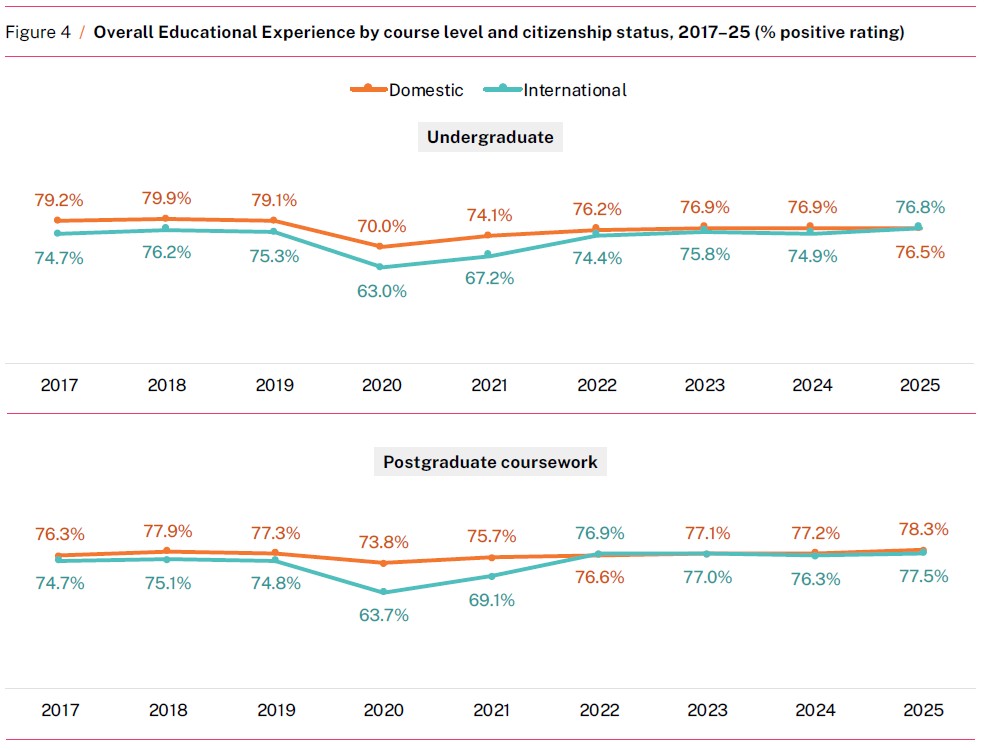
Both were the highest results in the 2017–25 series. However, the undergraduate result was only 0.6 percentage points above the previous high recorded in 2018, while the postgraduate coursework result exceeded its previous high by 0.5 percentage points.
The report describes the results as an all-time high. While accurate, both were only slightly above their previous peaks, and ratings have remained relative stable since 2022.
The survey attracted 116,201 responses from international students at 143 higher education institutions, representing a response rate of 42.6 per cent.
Recovery from the pandemic
International student ratings fell sharply in 2020 before recovering relatively quickly. By 2022, ratings of Overall Educational Experience had returned to around pre-pandemic levels. Since then, they have remained comparatively stable.
International undergraduate ratings are now broadly in line with those of domestic students, at 76.8 per cent and 76.5 per cent respectively. At postgraduate coursework level, international students recorded a slightly lower rating than domestic students: 77.5 per cent compared with 78.3 per cent.
Source: 2025 Student Experience Survey International Report
The report also said international student ratings had reached record levels across all five areas measured by the survey: Teaching Quality and Engagement, Skills Development, Learning Resources, Student Support and Services, and Peer Engagement. Comparisons for Peer Engagement and Student Support and Services should be treated cautiously because the underlying survey items changed in 2023.
A stronger sense of belonging
International students also reported a stronger sense of belonging than domestic students. Among undergraduates, 59.1 per cent of international students rated their sense of belonging positively, compared with 44.9 per cent of domestic students. The gap was wider at postgraduate coursework level, where the respective figures were 62.2 per cent and 39.6 per cent.
The report suggests differences in campus participation may help explain the result. International students are required to undertake at least some study in person, while 14 per cent of domestic undergraduate respondents and 53 per cent of domestic postgraduate coursework respondents were enrolled in courses delivered entirely online.
International students were also less likely to have considered leaving their institution. The proportion fell to a record low of 12 per cent for undergraduates and 12.2 per cent for postgraduate coursework students.
However, the report cautioned that international students may be less likely to disclose that they are considering withdrawing because of the financial investment involved and concerns about possible visa or enrolment implications.
Work experience remains a weak point
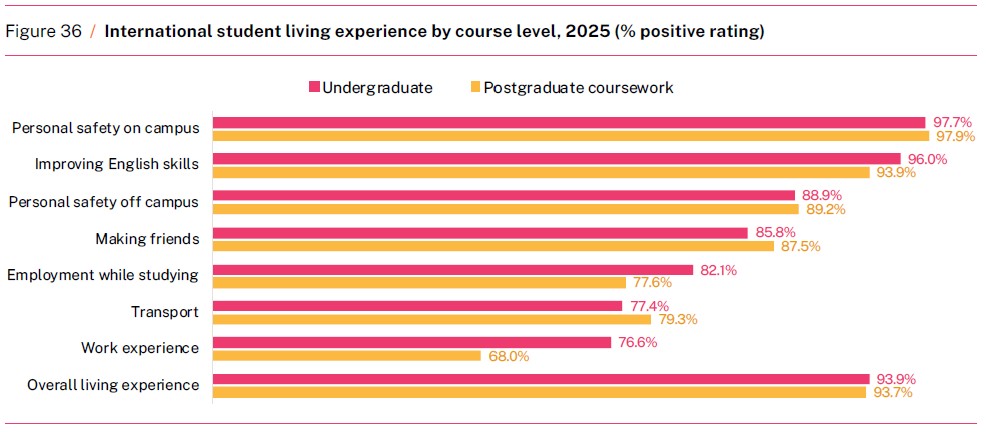
International students remained overwhelmingly positive about living in Australia. Overall living experience was rated positively by 93.9 per cent of undergraduates and 93.7 per cent of postgraduate coursework students. Personal safety on campus received the strongest ratings, at 97.7 per cent and 97.9 per cent respectively.
However, work-related experiences were rated considerably lower. Work experience was the lowest-rated aspect of living in Australia, receiving a positive rating from 76.6 per cent of undergraduates and 68 per cent of postgraduate coursework students.
Source: 2025 Student Experience Survey International Report
Agents play a major role
More than four in five students used an agent for their visa application: 86.7 per cent of undergraduates and 83.6 per cent of postgraduate coursework students.
However, 11.9 per cent of undergraduates and 13 per cent of postgraduate coursework students said they had received incorrect information, and students who reported receiving incorrect information were less positive about their overall educational experience. Their Overall Educational Experience ratings were 11 percentage points lower among undergraduates and 11.8 percentage points lower among postgraduate coursework students.
What do the results say about government policy?
The findings provide a positive picture of the experience of international students already studying in Australia, but they should not be read as an assessment of the impact of the government’s latest migration changes.
The survey was conducted between August and September 2025 and therefore predates a range of measures the government has implemented or announced since that time. It cannot tell us about prospective students deterred from applying, applicants refused visas or students who chose another destination because of Australia’s policy settings.
The report still provides some context for the policy debate. Around 70 per cent of students said the possibility of migrating to Australia was important or extremely important in their decision to study in Australia. However, it ranked below personal safety, the cost of living, the reputation of Australia’s education system, studying in an English-speaking country and experiencing a different culture or lifestyle.
The survey provides evidence of a generally strong experience for current international students. It does not, however, indicate whether prospective students will continue to choose Australia as policy settings become more restrictive.
The full 2025 Student Experience Survey International Report is available here.











