










International education has spent the past few years learning that resilience is not simply about surviving a crisis. It is about building institutions, people and systems that can keep functioning when the next disruption inevitably arrives.
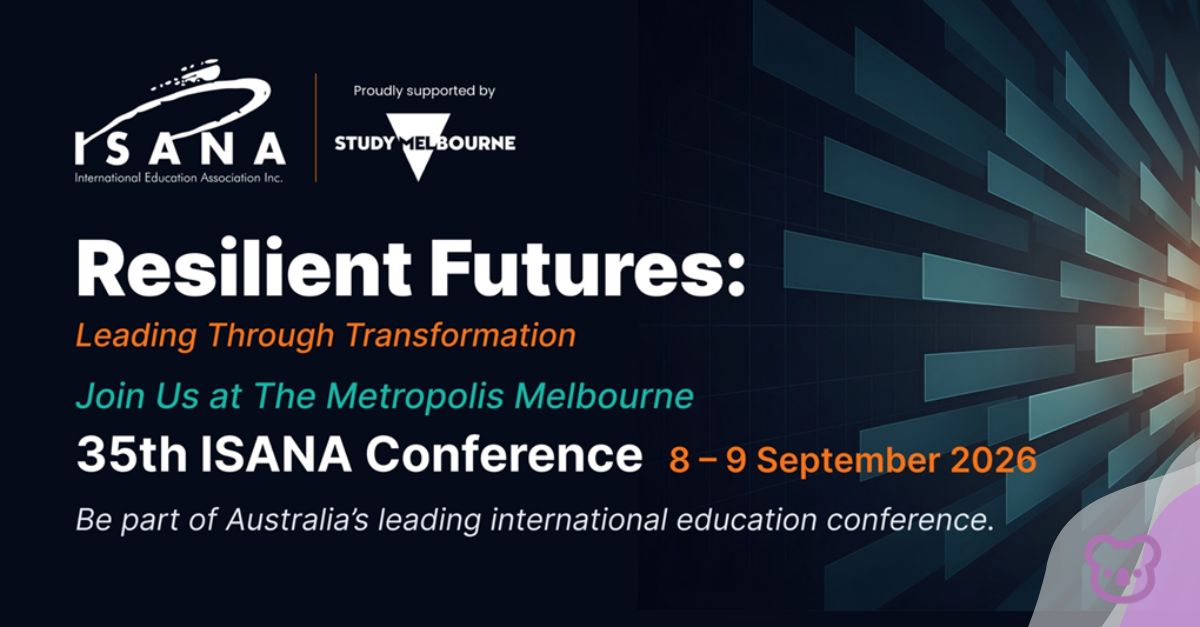
That is the thinking behind the 35th ISANA Annual Conference, which will bring international education leaders, regulators and student services practitioners together in Melbourne on 8 and 9 September under the theme Resilient Futures: Leading Through Transformation.
Proudly supported by Study Melbourne, the conference will take place at Metropolis Melbourne and feature a seven-stream program covering everything from artificial intelligence and student safety to regulation, workforce capability and crisis preparedness.
It is a broad agenda, but perhaps an appropriate one for a sector that has spent the past several years dealing with policy volatility, changing student expectations, housing pressures, technology disruption and growing scrutiny of how it supports international students.
The real test, however, will be whether resilience becomes more than another conference theme.
ISANA National President Annette Kalczynska says the program has been designed to give practitioners and executives practical tools rather than simply another set of discussions about the challenges facing the sector.
“A resilient future for international education requires strength at every layer, from compliant systems and workforce wellbeing to student safety and technological adaptation,” Kalczynska said.
The seven streams reflect just how interconnected those layers have become.
The Resilience, Crisis Preparedness and Sustainable Practice stream will look at crisis readiness, governance of uncertainty, climate adaptation and sustainable service design. The Technology, AI and the Human Future of Education stream will tackle AI ethics, automation, cybersecurity and the growing use of AI copilots by staff and students.
That second theme is particularly relevant. AI is rapidly moving from something universities and education providers are experimenting with to something that is changing the way students learn, communicate and access support. The question for international education is increasingly not whether AI will be used, but how institutions can use it without losing the human connection that remains critical to the international student experience.
The program also turns its attention to the student lifecycle, with a stream focused on innovation in academic and student services. Hybrid orientation, early-alert systems, peer-led learning and co-designed services will feature alongside case studies from institutions working to rethink how support is delivered.
Student safety and inclusion will have its own dedicated stream, covering anti-racism initiatives, safe housing, safeguarding under-18 students and cultural safety.
This is another area where the sector’s language has changed significantly. Student support is no longer simply about providing counselling services or an international student office. Issues such as housing, discrimination, belonging, safety and the ability to navigate unfamiliar systems are increasingly part of the broader institutional responsibility.
The workforce gets its own stream too, with ISANA focusing on capability, professional identity, leadership, high-performing teams and burnout prevention.
That may be one of the more important conversations on the program.
International education regularly talks about improving the student experience, but the people responsible for delivering that experience are themselves operating in an environment of increasing workloads, regulatory complexity and organisational change. A resilient student support system is difficult to build if the workforce delivering it is exhausted or constantly dealing with uncertainty.
The Quality, Regulation and Systems Leadership stream will focus on quality, compliance and governance across increasingly complex regulatory and digital environments, with regulatory insights from the Tertiary Education Quality and Standards Agency.
Jen Bahen, Executive Director of Regulatory Operations at TEQSA, will deliver a keynote, while First Assistant Ombudsman Sarah Bendall will address federal complaint data as part of the Student Safety and Social Justice stream.
The conference will also feature a Trans-Tasman perspective, with Chris Beard, Executive Director of ISANA New Zealand, delivering a strategic keynote on resilience and crisis preparedness.
Digital strategist Bosco Anthony will lead sessions examining AI and student lifecycles, while NEAS and RMIT University will host practical workshops and case studies covering areas including insourcing under-18 care programs, early-alert retention and staff wellbeing.
There will also be a dedicated research stream showcasing supervised doctoral and post-doctoral research aimed at strengthening evidence-informed practice.
There is no shortage of commentary about international education. What remains harder is turning that commentary into practical improvements in the way institutions recruit, teach, support and retain students.
With many international education teams operating under tight fiscal conditions, the association has introduced an Individual Advantage Bundle designed to offset annual membership dues and return a claimed net saving of $241 per delegate to departmental budgets. Four-delegate institutional packages are available for $3,500.
The conference runs from 8 to 9 September at Metropolis Melbourne.
For more information and to register, see here.











