











The Indicative International Student Profiles as proposed for 2025 were tabled by government to parliament last Friday. They were curiously spread across two tables making trend comparisons difficult.
After some deft cutting and pasting, it was possible to align the data to look at the winners and losers of the cap allocation outcomes.
The table below summarises:
- 40 Australian universities by their grouping, including the two largest private universities, Torrens and Bond, that had been included in a separate table.
- The remaining 157 non-university higher education providers and private universities.
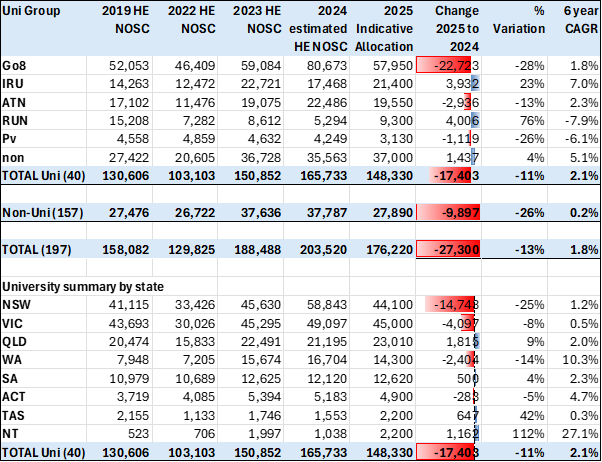
Go8 – Group of Eight, IRU – Intensive Research Universities, ATN – Australian Technology Network, RUN – Regional University Network, Pv – Private, non – not aligned.
Assuming the bill is passed in its current form and these indicative numbers are implemented, overall, a 13% decline in Net Overseas Student Commencements (NOSC) is forecast for 2025, bringing commencements below 2023 levels, although still well above 2022.
As foreshadowed, the Group of Eight will bear the brunt of the decline amongst the universities and a significant decline (actual and percentage) in the non-university sector.
An annual growth rate of 1.8% since 2019 is running well below the global average of circa 6%.
What is apparent from the data is that over the period, UNSW had become ranked first in 2024 with 17,359 NOSC, slightly ahead of USYD with 17,247. Their 2025 caps will be reduced by 7,859 and 5,347 respectively, representing 76% of the university sector reduction and 48% overall.
Consequently, NSW is the state with the most negative impact, followed by VIC where UMEL and Monash share a decline of 5,139 NOSC. In WA, UWA represents 88% of the cut, with a little lopped off Curtin’s growth streak.
Meanwhile, the foreshadowed Robin Hood strategy of taking from the city and giving to the regions results in a mere increase of 4,006 students from 2024 amongst the regional universities. This is still only 61% of the peak in 2019. Yet will these students attend a regional campus or a branch campus in a city – something which the government has signalled it is wanting to address in future cycles.
Flinders (IRU), La Trobe (IRU), Charles Darwin (non), James Cook (IRU) are the top four “winners”, with their caps set at the highest levels since 2019.
In the non-university sector, Group Colleges Australia Pty Ltd and Holmes Institute Pty Ltd are losing over 1,000 students each, closely followed by Proteus Technologies Pty Ltd. These three providers alone, out of 157 listed, represent 37% of the decline. It will take a little longer to undertake the state-based analysis for this segment, but it looks to be Sydney, Melbourne and Brisbane that will experience the cuts.
Solving the immigration problem seems to be unfairly limited to only a few providers.