


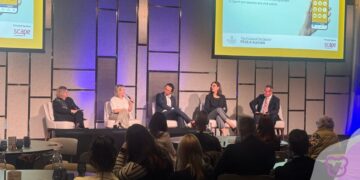









Last week, the new destination marketing body Experience Gold Coast board was announced.
The board is:
Chairperson:
The Hon Rob Borbidge AO – former Premier of Queensland, former member for Surfers Paradise, Chair of Study Gold Coast, Chairman of Life Flight, Senior Advisor for Govstrat Pty Ltd.
Directors:
Jackie Cross – Major Events Gold Coast board of directors, Director Cross Promotions International
Louise Bezzina – Artistic Director Brisbane Festival and former CEO and Artistic Director of Bleached Arts Ltd (Placemakers).
Clark Kirby –Destination Gold Coast and Major Events Gold Coast Board of Directors Chief Executive Officer & Managing Director of Village Roadshow Group.
The Hon Kate Jones – former Minister for State Development, Tourism & Innovation, Executive Director for Tech Council of Australia, Independent Commissioner on the Australian Rugby League Commission.
Adam Twemlow – Destination Gold Coast board of directors, Partner in Charge KPMG Enterprise division in Queensland, New South Wales & Victoria.
Danielle McFall-Weiss – HOTA Board of directors, Queensland Ballet Board of directors, Arts Manager.
Rebecca Frizelle OAM – former Chief Operating Officer Frizelle Sunshine Automotive, Co-owner Gold Coast Titans. Destination Gold Coast board of directors
The Koala is impressed with the calibre of appointees.
However, one question the Koala has is where does Education sit in the priorities of the new entity? Nationally education has been the powerhouse of Tourism spending. March figures from Tourism Research Australia confirm this (The Koala 19/7/23) and when extrapolated International Education is 3.8 times larger than Tourism, which moves to $7.013b from $0.412b in 21 (The Koala 10/7/23). Though the Gold Coast does have a unique profile.
Economic contribution figures for a region are hard to compute and the Koala is not an economist. In saying that, Study Queensland quarterly snapshots state that Feb YTD saw 17,584 students enrolled in the Gold Region. The Same data set for Apr YTD stated 22,064 while End of December 22 showed 25,312 students – which will no doubt be up for 2023.
With an average spend of AUD$44,000 based on the fact In 2022, about 600,000 international students in Australia spent $26.590 billion in fees and living expenses. This is an average $44,000 per student, likely being made up of $19,000 in fees and $25,000 in living expenses.
This would equate to
Using Feb YTD – AUD$773.7m annual contribution.
Using Apr YTD – AUD$970.8m annual contribution
Using Dec 22 Year End – AUD$1.1b
It should be noted the Gold Coast does lean more toward ELICOS programs making somewhere between the YTD Feb data and YTD Apr data, applied annually more in the ballpark. This considers shorter-term students cycling out and counted not as annual contributors but as a rough ratio of annual contributors.
Destination Marketing bodies
Destination Marketing bodies are typically a good way to showcase a specific region and make space for the key messaging of a sector in a place, most states have them – thinking Study Qld, Study NSW etc, and some regions and cities follow suit.
The Gold Coast appears to have gone the other way. Combining sectors under one umbrella.
The move will result in about $6.8 million in direct savings for the City each year which will be reinvested into the entity for tourism, events, arts and education outcomes, states a press release that can be seen here.
Gold Coast Mayor Tom Tate states “We need an overarching strategy, a better governance structure and more alignment. We don’t need multiple boards, multiple visions and duplication of effort.
“The work we need these entities to do is too important. We need them to be one team, heading in the same direction, together.” He said.
Good oh. But for an education sector whose spend per head far outweighs a tourist and clearly requires messaging other than fun in the sun on the GC this may be a challenge of which the proof will be in the pudding.