










Australia’s international education sector might be tightening its visa belt, but the cranes building student accommodation clearly haven’t received the memo.
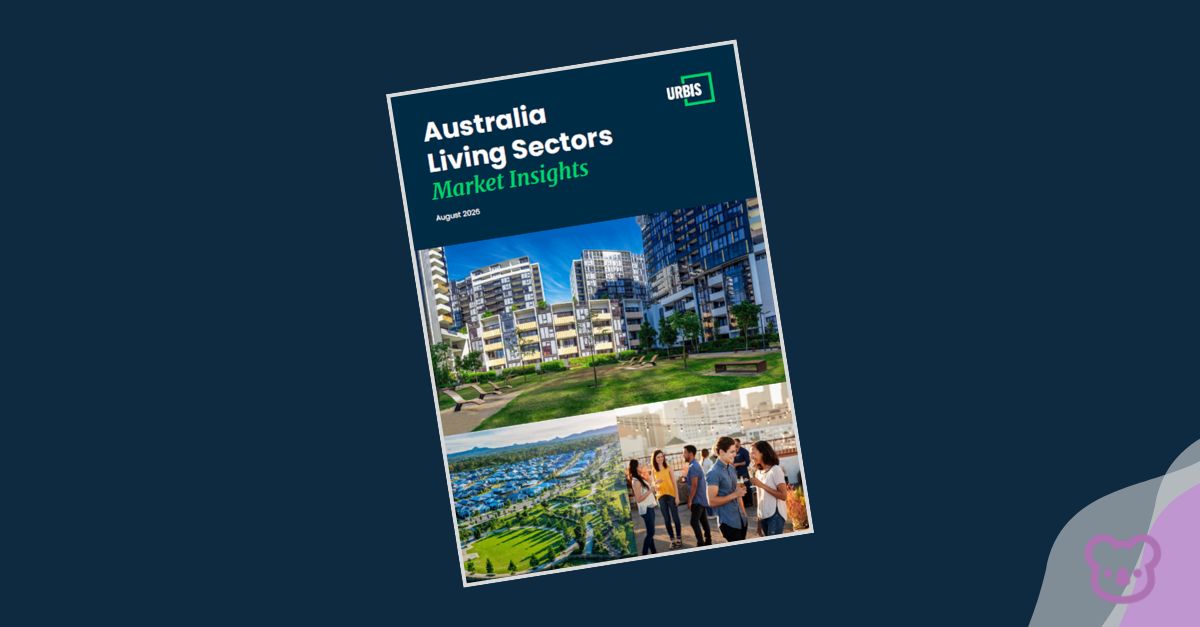
The latest Australia Living Sectors Market Insights report from Urbis paints an interesting picture of the Purpose Built Student Accommodation (PBSA) market: 47,600 beds are currently between development application and construction.
And while visa settings are undoubtedly creating uncertainty, the fundamentals of student accommodation remain robust. Urbis reports that occupancy rates in capital city PBSA were strong in Semester 1 2026.
Which is another way of saying that, whatever Canberra is doing with student visas, the students who actually make it to Australia still need somewhere to live.
And that isn’t in a three-bedroom rental with five strangers.
A pipeline that refuses to slow down
Of the 47,600 beds in the pipeline, 16,550 are already under construction, with Brisbane and Perth accounting for almost half of that construction activity.
That tells us something about where developers see the next opportunities.
Both cities have growing university populations, tight rental markets and increasing pressure on conventional housing. PBSA is increasingly being treated less as a specialised student product and more as part of the essential housing infrastructure supporting a university city.
Urbis says activity continues to be strongest in inner-city locations targeting students from Group of Eight universities.
The premium end of Australia’s international education market continues to look considerably healthier than the broader market. Universities with powerful brands, diversified source markets and strong domestic demand appear better positioned to ride out the current visa turbulence.
The latest developments reinforce the point.
UniLodge Brisbane City at 41 George Street is delivering 1,182 beds, making it Brisbane’s first PBSA completion since 2022. New supply is also coming online in Macquarie Park, Melbourne and the Gold Coast.
So, while the broader international education sector is obsessing over visa approvals, developers are continuing to put hundreds of millions of dollars into places for students to live.
The visa problem hasn’t gone away
Of course, there is a fairly large elephant sitting in the PBSA common room.
Visas.
The Government lifted the 2026 New Overseas Student Commencement allocation to 161,300 places. But by 7 August, only around 107,500 student visas had been approved.
That’s a gap of approximately 53,800 students between the number Australia says it is prepared to accommodate and the number of visas actually approved.
For accommodation operators and investors, it is a sizeable chunk of potential demand.
PBSA is growing up
There is another story buried in the Urbis numbers.
PBSA is becoming a serious institutional asset class.
It increasingly sits alongside build-to-rent, co-living and other residential sectors competing for institutional capital. As investors become more familiar with the living sectors, PBSA is benefiting from the growing recognition that student accommodation can provide relatively resilient demand and long-term income.
Urbis describes the sector as “rapidly maturing into an institutional asset class”, with specialised and offshore capital driving first-time investments.
That is a long way from the days when student accommodation was regarded as something of a specialist niche.
Transactions involving operators such as Weave, along with offshore-backed investment in Sydney’s student accommodation market, demonstrate that sophisticated investors are increasingly comfortable with the proposition.
And why wouldn’t they be?
Australia has a large university sector, an enormous international education industry and some of the world’s most expensive conventional rental markets.
Students still need beds.
The interesting story here isn’t simply that Australia is still building student accommodation.
It’s why investors are still willing to build it while government policy is making the underlying student market harder to predict.
PBSA sits at the intersection of three markets: international education, higher education and housing.
Universities need it because students who can’t find affordable accommodation may choose another destination or another university.
Cities need it because every student living in purpose-built accommodation is one less person competing for a conventional rental property.
Students need it because finding a safe, affordable and reasonably located place to live has become one of the biggest challenges of studying in Australia.
And investors need it because, despite the policy noise, the underlying demand hasn’t disappeared.
That’s the bet being made in Brisbane, Perth, Sydney and Melbourne.
The PBSA sector appears to be betting that today’s visa settings won’t permanently change Australia’s position as a major international study destination.
That may prove to be a very good bet.
But there is a warning here for policymakers.
You can regulate student numbers. You can increase visa fees. You can tighten approval rates. You can introduce allocation systems and decide which providers get access to international students.
What you can’t do quite so easily is separate international education from the infrastructure that has grown around it.
Australia has spent years encouraging billions of dollars of private capital into student accommodation. Those investors are now building the physical infrastructure of the international education system.
The cranes are effectively saying something the visa data isn’t:
They still believe students are coming.
The question is whether Australia’s policy settings will allow enough of them to arrive to fill all those beds.
Read the report here.












