













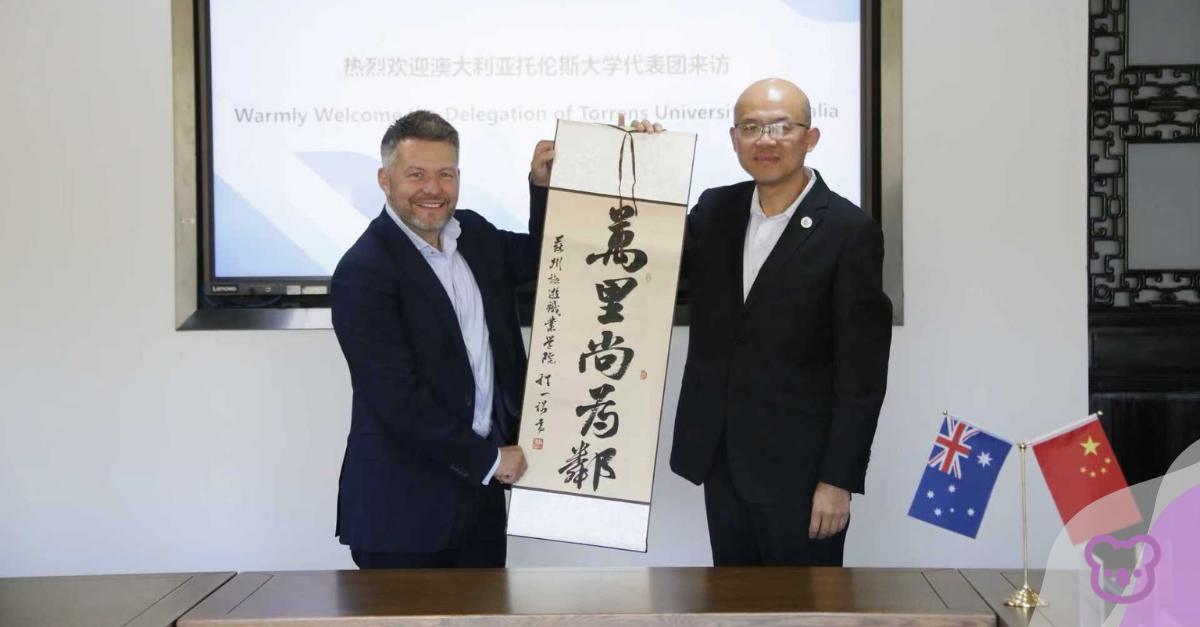
At a time when many institutions are recalibrating their international ambitions, Torrens University Australia is leaning into a strategy built less on volume and more on deliberate, long term positioning.
A recent visit to Suzhou by Vice President Future Students and Growth Rob McGowan and Country Director Greater China Ethan Duan has placed that approach into focus, with discussions underway to re establish the BMIHMS China campus in partnership with Suzhou Tourism College.
The move carries both symbolic and strategic weight.
It reconnects with a partnership legacy more than two decades in the making, when the Blue Mountains International Hotel Management School played a formative role in shaping hospitality talent in the region. It also points to a broader institutional reading of where international education is heading.
Rather than treating offshore engagement as a hedge against domestic uncertainty, Torrens appears to be framing it as core strategy.
That matters in the current environment.
With policy settings tightening, visa settings under scrutiny and governments placing greater emphasis on system integrity and sustainability, many providers have been forced into reactive mode. Torrens is presenting something different, arguing the response should be adaptation rather than retreat.
McGowan has been clear that the university’s international strategy is anchored around quality over quantity, diversity over dependence and sustainability over short-term growth. In practice, that has meant a sharper focus on offshore recruitment, lower-risk markets, and deeper academic partnerships, while moving away from models reliant on onshore conversion.
China sits prominently in that recalibration.
Around 500 new Chinese students join Torrens each year, and the ambition is to double that number over the next five years. In a sector conversation often dominated by diversification away from major markets, Torrens is making a more nuanced case. Diversity and engagement with China are not mutually exclusive. For some institutions, the future may depend on understanding both.
The Suzhou discussions reflect that logic.
A revived China campus would extend brand presence, deepen partnership infrastructure and potentially create a new offshore pipeline aligned to a more selective and sustainability-focused era of student mobility.
It also arrives at a moment when BMIHMS has regained momentum internationally, including recent recognition in the QS rankings, reinforcing the institution’s standing in hospitality education at a time when reputation matters more than ever.
There is a broader signal here for the sector.
Much of the current debate has centred on constraints. Caps, compliance and risk have dominated the narrative. What tends to receive less attention is how some institutions are repositioning through those same pressures.
Torrens’ China play appears to be one such example.
Rather than seeing tighter policy as a brake on ambition, the university is treating it as a filter through which quality institutions can differentiate more clearly.
That may prove prescient.
As the system becomes more selective, international growth may increasingly favour providers able to pair strong student outcomes with credible global partnerships and disciplined market strategy.
The Suzhou talks are still exploratory, but they point to a bigger proposition.
In a period defined by caution, Torrens is making the case that international strategy can still be expansive, provided it is built on integrity, partnership and patience.
For a sector often focused on the next intake cycle, that kind of long-horizon thinking stands out.












