













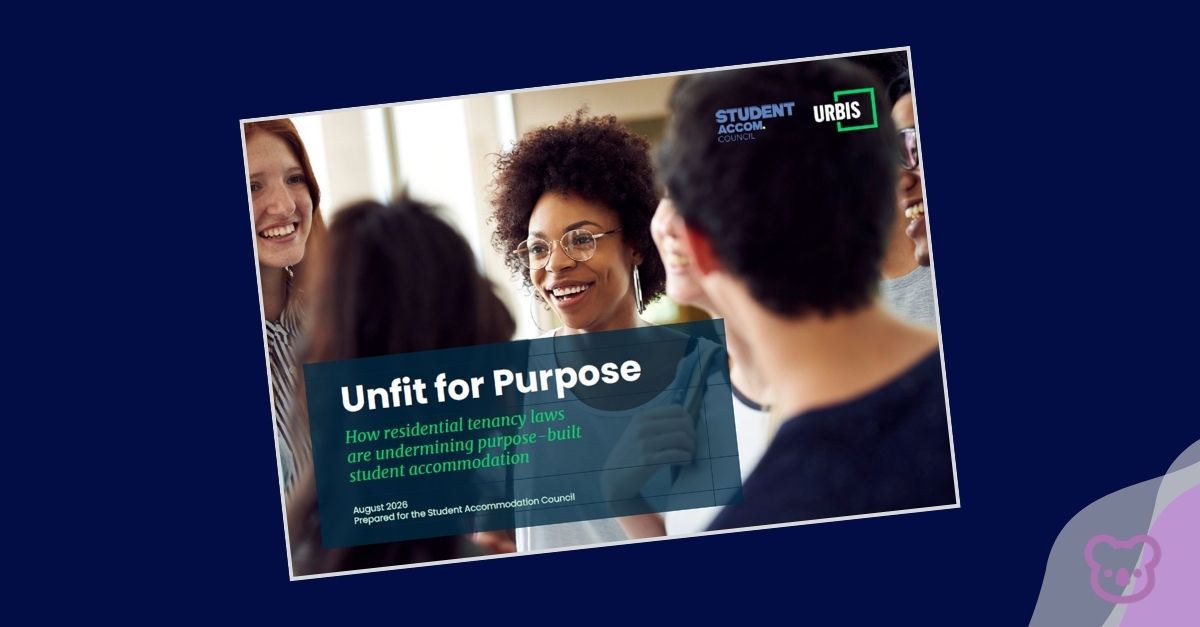
Australia’s growing shortage of student accommodation is at risk of becoming a self-inflicted problem, with tenancy laws designed for the conventional private rental market threatening to undermine investment in purpose-built student accommodation (PBSA), according to a new report from Urbis and the Property Council of Australia.
The report, Unfit for Purpose, argues that tenancy legislation in Queensland, New South Wales and Victoria is increasingly being applied to PBSA without properly accounting for the very different way student accommodation operates.
PBSA is one of the few forms of housing that can add substantial numbers of beds specifically for students, potentially taking pressure off the wider private rental market. Yet the report warns that poorly targeted regulation is making new projects less attractive to investors at precisely the time Australia needs more supply.
There are currently almost 70,000 privately provided PBSA beds in Australia, supporting a sector that is itself a critical part of the country’s $55 billion international education industry. More concerning, however, is the pipeline. Of the approximately 47,000 approved PBSA beds, around two-thirds have yet to commence construction.
Property Council Chief Executive Mike Zorbas said governments risked worsening the housing shortage by treating student accommodation as though it were simply another form of private rental housing.
“Without proper targeting, these laws are chilling new investment interest in this higher quality accommodation that can drive the cost of renting down for everyone,” Mr Zorbas said.
The argument is relatively straightforward. A student who moves into a purpose-built student apartment is, theoretically, one less person competing for a room or apartment in the conventional rental market.
That makes PBSA a particularly attractive form of housing supply from a policy perspective. It is not simply adding another dwelling to the market; it is adding accommodation targeted at a demographic that is heavily concentrated in some of Australia’s most supply-constrained rental markets.
But the economics of student accommodation are different from those of a conventional apartment block.
Students generally arrive and leave according to academic calendars, creating highly predictable but concentrated periods of demand. A room that becomes vacant halfway through a semester cannot necessarily be filled by another tenant within weeks, as might happen in the broader rental market.
That distinction has become particularly important in New South Wales.
The Urbis and Property Council report identifies NSW as a warning for other jurisdictions, arguing that break-lease provisions have shifted vacancy risk onto PBSA operators and weakened investor confidence.
Victoria is now moving in a similar direction.
Victoria’s new break-lease legislation has passed Parliament, prompting the Property Council to warn that the state could make it harder to attract investment into new student accommodation.
For a state already carrying significant debt and facing substantial housing pressures, the concern is that legislation intended to protect renters could inadvertently make it more difficult to build the additional accommodation those renters need.
The problem is not necessarily the principle behind stronger tenancy protections. It is whether those protections are designed with the realities of student accommodation in mind.
The report makes a similar argument about Queensland, where room-based rent increase rules can prevent operators from resetting rents when a room changes occupants. The restriction can mean a discounted rent offered to one student remains in place for a subsequent tenant for up to 12 months.
Again, a rule that may make sense in the conventional rental market can have very different consequences in a student accommodation environment where leases, pricing and occupancy are structured around academic cycles.
This is where the broader policy debate becomes important.
Australia is simultaneously trying to increase housing supply, manage rental affordability and arguably, maintain the international education industry as a major export sector. PBSA sits directly at the intersection of all three.
International students become dependent on the private rental market when universities and private providers cannot offer enough purpose-built accommodation, and they do not have families locally to board with. In cities such as Sydney and Melbourne, that can put additional pressure on an already constrained supply of rental rooms and apartments.
The irony is that governments can therefore end up making PBSA more difficult to build while simultaneously trying to reduce the housing pressures that PBSA could help alleviate.
The report also points to another emerging regulatory complication.
The National Higher Education Code to Prevent and Respond to Gender-based Violence 2025, while broadly welcomed, can create tensions with state tenancy legislation when applied to student accommodation.
The Property Council and Student Accommodation Council argue that these overlapping obligations should be better integrated rather than forcing PBSA operators to navigate a patchwork of rules developed for different purposes.
Western Australia provides a contrasting example.
According to the report, WA is working with industry on a more tailored regulatory framework for student accommodation, recognising the sector’s operating characteristics and its potential contribution to housing supply.
That approach may offer a useful lesson for other states.
Rather than asking whether PBSA should be subject to tenancy protections, the more useful question is what those protections should look like when applied to accommodation built specifically around the student lifecycle.
This is important because the alternative is not necessarily more student protection or better housing outcomes. It could end up being less investment.
The Property Council says the Federal Government also has a role to play, arguing that all 140,000 student accommodation beds should be included within the national definition of housing.
That may sound like an administrative issue, but definitions matter when governments, lenders and investors are making decisions about housing supply and financing.
If PBSA is treated as a peripheral category rather than a legitimate component of Australia’s housing system, the sector can face additional barriers to financing new developments.
The stakes are therefore considerably larger than a dispute over individual tenancy provisions.
More PBSA can mean more accommodation specifically for students, less pressure on the broader rental market and better living conditions for students. But that only happens if the projects actually get built.
And that brings the debate back to the pipeline.
With two-thirds of the 47,000 approved PBSA beds yet to commence, Australia already has a significant amount of potential supply sitting on paper.
The policy challenge now is to make sure regulation does not turn that approved pipeline into a stranded pipeline.
As Zorbas put it: “Sydney needs more student housing, not policies that push investment away.”
The report can be downloaded here.












