











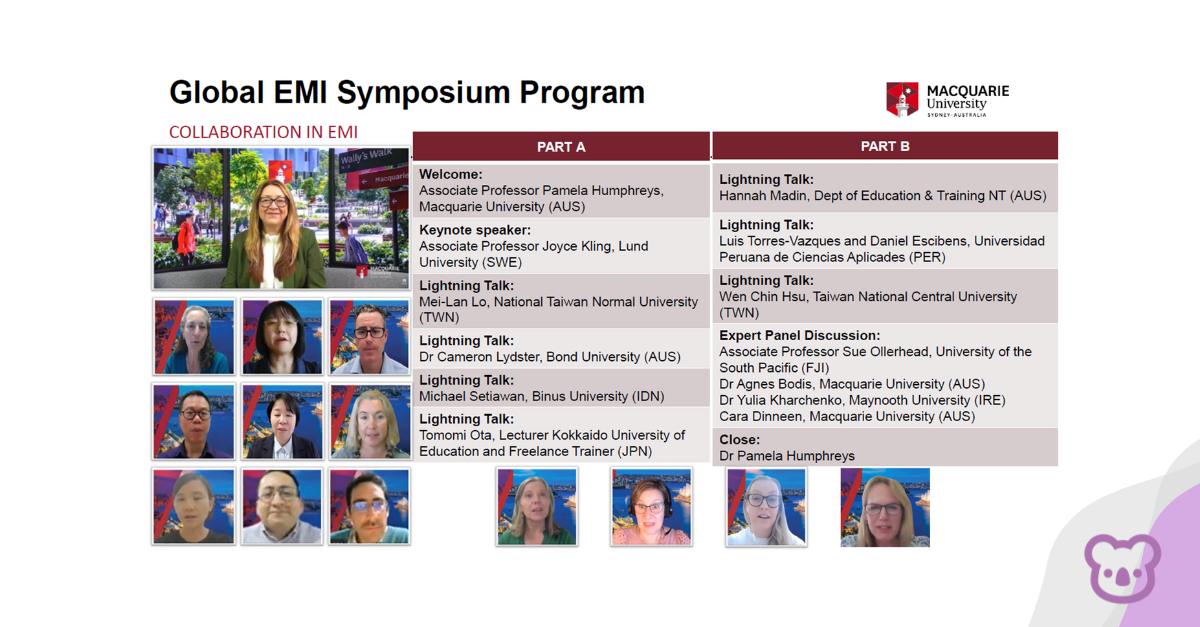
English is no longer just a subject – it’s the medium through which content is being taught in many classrooms and lecture theatres from Hanoi to Helsinki. But as the global shift toward English Medium Instruction (EMI) accelerates, are educators and students truly prepared for the change? The Macquarie English Medium Instruction (EMI) Centre delivered a free online global EMI Symposium on 23 October, themed Collaborations in EMI, bringing together an international line-up of experts and practitioners to share research, practice and experiences as a way to address some of the challenges.
What is EMI?
For those unfamiliar with the term, EMI is typically explained as the use of English to teach subjects other than English in locations where English is not the first language of the majority of the population, and where other languages have traditionally been used (see Macaro, 2018 and McKinley, 2025). Let’s say, a Vietnamese academic is delivering their engineering content in English at a university in Vietnam either to local students or to both local and international students.
This is not ELICOS or TESOL so brace yourself for some more acronyms. In its purest form, EMI involves the delivery and assessment of content in and through English without explicitly teaching or assessing the language. In reality, the situation is far more nuanced and it is certainly not a monolithic concept. Related terms and approaches include EMEMUS (English-Medium Education in Multilingual University Settings) (Dafouz & Smit, 2016), CLIL (Content and Language Integrated Learning), and the what-it-says-on-the-tin English-taught Programs (British Council/Studyportals, 2024).
Regardless of the variation or definition (and there’s a whole literature on the lack of definitional clarity), it is undoubtedly a growing phenomenon globally, and particularly evident in Asia Pacific in schools and universities. By last year, 240,000 programs were taught in English worldwide at over 3,500 higher education institutions (British Council/Studyportals, 2024), and there has been a six-fold increase in research outputs since 2018 (Rose et al., 2025).
Drivers for adopting EMI
The drivers for adopting EMI are numerous and heavily linked to internationalisation agendas: from the altruistic (nation-building; mobility; global citizenship) to the more commercial (attracting international students and/or faculty staff; improving rankings). The rational for switching to English is typically well-intentioned. Sadly, though, such top-down policy changes – whether at the institutional, provincial or national level – can be made without due consideration of the impact on the two key stakeholders: educators and students.
Key challenges with EMI
In some contexts, educators have adequate English proficiency to undertake research and to publish, but the work of teaching and developing content and assessments in English requires a different skill set. This is where some come unstuck. In extreme cases, there have been tales of attempted suicides by academics who feel unprepared to pivot to teaching in English as a result of top-down policy changes.
Similarly, there is often minimal consideration of the students’ level of English proficiency and their (in)ability to engage with complex concepts in a language that is not their first. Translanguaging (a pedagogical approach whereby the first language and English are purposefully selected at different stages of a lecture/class) may be discouraged or misunderstood as a critical pedagogical stance that can support learning as well as minimise the potential ‘domain loss’ of the home language. Often there is no tracking of student outcomes when changing the medium of instruction to English, yet research has shown that pivoting to English can result in the dumbing down of content and poorer student outcomes. Instead of the hoped-for double positive of content and English acquisition, EMI can result in a double negative if enacted poorly. Literature reviews show that language challenges persist in many EMI contexts (Rose et al., 2025), especially in academic writing.
Collaborative solutions
So how can we ‘do’ EMI better? It’s clear that EMI can be a positive if well-managed. With consideration of the actual language levels of educators and students, and a realistic, well-considered strategy for implementation that includes capacity-building in language and methodology for educators, it can yield benefits. We have focused on these topics in our previous symposia.
A further solution is through meaningful collaboration between language experts and subject matter experts. Partnerships between institutions, cross-cultural teaching teams, and multilingual pedagogical strategies can enhance student learning outcomes. Language professionals have much to give, and this is why we chose collaboration as the focus of this year’s symposium.
Highlights from the symposium
The keynote speaker, Associate Professor Joyce Kling, provided a typology of collaboration, and practical examples of targeted CLIL in EMI contexts. The Lightning talks from practitioners from Taiwan, Japan, Indonesia, Peru, and Australia spoke to collaboration in action in their contexts, the need for dialogue, scaffolding, and the preparation of students for content and assessments.
A highlight of the symposium was the panel discussion with Dr Agi Bodis, Associate Professor Sue Ollerhead and Dr Yulia Karchenko, facilitated by Cara Dinneen, which drew together the discussions. Panellists shared insights into collaborative strategies between language and content experts, the importance of contextualising EMI within local educational cultures, and the need for flexible pedagogical approaches such as translanguaging. They noted that collaboration starts when educators are able to self-reflect and focus on more student-centred methodologies. The conversation highlighted both the challenges and successes of EMI adoption, emphasising the value of cross-institutional partnerships, ongoing professional development, and inclusive policymaking to ensure that EMI enhances student outcomes. Practical tips were provided on how to mobilise and share good practice through an ecosystem of grassroots approaches including CoPs; practice-based inquiry; action research; membership of relevant associations; conferences/events, and by undertaking formal programs of study in EMI.
Looking ahead
EMI is happening whether we like it or not. Our work at the Macquarie EMI Centre aims to support those navigating EMI, CLIL and bilingual education policies to yield the best possible outcomes for educators and learners through bespoke programs, asynchronous microcredentials, and free access to our symposia and Papers in EMI Practice and Pedagogy. The latest proceedings will be published in the upcoming months but, in the meantime, you can watch the 2025 symposium here.
Associate Professor Pamela Humphreys is the Director and Founder of Macquarie University’s EMI Centre, the region’s first to focus exclusively on English Medium Instruction and its associated practice through a suite of programs endorsed by NEAS, and an MoU with the ASEAN Universities Network (AUN). Pamela publishes on EMI and leads capacity-building and consultancy events nationally and internationally. She will be presenting next on EMI at the ASEAN Australia Education Dialogue (AAED) and NEAS 2025 Conference in Penang, Malaysia, on 1 December 2025.











