












Over the past five years, the nature of the conversation between international education counsellors, prospective students, and their families has fundamentally transformed. Where discussions once centred almost exclusively on rankings, admission requirements, entry scores, and campus locations, the primary focus has now shifted downstream to a much sharper question: “What will this qualification actually deliver in the labour market?”
International education represents one of the largest financial investments a family will ever make. As economic pressure increases globally, students are no longer simply selecting an academic destination—they are choosing a career trajectory.
The Data Behind the Shift
This evolution in student decision-making is clearly documented in recent sector research:
- ICEF Agent Voice Survey: Education advisers rated the importance students place on employment opportunities when evaluating study options at 7.56 out of 10, confirming career outcomes as a dominant decision driver.
- OECD Labour Market Analysis: A recent OECD study across six major study destinations revealed that international students remain significantly under-informed regarding local hiring expectations, language requirements, and sector shortages. Simultaneously, institutions can sometimes present graduate employment outcomes in broad, uncontextualised terms with different timeframes associated with outcomes.
This creates a clear challenge for front-line advisers. Institutions flood agency networks with diverse metrics—graduate employment rates, university rankings, work-integrated learning opportunities, and industry partnerships. However, without a standardised framework to evaluate and compare these claims across different destination markets, counsellors can struggle to separate marketing narrative from labour market reality.
Moving Beyond Admissions to Career Outcomes
To address this critical knowledge gap, Successful Graduate has partnered with ICEF to launch The Understanding Employability Course for Education Counsellors.
Delivered as a fully online, self-paced professional development programme in partnership with the ICEF Academy, the course equips education advisers with a structured framework to evaluate and communicate employability indicators. It provides counsellors with the analytical tools needed to:
- Understand Institutional Claims: Understand what graduate outcome statistics, employability rankings, and career service models actually mean for different student cohorts.
- Navigate Labour Market Realities: Connect academic course selection directly with shortage occupations, graduate recruitment cycles, and employer expectations across the top 10 major destination countries.
- Build Long-Term Trust: Elevate student consultations from transactional admissions support into authoritative, data-backed career strategy sessions.
Turning Insight into Action: The Global Employability Dashboard
Professional development is most effective when paired with practical, day-to-day utility. To ensure advisers can apply these concepts directly in student counselling sessions, enrolment in the course automatically grants agents with exclusive access to the Agent Resource Hub and the live Global Employability Dashboard which refreshes labour force data from multiple sources daily.
Built as a responsive visual telemetry engine, the dashboard provides advisers with real-time macro-employment data across the top 10 global destination markets (including Australia, the UK, the US, Canada, Germany, New Zealand, Singapore, Ireland, France, and Japan).
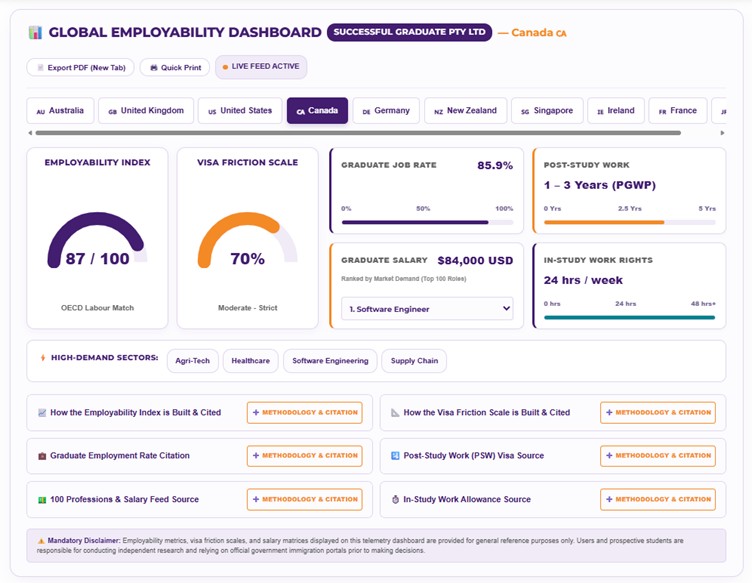
Key Telemetry Included on the Hub:
- OECD Employability Strength Index: Evaluates tertiary graduate workforce absorption and high-skilled job alignment across markets.
- Student Visa Friction Scale: Quantifies visa processing complexity, financial proof thresholds, and approval probability on a 0%–100% scale.
- 100 Demand-Ranked Professions & Salaries: A categorised selector detailing starting salary medians across Tech & AI, Engineering, Healthcare, Finance, and Public Policy—ranked strictly by local market shortage volume.
- Work Rights & Policy Parameters: Clear numeric meters outlining in-study working caps (e.g., 48 hours per fortnight) and post-study work (PSW) visa durations.
- Co-Branded 1-Page PDF Generator: Counsellors can instantly generate a single-page, co-branded PDF summary featuring their own Agency Business Name to hand directly to students or parents during consultations.
- Other features: The Hub is designed to be updated and refreshed frequently, providing education agency counsellors with real time data sources that can lead to informed employability discussions with students and their parents.
Access to this live dashboard engine and the broader Agent Resource Hub is restricted exclusively to agencies and counsellors who undertake the training.
Elevating the Counselling Profession
As international education becomes more competitive, agency differentiation will no longer be driven by destination familiarity alone. The most trusted advisers will be those who can connect educational choices directly to workforce realities with transparency, accuracy, and independent data.
I’ve been waiting for a long time to launch this innovation and bring about real change in the way employability is introduced to the ROI discussion with families at the top of the funnel. Kudos to ICEF for partnering with us to launch this course globally.
Understanding Employability Course overview:
Learn more about the course here.












