









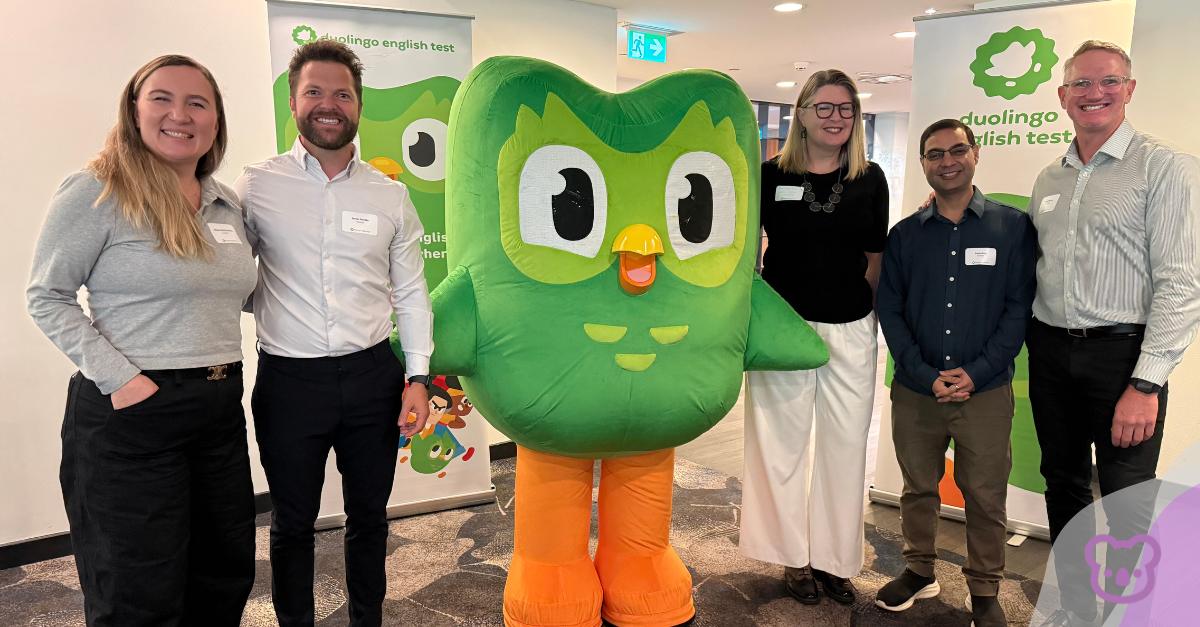
The future of English language testing is being quietly renegotiated in seminar rooms rather than policy chambers, if a recent three-city tour by Duolingo is anything to go by.
Across Sydney, Melbourne, and Brisbane, the Duolingo English Test gathered a cross-section of admissions leaders, researchers and assessment specialists for a Masterclass Series that signals something more than professional development. It points to a sector trying to get ahead of a problem it can no longer contain.
At the centre of the conversation was a simple but uncomfortable truth. Artificial intelligence is already embedded in the way students learn and, increasingly, the way they are assessed. The question is no longer whether to respond, but how.
In Sydney, Professor Cath Ellis from Western Sydney University set the tone. Her argument was direct. Chasing misconduct through detection is a losing game. Redesigning assessment to reflect authentic learning is the only sustainable path forward. It is a position that cuts against years of institutional instinct, where integrity has often meant surveillance rather than structure.
In Melbourne, the focus had shifted from principle to practice. Professor Therese Hopfenbeck of the University of Melbourne framed the challenge as one of balance. Innovation in testing is inevitable, but without methodological rigour it risks undermining the very standards it seeks to modernise. Her experience advising bodies like the OECD and UNESCO added weight to a message the sector has heard before but not always acted on.
In Brisbane, Associate Professor Mark A. Bassett from Charles Sturt University brought it back to institutional reality. Universities, he suggested, are now operating in an environment where technological disruption is outpacing governance frameworks. Maintaining trust requires assessment systems that are not only fair, but defensible.
Running through each discussion was the growing presence of the Duolingo English Test itself. Once seen as more accessible to traditional English testing, it is increasingly presenting as something more ambitious. A partner in shaping how assessment evolves.
According to Brett Blacker, Managing Director ANZ for Duolingo, the pace of change has outstripped any single institution’s ability to respond in isolation. The logic of convening is therefore as important as the content. Bring together academic leaders, platform engineers and assessment scientists and a shared framework might begin to emerge.
That framing matters. English language testing sits at the front door of international education. It determines who gets in, how quickly, and at what cost. For a system like Australia’s, where access and integrity are in constant tension, the stakes are unusually high.
The Masterclass Series also served as a reminder that the politics of assessment are shifting. Accessibility is no longer a secondary concern. With results delivered in under 48 hours and at a lower price point, digital-first models like DET are positioning themselves as both efficient and equitable. Whether regulators and institutions fully accept that framing remains an open question.
What is clearer is that the sector is beginning to converge around a new centre of gravity. One where AI is not treated solely as a threat to integrity, but as a tool that can expand access if used well. The risk, as always, is that the rhetoric moves faster than the reform.
For now, the conversations are happening in rooms like these. Quietly, incrementally, and with just enough consensus to suggest that change is no longer hypothetical.












