












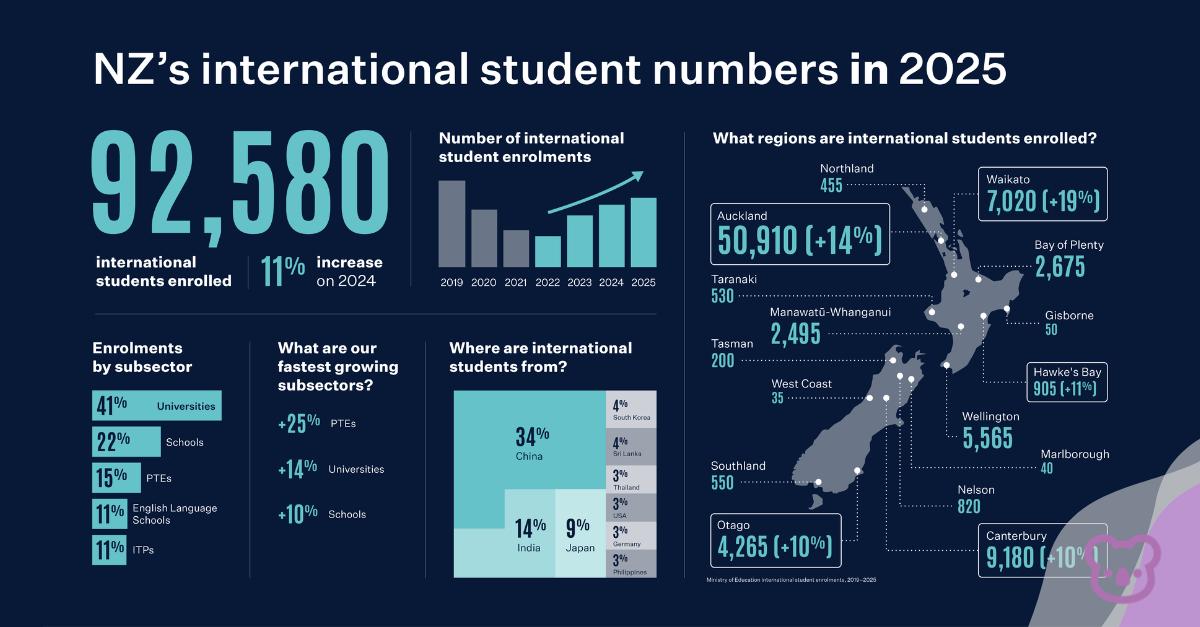
New Zealand’s international education sector continues its steady rebuild, with new data from Education New Zealand showing international enrolments climbed to 92,580 students in 2025, up 11 percent on the previous year.
The result places the sector at around 80 percent of its pre pandemic peak and reinforces the sense that New Zealand has moved from recovery mode into a new phase of competitive repositioning.
For a country often overshadowed by larger study destinations such as Australia, Canada, the United Kingdom and the United States, the latest figures suggest New Zealand’s smaller scale may actually be working in its favour.
At a time when policy volatility, visa uncertainty and migration politics are reshaping international education globally, New Zealand appears to be benefiting from a perception of relative stability.
According to ENZ Acting Chief Executive Dr Linda Sissons, the growth reflects “steady progress across the sector driven by the sustained effort of education providers and enabled by ENZ’s brand and promotional activity.”
A recent ENZ survey found 22 percent of prospective students now place New Zealand in their top three preferred study destinations, a notable positioning gain in an increasingly crowded global market.
Universities drove much of the recovery, with enrolments rising 14 percent to 38,025 students. Schools also continued to perform strongly, increasing 10 percent to 20,155 enrolments.
The school sector remains one of New Zealand’s most distinctive international education offerings. While competitors continue to focus heavily on higher education migration pathways, New Zealand has quietly maintained a strong pipeline through primary and secondary education, often creating longer term connections with families and future tertiary students.
There are parallels here for Australia. As Australian policymakers intensify scrutiny on migration linked to higher education, New Zealand’s diversification across sectors may prove strategically important.
That said, the recovery story is not evenly distributed.
Institutes of technology and polytechnics continue to recover at different rates, highlighting the ongoing challenge of rebuilding vocational education demand after years of disruption. Similar pressures are being seen across other major destination countries where vocational providers have faced sharper swings in visa policy and market confidence.
China remains New Zealand’s dominant source market, accounting for 34 percent of enrolments, followed by India at 14 percent. But perhaps more interesting is the emergence of newer growth markets including Sri Lanka and Nepal, both of which ENZ says are now influencing future investment priorities.
That shift reflects a broader trend playing out globally. Institutions and governments are increasingly searching for diversification beyond the traditional “big two” markets, partly for resilience and partly to reduce geopolitical and policy risk.
Regionally, Auckland continues to dominate, hosting around 55 per cent of international students, although growth in Waikato and Canterbury suggests benefits are beginning to spread more broadly across the country.
The challenge now will be maintaining momentum without falling into the same policy traps emerging elsewhere. Globally, international education has entered a far more politically sensitive era.
New Zealand’s recovery is clearly real. The next question is whether it can sustain growth while preserving the policy consistency and student experience advantages currently helping it stand out.