










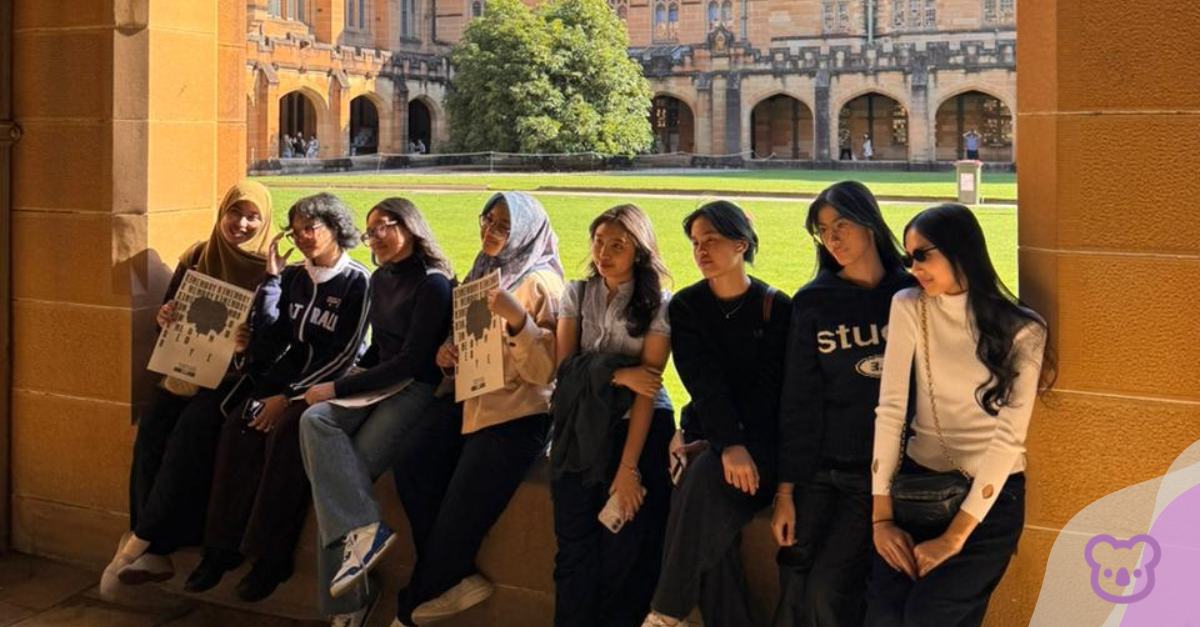
There is a familiar rhythm to most international student study tours. Campus walk. Lecture theatre. Information session. Photo in front of the sandstone building. Repeat.
But every now and then, a program cuts through because it understands something the sector too often forgets. Students do not just want information. They want to see themselves in the story.
That was the difference during a recent Australian university experience program involving Indonesian high school students visiting Melbourne and Sydney. Across visits to Monash University, University of Technology Sydney and University of Sydney, the most valuable voices were not necessarily the staff delivering presentations. They were the students already living the experience.
Members of Perhimpunan Pelajar Indonesia di Australia stepped into mentoring roles, speaking candidly about academic pressure, housing, cost of living, loneliness, adaptation, and what it actually feels like to arrive in Australia as an international student.
And unsurprisingly, the energy shifted immediately.
The polished presentation style that dominates so much international recruitment gave way to something much more effective: conversation. Real questions. Real answers. Real trust.
For students aged 16 and 17, these visits are not simply educational tourism exercises. They are moments where future identity starts to form. A university stops being a logo and starts becoming a possible life. That matters.
The international education sector talks endlessly about student engagement, peer connection and belonging. Yet peer-to-peer interaction is often treated as an add-on to the “real” recruitment effort rather than the centrepiece. This program quietly flipped that model.
And frankly, it makes sense. Students are increasingly sceptical of highly polished marketing language. They are digitally literate, deeply researched, and painfully aware when something feels scripted. What cuts through now is authenticity.
The collaboration behind the program also says something important about where recruitment may be heading. Mulia Edukasi Mandiri supported and prepared the students before departure, while OZiHOUSE Group helped shape an experience grounded less in institutional promotion and more in human connection.
The standout contribution came from the student associations themselves. The students from PPIA were not there to deliver rehearsed talking points. They were there to translate the experience in a way only peers can.
That kind of trust cannot really be manufactured.
As competition for international students intensifies globally, the institutions that stand out may not necessarily be the ones with the biggest campaigns or the flashiest brochures. They may simply be the ones willing to let students speak honestly and be heard.
Because in the end, prospective students are not just choosing a university.
They are choosing a place where they can picture themselves belonging.
Daniel Yuen is Head of Operations and Growth at OZiHouse.