











International education avoided becoming the headline villain of Budget night. But that does not mean the sector escaped untouched.
In fact, buried within the Budget papers were several signals that the Albanese Government remains firmly focused on tightening migration controls, strengthening visa integrity measures and increasing regulatory pressure across higher education.
For many providers, that will sound less like relief and more like a pause before the next announcement.
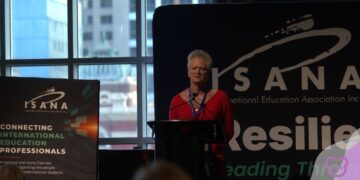
Phil Honeywood, CEO of the International Education Association of Australia (IEAA), was quick to sound the warning.
“My best guess is that our beleaguered international education sector was provided with only a temporary reprieve last night,” he said.
“Given this year’s Budget was always going to be dominated by the tax package, why waste a good ‘tough on migrants’ headline now?”
That sentiment captures the uneasy mood across the sector following a Budget that largely avoided direct references to international students while still allocating significant funding toward migration compliance and visa integrity systems.
Among the measures was an additional $19.8 million for student visa processing reform. Officially, the funding is intended to improve efficiency and strengthen the integrity of the visa system. Unofficially, many in the sector believe it points to more filtering, more scrutiny and slower decision making.
Honeywood certainly does.
“Similarly, the Government is not throwing another $19.8 million at student visa processing reform because they want to get more visas approved for education providers more quickly,” he said.
“Instead, this money will most likely assist Case Officers in applying additional ‘filters’ to their decision making.”
That interpretation aligns with the broader direction of policy over the past 18 months. The Government has repeatedly framed international education through the lens of migration management, housing pressures and system integrity, rather than as one of Australia’s largest export sectors.
The language may have softened slightly on Budget night. The policy settings have not.
There was also growing concern within higher education about the expanding cost burden being placed on universities and providers themselves. Included in the Budget was confirmation of increased funding and enforcement activity tied to the Tertiary Education Quality and Standards Agency, with the sector effectively continuing to shoulder higher regulatory costs through the TEQSA levy framework.
For universities already navigating weaker international enrolments, rising compliance obligations and increasing visa refusals, the optics are difficult to ignore. Providers are being asked to pay more to operate within a system that is simultaneously becoming harder for international students to access.
Honeywood believes the politics behind the timing are important.
“This deferral of additional pain for us might well have been motivated by last weekend’s One Nation victory in the Farrer By Election,” he said.
“The Albanese Government has proven very adept at waiting for the right time to make ‘hairy chested’ policy announcements.”
That observation will resonate with many education leaders who increasingly feel the sector has become politically expendable. International education continues to contribute billions to the Australian economy, underpin university research capability and support thousands of jobs. Yet politically, it is now routinely discussed as part of the migration challenge.
That shift is reshaping policy.
The Government’s migration forecasts continue to point toward lower net overseas migration numbers over coming years, with further pressure likely to flow into international student settings and planning levels.
“With the overall NOM clearly on a downward trajectory, then a reduced NOSC figure is bound to be announced for 2027 later this year,” Honeywood warned.
That looming possibility may matter far more than anything explicitly announced in the Budget itself.
Because while there was no dramatic crackdown unveiled this week, the architecture of restriction continues to grow quietly in the background. More compliance funding. More integrity measures. More regulatory oversight. More political caution around student migration.
The sector may have avoided another bruising headline this time.
But few appear convinced the Government’s work is finished.
As Honeywood concluded: “Notwithstanding all of the above, things could have been more diabolical for us in the Budget. But dare I suggest ‘the best is yet to be announced?!’”
For a full analysis of the budget’s impacts on International Education, see Tracy Harris’s piece published earlier this morning here.