











In an environment of persistent uncertainty, internationalisation remains a high priority for universities but is increasingly influenced by government policy and financial pressures, according to a new report from Nous Group and Navitas.
Internationalisation in the midst of slowbalisation explores the findings from the second Global Survey of International Education Leaders (GSIEL) conducted between September and October 2024.
Over 200 senior operational and strategic leaders with responsibility for international education and global engagement at universities in Australia, the United Kingdom and Canada shared their insights about their internationalisation agendas, priorities and assessments of future opportunities.
Key themes from the report
The report identifies and explores six key themes from the survey findings:
- Internationalisation remains a high priority for universities but is increasingly influenced by government policy.
- Revenue is front of mind for universities amid financial pressures and intensifying competition.
- Universities expect to increase revenue through higher fees, reduced scholarships and, for some institutions, lower entry requirements.
- Universities are expecting to reduce investment across many areas of international student recruitment.
- Transnational education is becoming an increasingly important strategy, though many institutions are not confident on their ability to execute.
- While pessimism among university leaders is generally increasing, there is still cause for an optimistic outlook over the longer-term.
‘Slowbalisation’ risks
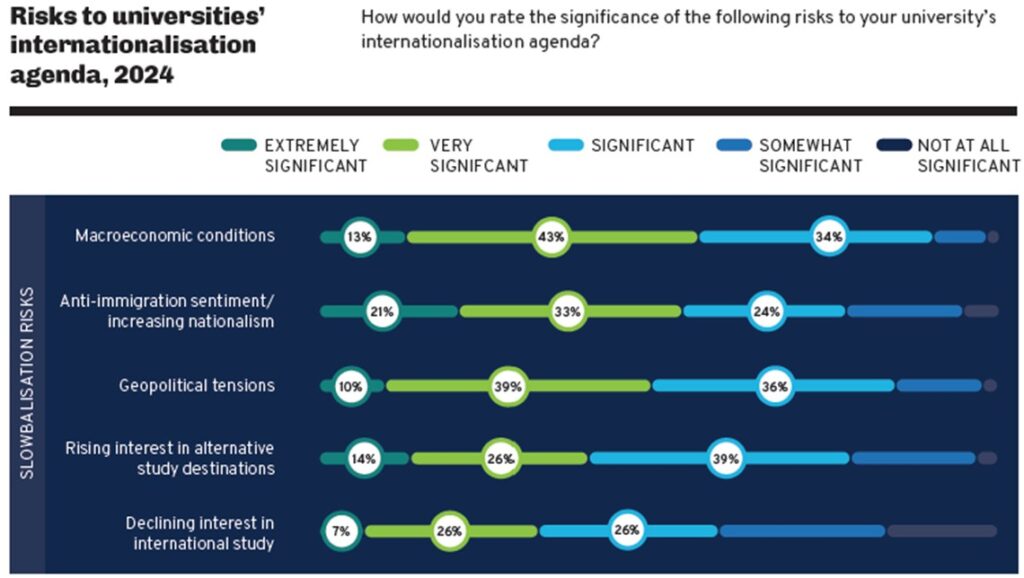
When asked to respond to the question of ‘How would you rate the significance of the following risks to your university’s internationalisation agenda?’, the top five ‘slowbalisation’ risks were:
- Macroeconomic conditions
- Anti-immigration sentiment / increasing nationalism
- Geopolitical tensions
- Rising interest in alternative study destinations
- Declining interest in international study
“Beyond the financial pressures in the immediate term, university leaders must contend with the possibility that the shift from the market era to the managed era will continue to deliver greater levels of government intervention and control, which will in turn have important implications for strategic planning,” said Jon Chew, Navitas Chief Insights Officer.
Student recruitment still the key focus
International student recruitment remains the most important area of focus, with 88 per cent of survey respondents indicating it is very important or extremely important to their internationalisation strategy.
But 89 percent of global university leaders also acknowledged that recruitment would become even more competitive in the next one to two years. And as competition intensifies, international student revenue will become a greater focus, with more than half anticipating an increase in tuition fees in the next one to two years.
The report concludes with cautious optimism about the future of the international education industry and advice about strategic actions to navigate the changing environment.
“Pressure to compete while reducing costs will lead to new approaches to internationalisation going forward. There will be a portion of the sector that reduces its dependence on international, while others will find opportunities within the constraints of this managed era,” said Nous Principal, Matt Durnin.
The full report is available for download here.