













The writing has been on the wall for some time now for unbecoming behaviour and unscrupulous players in Australia’s International Education Sector. Repeated statements by multiple Ministers all singing from the same song sheet, confirm it – the government has their eyes on them, and the party is over.
The question remains, though. When?
According to Ravi Lochan Sign, MD of Global Reach “The time to enact legislative changes is one thing, and understandable, but what we hear is that opposition to some of the proposed changes may even lead to them being tweaked.”
“The speech of the Education Minister still sticks to what was announced previously though what we learnt from other stakeholders has indicated a delay with Migration review due to the questions that have arisen since the announcements.” Says Signgh.
The Minister’s speech at AIEC can be seen here .
“Over the time we spent around the AIEC conference on the first day, we heard chatter but it is not clear how it will be implemented or when it will be implemented.” He says.
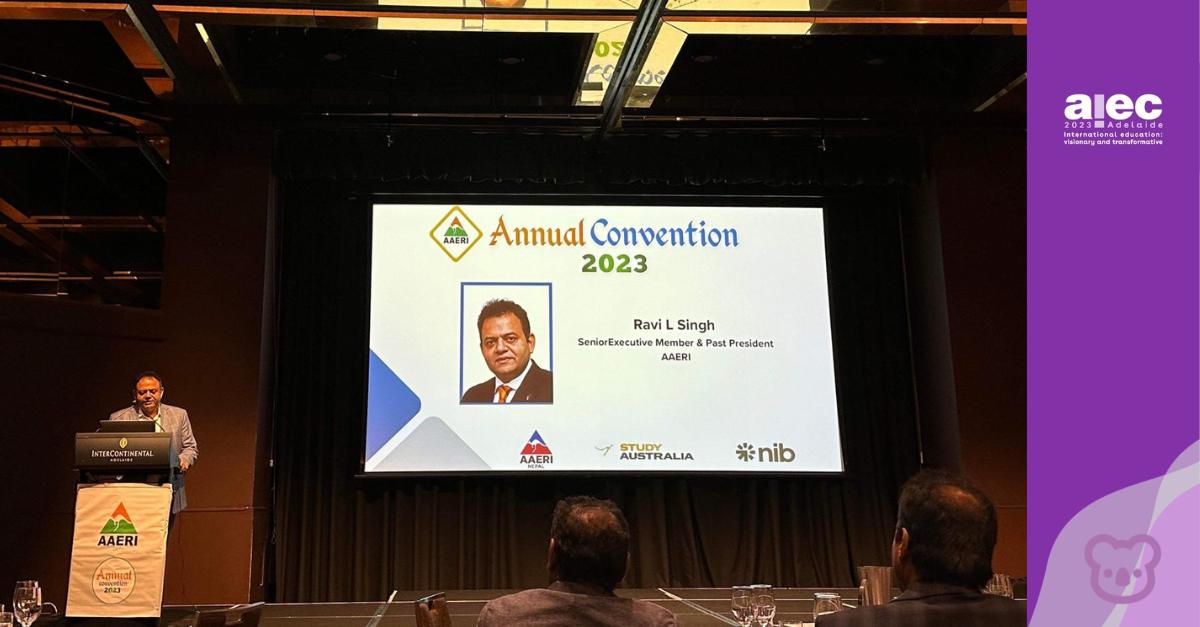
To substantiate the claim, Singh points to a number of key areas of policy change, which he included in his address at the AAERI convention in Adelaide yesterday, where he believes AAERI’s role will be critical in India. He was speaking in his role as past President of the association.
Commission payments for onshore student recruitment was to be banned
Singh highlights what was reported by the AFR:
The Minister is now emphasising the commission payments for “course transfers” and so clearly there is a difference being made with commissions that are paid to onshore agents when students moves from one level to another upon completion of the degree.
Singh says “This difference is important and welcome, but when will it be enacted and applied? My guess is that it will take another six months as it might be part of the new ESOS act. Yes, another six months.”
Cross-ownership of education institutions and education agencies will be prohibited
Singh says “We heard it, but how will they apply this? The existing colleges are in hundreds who have some stake in education agencies. Or will it only apply to private colleges in future? Certainly, none can delist existing colleges as in Australia, the legalities will come in the way. If it is across all institutions, then even large private HE institutions have instances of having a stake in the agency business. Let’s not forget that even Universities have a stake in the industry’s leading education agent.”
“I agree with the Minister that there is a conflict of interest when education institutions have a stake in education agencies, but then I would want him to begin with leading by asking public universities to divest the shares in “the” education agent. I guess that this particular announcement will not be easily applied. Maybe never.” He says.
GTE transition
Singh says, “The Genuine Temporary Entrant test (GTE) will soon be history along with the SOP requirement, and in the future, students will not be considered unfavourably for a student visa grant if they have post-study work or even migration aspirations, provided they demonstrate that they are meeting the GST (Genuine Student Test): We learnt of this several months ago and have been waiting for the details of what will determine the GST.”
Watch this space.
“The expectation was that by now, we will have the draft, and it will be applied soon so that students who apply for visas for the main intake of 2024 (Feb-March 2024) will be fairly tested. However, now we hear whispers that while the draft might be available at the end of this month, we don’t expect it to be applied anytime soon. My guess is that the students who will apply for visas for the first intake of 2024 will still have to meet the GTE criterion.” He says.
Lead Referring/Sub Agents
Singh says, “Amongst other whispers is that the realisation on the part of policymakers is that most agents do have lead-referring third parties. Some refer to this as sub-agents, and Universities are quick to point out that even traditional agents are often aggregators.”
“There is a difference with the so-called edTech aggregators of sub-agents whose sole role is to aggregate the uncontracted sub-agents, but will leave this bit for a later discussion. However, what we now are hearing is that our prophecy that edTech aggregators don’t really introduce a change way of operation and that life will return to F2F agents post-pandemic is turning true.
“Education providers that I have spoken to say that most edTech aggregators are on a slide down and their real enrolments or retentions are low, and their visa refusal rate is high. Are we surprised? However, there is still a need to insist that principal agents take full ownership of the applications lodged by them even if it is sourced from third parties.”
“Visas for all their applicants should be lodged by the contracted agents. Can this be enforced? of course. Very easy. Look at what immigration NZ does. If a student applies for a visa directly or through another agent after receiving the offer of admission through the contracted agent, the NZ visa team considers them unfavourably and tends to question the student.”
“This has helped greatly to correct the situation. In the case of Australia, if the COE can list the agent clearly and it is visible to even the student, Home Affairs can then obtain a clearer picture when the visa is not being applied by the contracted agent. Also, if a student applies for the visa directly, even when the COE is through an education agent, I can say with near 100% certainty that there is a reason to look closely into that visa application. Often, dodgy applicants are guided that way by the dodgy agents.”
The Koala thanks Ravi Lochan Singh for sharing his views.












