












An Examination of The State of the International Education Sector
Let’s talk about student exploitation.
Let’s talk about integrity.
Minister Clare O’Neil has promised to restore the integrity of the ‘broken’ education system, and in general, this is something we all support.
However, through a series of untransparent actions and quite plainly exploitative decisions, our government has placed a number of students at extreme risk and is exploiting students for their own financial and PR gains..
PR Wins at the Expense of Students are Exploitative
We all saw that tweet from Claire O’Neal publicly celebrating success in reducing net migration thanks to a tough stance on visa approvals for international students. This celebrative tone is somewhat callous given the enormous negative impact this strategy is having on students, universities, colleges, and education industry employees across Australia.
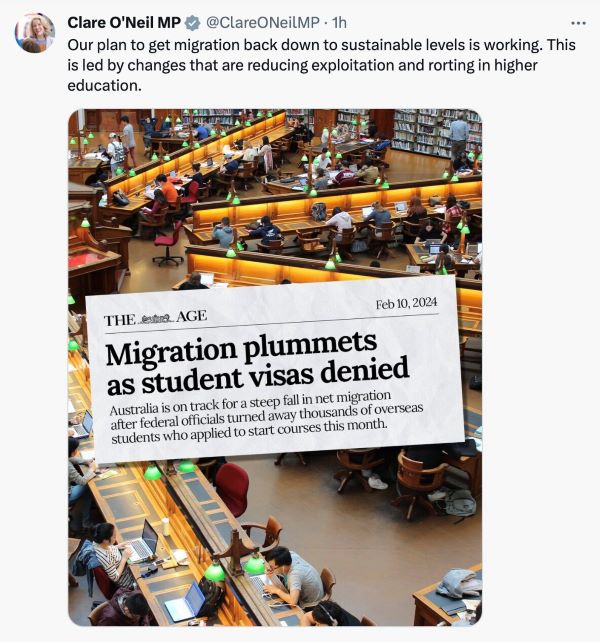
Despite the negatives, the social media comments from the Aussie public are full of supporters stating there are too many foreigners causing havoc on our economy and housing, so the PR win at the expense of economic progress and ethical treatment of students is worth it (I guess).
However, most of the education sector sees this as a simple case of exploiting students for PR points, and when mixed with statements about integrity and rorting, it certainly raises a few eyebrows
Who is Rorting Whom?
First of all, the current wave of unjustified visa rejections has significant impacts on the lives and wellbeing of students offshore and onshore. It’s been well-documented in many news articles that students prepare and save for a number of years to come to Australia.
Many families and communities devote their lives to supporting their students’ dream of studying with us Down Under. These dreams are being crushed en masse, even though these students meet the rules and guidelines according to visa policy.
We are seeing a wave of visa rejections with no real justification, except for thousands of copy and paste responses from case officers stating:
“I have considered the applicant’s likely earning capacity in Australia and in their home country. Based on the information before me, I am not satisfied the financial incentives to return home outweigh the financial incentives to remain in Australia. I therefore place little weight on the applicant’s implied intention.”
What is the outcome?
- Visa refusal for no apparent reason other than stating a person could earn more in Australia than their home country (copy and paste reason across thousands of rejections).
- Providers are withdrawing letters of offer and COEs to save their risk rating.
- Providers are blacklisting offshore markets at rates previously producing great students, simply to protect their ratings.
- Tens of thousands of students have not yet had a decision on their visa in time for them to commence their studies and have had to withdraw their enrolments.
This all has a significant effect on students’ lives, livelihoods, and their future plans. Let’s also remember that when a person has their visa rejected, this is a black mark against their name in every country that they choose to travel to.
At least Canada had the courage to call a spade a spade and announce a flat 35% reduction in student numbers for 2 years. While drastic, at least providers, agents, and students know what field they are playing on and the rules of the game. We as an industry, on the other hand, are flying blind.
Onshore Students – Chaos, Confusion, and Mental Anxiety
And now let’s switch our attention to onshore matters. The government has stated very plainly that it intends to reduce the number of student visas approved for those who are on other temporary visas, such as the 408 COVID visa, the working holiday visa, previous student visas, and tourist visas. For some reason, these are seen as less genuine than people who are offshore, no reason given, but it’s always a good idea to demonise your tourists and working holiday makers and critical sector workers for their economic contributions, isn’t it?
The government has either been rejecting visas at random or, in most cases, they have failed to give a response on visa applications within a reasonable time frame. Reports from agents onshore indicate we have thousands of students who have been waiting 4+ months without a visa outcome, and many of these are from ‘low risk’ countries.
Every day, agents and colleges are reporting they have onshore students who have been waiting three, four, five months with no visa outcome. While these students have an advantage over offshore applicants in that they can actually commence their class without a visa, these people are in a form of limbo, and this causes a range of problems.
For instance, those who were previously on a tourist visa and sought to move to a student visa, this limbo means they’re stuck in Australia without the ability to work, and this places them at extreme financial risk – living in Australia without an income. This, in turn, leads to the risk of exploitation, the risk of entering the black-market labor force without work rights, and of course, they are exposed to various mental health and psychological issues that go with such instability.
Just like we saw during Covid, government policy is putting the lives of international students at risk for their own political gain.
Financial Gains from Visa Rejections
And what about those onshore applicants who had their visas rejected? Well, being onshore, they have the right to appeal and take their fight to AAT – no worries, eh? Well, think again. The cost to appeal your visa refusal at the tribunal is $3,374 plus your migration agent fees (let’s say $1500). So a student needs to pay about $5,000 just to prove they are attending classes and are legit.
And people are appealing in droves. I have had reports from many migration agents that they’re currently making more money from appealing wrongful visa rejections than they are supporting actual migration cases. So when we talk about exploitation and integrity, should eyes be on the providers, students, or the Government that is driving this train wreck?
A boom in revenue is blossoming, and with their stated extra scrutiny on onshore visa applications, how much does the Government stand to make from appeals? Hundreds of millions? Only time will tell. Sounds a bit exploitative to me.
Integrity is an interesting word, isn’t it?
Only 6 months ago, it was all about shutting down dodgy colleges but we are yet to see an update on this, let alone see any deregistration of the numerous colleges identified in people trafficking scandals. We all agree an industry clean up is necessary, but actually regulating providers does not win elections whereas freeing up shared rental houses in Newtown and Bondi does apparently.
There is a clear intent to reduce net migration numbers, and students are an easy lever to pull; however, the methodology and decisions by the Australian government are inconsistent with the migration strategy that has been outlined. Rather than increasing the integrity of the sector, we are seeing a slash and burn approach with legitimate students and quality providers left to bear the consequences for poorly planned reform.
The migration strategy stated many times that priority will be given to students studying courses that give career outcomes. However, the number of rejections coming for the Vet sector, even for highly skilled courses such as hospitality, means that the Labour government is more committed to increasing rental vacancy rates in inner city locations than solving the national skill shortage crisis.
Integrity, inconsistency and lack of transparency
The government talks a lot about integrity yet fails to act with the very word that they insist our industry lacks.
- There is chaos amongst providers who cannot plan for intakes because thousands of students are waiting for their visas to get approved.
- There is chaos amongst students who have their lives thrown into the air, waiting for their visa to get approved, or receive a rejection for no reason at all, other than the fact that they happen to be from a certain country, even though they meet all the criteria and have the most genuine of intent.
- Rejections seem to be targeting particular countries (India, Colombia, Pakistan etc.). Most of us would acknowledge these markets are producing an unsustainably high volume of students, which leads to many problems (just look at what has happened in Canada recently), but is there a better, more honest approach that could be taken? Wouldn’t a transparent approach (e.g., an announced cap on numbers, or a strict set of rules for entry) be better than smokes and mirrors that leave us guessing what the rules are; we are fumbling in the dark?
Example: I recently arranged for 9 students to study in Australia on a study abroad program. All students had confirmed enrolments from a French uni, due to commence shortly after the conclusion of their course in Australia. All students could prove finances and could prove they had a commitment to study in France 6 months after commencing studies in Australia. They were as genuine as you can find.
We had 8 students approved (all French), and 1 rejected (Indian passport but was living/studying in France). Her situation was exactly the same as the others, if not even stronger, being the daughter of a diplomat.
The reason according to the case officer was the same subjective statement: The student could earn more money in Australia than France and therefore had no incentive to return to Europe. But this student didn’t need to study or work in Australia, and there was no reference to any of the documents provided including:
- A letter from the Australian college inviting the student for a study abroad program on a study abroad/pathway style program,
- The agreement between 2 colleges proving the study abroad agreement and education pathway,
- The COE from the French college proving a financial commitment to study back home,
- A statement from the student that she didn’t need to work while in Australia as she had enough funds to cover her study abroad experience in Australia.
What we saw was a copy/paste rejection letter stating the student could make more money in Australia. 8 visas approved and 1 rejected.
Inconsistency = lack of integrity
Students Exploited for Government Wins
The easy wins of attaining a reduction of net migration have started by hacking away at international students, an industry long heralded as our 4th largest export industry and there is going to be a lot of collateral damage. Once again, students are singled out as they’re not voters, they have no voice, and are treated as just another pawn in the government’s chessboard.
It wasn’t too long ago that international students were being touted as the heroes of Australia, fulfilling the jobs that local Aussies don’t want to do. I imagine as soon as the next election is over, the rhetoric will change to how we need people to fill job gaps in cafes and cleaning companies and we will welcome them back with open arms.
The 408 visa was extended to international people to fill critical labour gaps, yet very quickly, it became branded by the Government as a backdoor visa for work rights. But this worker gap fill was the exact reason why the government created the expanded definition and access to the 408. Now, to blame students for taking this option and publishing them for trying to move back into studies screams out ‘lack of integrity.’
We’re now hearing stories that those who moved onto a 408 are either getting rejected or having no visa outcome and are stuck in limbo.
And in a government’s effort to reduce the number of ‘permanent temporary residents’, they’ve simply moved this problem to another class of people and the mental anxiety and social problems that result are starting to manifest.
A Way Forward
For us to move forward as an industry, and to plan effective education delivery and recruitment strategies, we need to know the rules on which the government will be operating. A set of clear rules that providers need to operate their recruitment strategies will allow appropriate planning, communication, and resource allocation. The current practices are seeing good businesses waste time and money and quickly move into lower risk ratings due to unwarranted and random visa rejections.
We are all playing a complex board game without having read the instructions. Those who guess the game rules incorrectly suffer the consequences.
There are many genuine students looking to study, and there are many genuine providers eager to educate these students. It is OK for someone to come here on a working holiday or a tourist visa and then choose to study – we should be encouraging this. We have a world-class education system, incredible public and private providers who are eager to educate them. Why is there now rhetoric that these people are here to take advantage of us all because they want to study and work and gain a taste of Australia?
Soon we will be left with an industry on its knees, still recovering from border closures because of the multiple students who cannot study their intended courses, and colleges having to foot the bill for recruitment costs and operational costs when students can’t turn up.
The education industry is more than just universities. It’s the 1,100+ CRICOS colleges made up of the niche VET providers, humble ELICOS colleges, hard-working education agencies and brand-building organisations that are on the ground recruiting and promoting Australia as the place to have a transformative educational experience.
We all want to see an education sector with integrity, and we agree the bad providers and the bad students should be kept at bay – but this is not the way. A slash and burn approach is destroying the whole farm, not just the rotten crop.
Australia is effectively saying “come study with us, but we won’t tell you what our entry criteria actually are” and this is akin to saying, take a gamble with your life and dreams. It won’t fly – prospective students will look elsewhere, agents will direct students to safer options and all the good work that has been done by the industry, by Austrade, by Tourism Australia, and by all the other brand-building agents and colleges over the last 10 years will soon have all gone to waste.
When we think about integrity and we think about exploitation, I’m not worried about education providers. I’m not worried about employers either. I’m worried about the government that operates shadow policies at whim, and whose actions are destroying our industry and ruining the lives of our students.
Rant Over
Simon
Originally published via LinkedIn here. The Koala thanks Simon Costain – General Manager, International Business Development at ASX listed NextEd Group for his permission to republish.