











For more than a decade, international education has been one of the great success stories of higher education. Universities expanded their global reach, governments celebrated growing enrolments, and students crossed borders in record numbers seeking qualifications, experiences and opportunities that could change their lives.
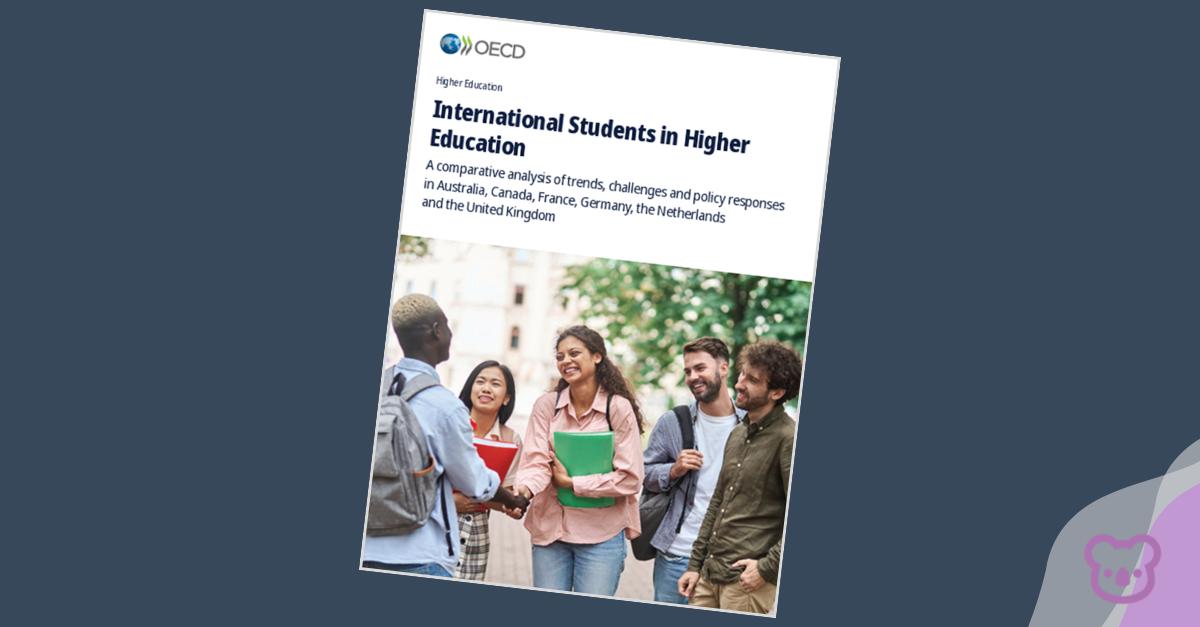
The OECD’s new report, International Students in Higher Education, suggests that era of uninterrupted growth may be coming to an end.
Drawing on evidence from Australia, Canada, France, Germany, the Netherlands and the United Kingdom, the report paints a picture of a sector at a crossroads. International student numbers have reached historic highs, but so too have concerns about housing, migration, institutional dependence on fee income and the ability of host countries to provide a positive student experience.
The report is significant because it moves beyond the familiar discussion about recruitment numbers and economic contribution. Instead, it follows the entire student journey, from choosing a destination through to graduation and employment, and asks a more fundamental question: what happens when success becomes so large that it begins to create its own challenges?
The first major finding is that international education has become a victim of its own success.
Across all six countries examined, international student numbers grew dramatically throughout the 2010s. Even the disruption caused by COVID did not permanently alter the trend. By 2023, all six countries had recovered to or exceeded pre-pandemic levels. Australia, Canada and the United Kingdom became particularly dependent on international enrolments as a source of growth and revenue.
Yet the political mood has shifted. Concerns about migration levels, housing shortages, recruitment integrity and pressure on public services have led governments in Australia, Canada, the Netherlands and the United Kingdom to tighten policy settings. The OECD notes that growth is now slowing and in some countries enrolments are beginning to decline. Meanwhile France and Germany have maintained policies designed to attract more international students, viewing them as an important source of future talent and skills.
This divergence is perhaps the most important message in the report. International education is no longer being treated solely as an export industry. It is increasingly being viewed through the lenses of migration, labour market planning, housing policy and social cohesion. The debate has become much broader than universities.
Australia features prominently throughout the report because it sits at the centre of many of these tensions. International students account for a substantial share of enrolments and have become an important source of institutional funding. The OECD acknowledges that international student revenue has helped universities maintain activities that may otherwise have been difficult to sustain. However, it also warns that heavy dependence on international fees creates financial vulnerabilities when enrolments slow or governments change policy settings.
For Koala News readers, this will sound familiar. Australian higher education has spent years balancing two competing realities. On one hand, international students have supported research, innovation and institutional growth. On the other, the sector has become increasingly exposed to fluctuations in global mobility, geopolitics and government policy.
The report also challenges the tendency to view international students primarily as economic contributors. Instead, it focuses on the lived experience of students and the obstacles they encounter.
Housing emerges as one of the most significant challenges. Students across the six countries report difficulties securing accommodation and managing rising living costs. Many rely on part-time employment not simply for extra spending money but to meet essential expenses. Financial stress is identified as a major contributor to student dissatisfaction and, in some cases, withdrawal from study.
The social dimension is equally important. The report finds that many international students feel a strong sense of belonging within their institutions and often report positive experiences on campus. However, those same students can feel disconnected from the communities around them. Evidence from several countries shows that students frequently struggle to build relationships with domestic students or integrate into local society.
This finding deserves attention because it highlights a gap between internationalisation and integration. Universities have become highly successful at recruiting students from around the world. Creating genuine connections between those students and their host communities has proven more difficult.
Language also remains a critical factor. Students who are confident in the local language generally experience stronger social integration and greater comfort navigating everyday life. Those with weaker language skills often remain within international student networks, limiting their opportunities to connect more broadly.
Another interesting theme is the growing importance of post-study outcomes.
The report notes that many students now choose destinations not only for educational quality but also for employment opportunities and potential pathways to longer-term residence. Governments themselves have encouraged this by promoting post-graduation work rights and migration opportunities. Yet the reality often falls short of expectations.
Most international students express a desire to remain in their host country after graduation, but only a minority stay long term. Many graduates struggle to secure employment, navigate visa requirements or convince employers to hire temporary visa holders. The result is a disconnect between aspiration and outcome.
This has important implications for policymakers. If countries use international education as a talent pipeline, then supporting graduates into meaningful employment becomes just as important as attracting them in the first place.
Perhaps the most valuable contribution of the OECD report is its insistence that international education cannot be understood through a single policy lens. It sits at the intersection of higher education, migration, employment, housing, foreign affairs and economic development. Decisions made in one area inevitably affect outcomes in another.
The report concludes with four broad recommendations. Governments and institutions should create more predictable policy environments, strengthen student wellbeing and integration support, improve pathways into employment and enhance data collection and monitoring. None of these recommendations are revolutionary, but together they point toward a more balanced and sustainable model of international education.
The broader message is clear. The next phase of international education will not be judged solely by how many students can be recruited. Success will increasingly be measured by how well students are supported, how effectively they integrate into society and whether host countries can align educational ambitions with social and economic realities.
For Australia, that may be the report’s most timely lesson. The challenge is no longer simply attracting international students. It is building a system that remains globally competitive while also being politically credible and genuinely supportive of the students whose journeys make international education possible.
After years of focusing on growth, the OECD is asking a different question. What does a mature international education system look like? The answer may shape the next decade of policy far more than enrolment targets ever did.
The report can be downloaded here.