











The 2025 THETA Conference opened in Perth with a valuable reminder: in an age of artificial intelligence, automation, and accelerated change, it is still connection – not technology – that underpins the human experience.
The Day 1 keynote speaker, Sisonke Msimang of Perth’s Centre for Stories, invited the sector to reflect on the role of authenticity in teaching and learning. Framing storytelling as “the oldest app,” she explored how our brains are hardwired to seek meaning through narrative.
Msimang also reflected on how storytelling is built through a balance of logic, authenticity, and empathy, which ultimately generates trust. In a time when institutional trust is under strain, the message was subtle but consistent: building meaningful learning experiences doesn’t start with platforms or policies, but with stories – and the humans at the heart of them.
Inspired by her reflections, it’s worth considering how the storytelling instinct can help higher ed engage meaningfully with learners increasingly sceptical of institutional roles and narratives. Can institutions highlight the human impact of academic work – not just the research outputs? Can co-designing policies or learning spaces with students and staff, grounded in how they use them, become the norm rather than the exception?
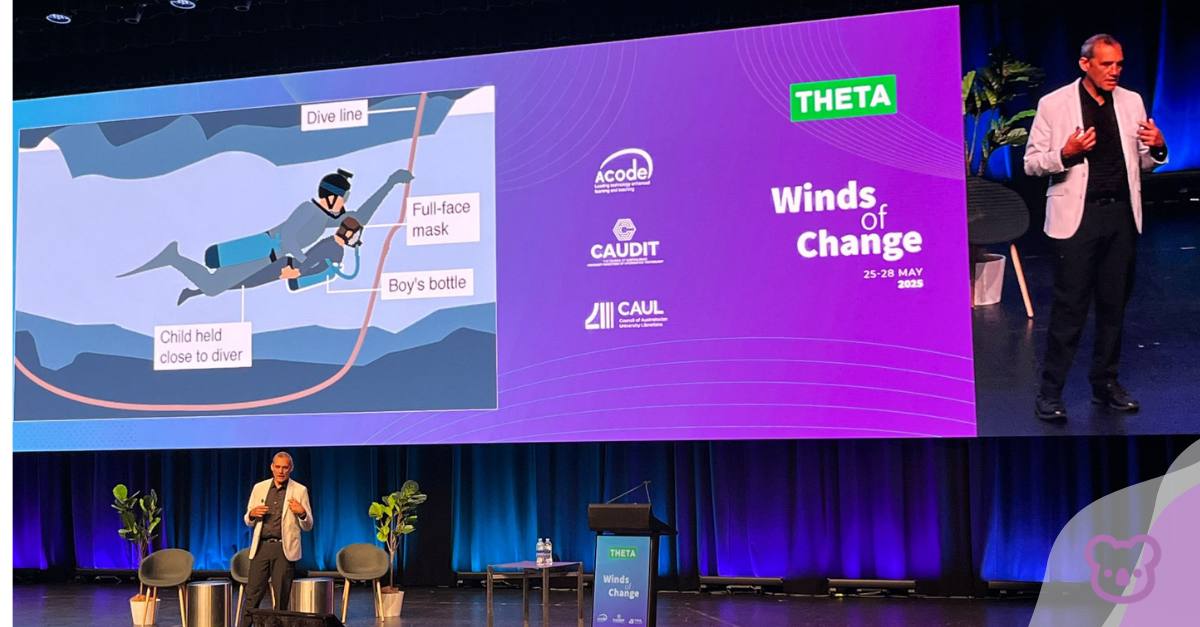
Day 2 opened with a compelling keynote from Dr Craig Challen, who shared a first-hand account of the Tham Luang cave rescue. Told with humility, humour, and quiet intensity, his story was a powerful illustration of trust, teamwork, creativity, and problem-solving under extreme pressure. These are human qualities that technology can support, but not replicate.
The human-centred theme continued into breakout sessions, where speakers highlighted how generative AI, virtual reality, and data-driven tools are being used to support inclusion, engagement, and agency. There was a refreshing array of AI case studies from projects now several years in, with insights grounded in practice and impact rather than ‘this is going to change it all’ hype.
Several sessions pointed to a broader transformation: as competition and innovation accelerate, are higher education institutions evolving into technology-first organisations? As Mark Roman observed, “The schools that will survive are the ones that embrace change at an exponential pace.”
But while change accelerates exponentially, institutional capabilities often progress more slowly. One example is the shifting role of data. No longer just a by-product of applications, data offers the opportunity for insight driven decision-making. Like stories, data can reveal patterns, make sense of complexity, and help institutions that leverage it to respond to the evolving needs of today’s learners.
As the conference continues, what’s becoming clear is the delicate balancing act of embracing innovation without losing sight of the human. And the crucial question for the sector: if higher ed becomes more digital by design, how will it remain deeply human by intent?