


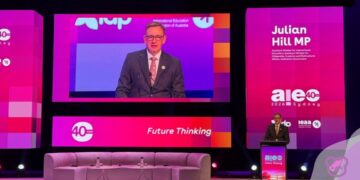





The ITECA International Forum was held yesterday in Adelaide with proceedings continuing today as part of ITECA 2025. With private sector VET and, to a lesser extent, Higher Education, it was a rather sober affair.
Felix Pirie started off the day with opening remarks in lieu of Rebecca Bendall from SannamS4, whom she has just given birth to baby Eddy – a huge congratulations to Rebecca and her partner and welcome to the world little Eddy.
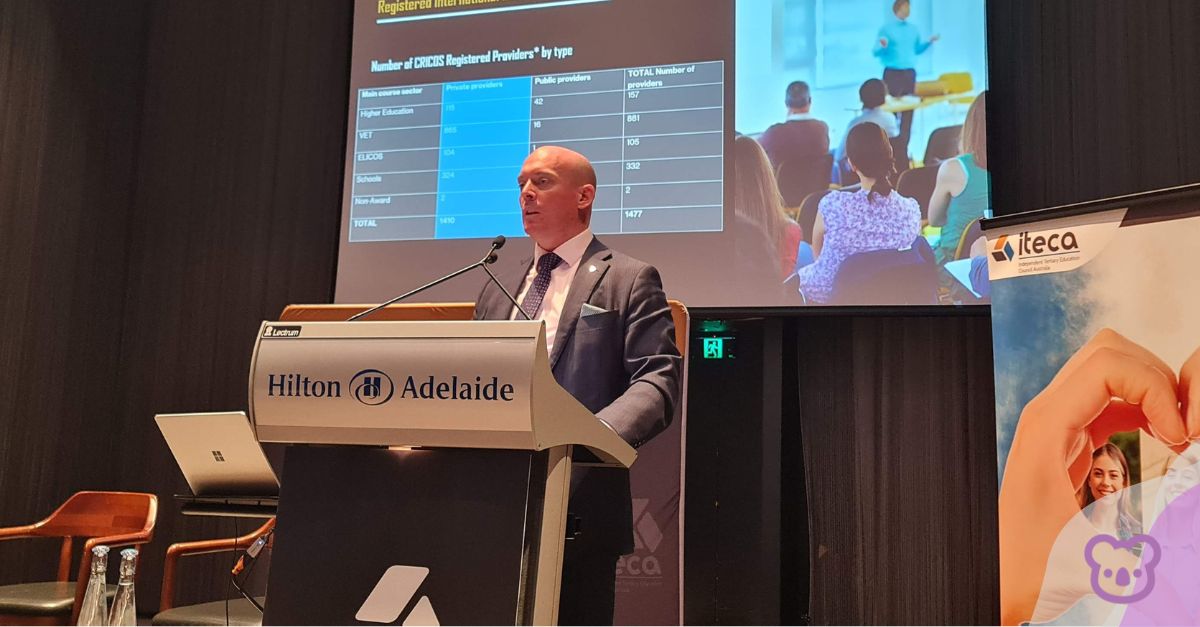
Pirie’s opening remarks set the scene for the day with a series of statistics that clearly demonstrate that private education is doing it tough. Through pretty much every metric, student numbers are down, and while there was a good showing at the event, participant numbers were down from last, with Perie stating he had contacted many members who “just need to concentrate on their business at the moment”. This isn’t surprising.
Next up was Robert Parsonson from the International Student Education Agents Association (ISEAA), who provided an agent perspective. He detailed the demise of GrowPro and the move now to lobby the government to ensure agents do not hold student fees. This is dependent on commissions being paid promptly as cash flows for agents are critically important. Parsonson went on to discuss the issue of commissions. In ISEAA’s view, which may be an unpopular one amongst some, commissions need to be drawn in. He used the number of 40 per cent as just being too high and unsustainable.
He spoke well and made a lot of sense.
Post morning tea, Phil Honeywood from the International Education Association of Australia took the stage. He spoke on the Social License.
It appears NZ wants to double the number of international students they welcome. The NZ international education social license battle appears to be far better off than here in Australia. Honeywood indicated that NZ has 20% of its international students in the schools sector, as opposed to Australia’s 2-3 per cent. This allows students to form relationships at a much earlier age and exposes parents to it as well.
It’s a good point he makes.
He moved to recap the campaign ‘Help Australia Thrive’, which sought to break down pre-tested pretested on international students. This campaign speaks directly to social license.
Next up was Luke Sheehy from Universities Australia, who spoke eloquently and with purpose on a year of chaos that began with the Labor’s announcement of capping students based on integrity. He outlined step by step the political overtures to the arguments of attack on the sector and the potential losses these will inflict. He sums up by stating we are on a two-way street, “made in Australia” can’t happen if universities aren’t graduating engineers and other professions and universities require secure funding, and the lower international student fees require increased government partnership.
Lunch.
Ian Aird from English Australia was next on the stage and spoke about the experience of the past 12 months from the English Language sector experience. He covered the range of government interventions into international education over the last 18 months. He pointed out that the government’s negative rhetoric and multiple damaging policy and legislative changes have badly seen dramatic cuts to the ELICOS and VET sectors costing Australian businesses billions of dollars in local spending and billions more in export earnings.
Aird gave lots of data, such as that while the government claims it needs to bring the numbers of foreign nationals in Australia down, it has been silent on tourism, which represents more than 100,000 more foreign nationals in the country at any one time than education while generating $12 to $15billion dollars less in 2024. Meanwhile, tourism was supported in the federal budget to the tune of $ 195 million in government funding versus zero dollars support for international education.
Aird also noted that data from the Administrative Review Tribunal reveals that from October 2024 to January 2025, 1,000 student visa refusal appeals were heard. Of these 48% of decisions were set aside while the Tribunal on agreed with 14% of refusals.
Next up was a panel with Jane Johnston (Study Adelaide), Toshi Kawaguchi (Study NSW) and Suha McCartney (Study Cairns) on the topic of Creating a welcoming, safe and supportive environment for overseas students. Johnston spoke of the importance of Airport Welcome, the ambassador program and linking students to information and the local community.
McCartney spoke of safety and belonging through community integration, including playing a really uplifting video of students in Cairns ‘feeling at home’. Kamaguchi spoke to student drivers using analytics, the experience that follows and how this meets or does not meet expectations. He goes on to highlight the skills, needs, and successes in which international students are involved.
Post afternoon tea, yours truly spoke on ‘finding hope in the ashes of international education’, a provocative topic. This session was the session of death as much of the content had been covered by previous speakers, and it was the last single session of the day, immediately post afternoon tea. I walked through predictive data based on allocations, visa data that shows trends in what may be happening within Home Affairs, how we got to this place and what both the sector and we can be doing individually to put our best feet forward at this time both in the storm of the sector and through the election.
To conclude the day it was a Panel discussion on the topic of: Where to now for International Education – learning from the lessons of the past . with Felix Pirie, Ian Aird and Mel Koumides. A thoughtful look at the topic concludes in a wider-ranging discussion about why the importance of our sector to the community and economy appears to have been ignored by our politicians.
The Koala thanks ITECA for the invitation to join the day.
Photo: Felix Pirie of ITECA