









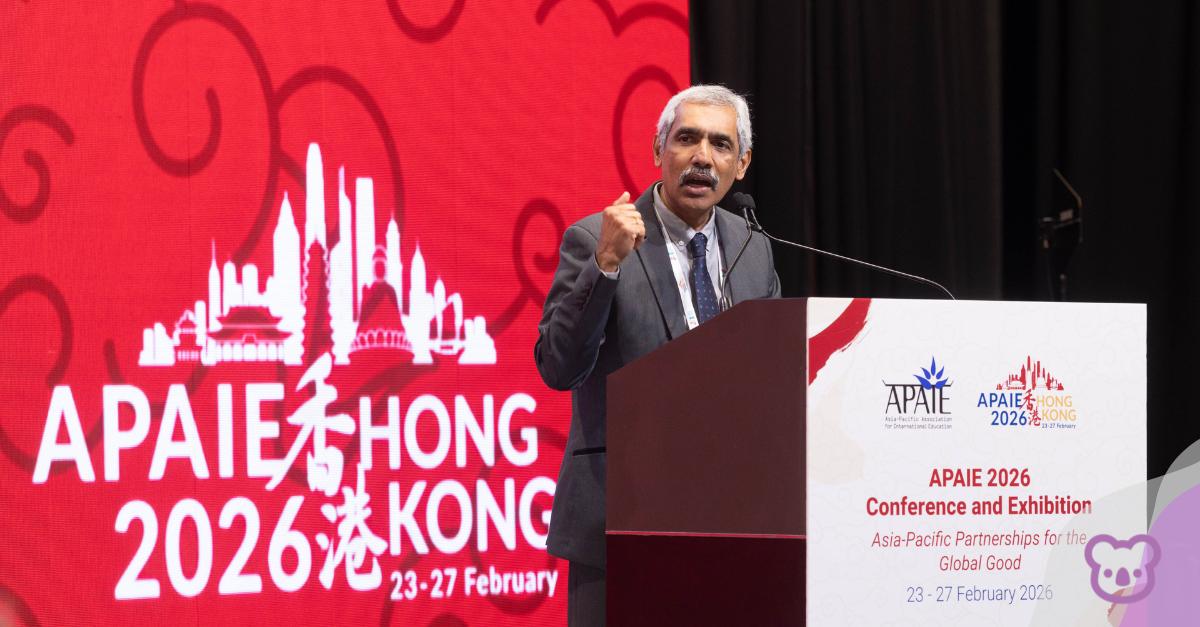
As the lights dimmed inside the Hong Kong Convention and Exhibition Centre, APAIE President Professor Venky Shankararaman closed the 2026 conference with a simple but resonant line: “As we depart, the real work begins.”
It was a fitting end to a record-breaking gathering. More than 3,000 delegates from over 70 countries and regions attended the largest-ever Asia-Pacific Association for International Education conference. Energy was high. Deals were done. Partnerships were seeded. The Asia Pacific’s confidence was unmistakable.
And yet, as I sat reflecting on that “real work”, one question lingered: how do we supercharge what is already a powerful regional platform?
A region in its stride
APAIE 2026 was not short on evidence that the Asia Pacific has come of age as a global education powerhouse.
Under the theme “Asia-Pacific Partnerships for the Global Good”, employability, skills development and workforce relevance were woven throughout the program. This was not education as export transaction. It was education as collaboration, as capability-building, as shared prosperity. Inextricably linked to industry and regional priorities.
Professor Dr Mohd Shafry Mohd Rahim, Vice Chancellor of Universiti Teknologi Malaysia, highlighted the scale of regional excellence: 609 Asia-Pacific universities ranked by QS, 19 in the global top 50 and 54 in the top 200. This is not emerging quality. It is an already embedded framework of systemic excellence.
The APAIE President-elect extended that lens beyond campuses. The 2025 Global Startup Ecosystem Report shows six of the world’s top 20 startup cities are in Asia, drawn from analysis of 3.5 million start-ups across 290 ecosystems. The 2025 Global Innovation Index places nearly half of the world’s top 50 science and technology clusters in Asia, including 15 hubs in China alone.
Universities, researchers, inventors, venture capitalists and R&D firms are already co-located and co-creating across the region. The ecosystem exists. The ambition exists.
So oozing capability, the Asia Pacific is not waiting to be invited into the global conversation. It is shaping it.
Beyond mobility, toward mutuality
There was also intellectual honesty in the room.
During the Global Dialogue Panel, Professor Shankararaman asked: “What’s one thing people in this room could be doing?”
The responses spanned diversification, sustainability, reciprocity, trust-building, experiential learning and fierce advocacy. While admirable, these now extend well beyond pursuits we make with students, it’s how we engage with industry and community.
Dr José Celso Freire Jnr., President of the Brazilian Association for International Education (FAUBAI) and Associate Provost at UNESP Brazil, offered a powerful reframing:
“Mobility only moves the students, not opportunities. Mobility should circulate knowledge, capacity and trust in multiple directions, not just talent.”
That sentiment captures the shift underway. The sector is moving from placement to partnership, from volume to value, from recruitment to reciprocity and the movement of ‘ideas’. The fierce fragmentation in the global landscape was identified by panellists as an “opportunistic moment to rebalance mobility”. This target to redesign partnerships with a greater shared responsibility will inevitably require placing our international education conversations more centrally within the public domain. Inevitably with greater scrutiny however with an uplift in legitimacy and social impact.
This is mature thinking. It reflects a sector conscious of its public role.
The echo in the room
And yet, for all the strength of those conversations, there was a relative absence that echoed.
Scanning the program of more than 260 speakers, industry and business leaders, employer groups, city representatives, investors and community voices appeared limited. The dialogue shaping international education was, in many sessions, largely held within the sphere of international educators.
This is not a criticism of APAIE. It is a reflection of a broader sectoral pattern and identifies our allies.
As Ascent One CEO Naresh Gulati reminded delegates earlier in the week, “education isn’t just a degree; it’s a transformation of life.” But that transformation does not sit solely within universities. It plays out in cities, in workplaces, in start-ups, in NGOs, in the communities where students come from and where our programs are influential.
Sara López Selga, President of the European Association for International Education, urged us to “go back to what education means – public good. Partnerships for social good will follow.” If education is a public good, then it must continuously earn and renew its social licence within the public domain.
That requires more than speaking passionately among ourselves.
From ecosystem rhetoric to ecosystem reality
The Asia Pacific is rich with innovation clusters, economic integration and progressive institutions embracing industry. If we claim to be part of that ecosystem, we need to bring its other nodes into the room and design the future together.
City mayors. Chambers of commerce. Employer associations. Tourism bodies. Venture capitalists. Diaspora leaders. Alumni entrepreneurs. Mainstream media. NGOs. Policymakers.
Not as sponsors or peripheral attendees, but as panellists, provocateurs and partners in defining what international education means for communities.
Let them tell us how the sector is viewed.
Let them articulate what social licence looks like from their perspective.
Let them challenge our assumptions about employability and impact.
True advocacy is not advocating to and for ourselves. It is speaking with and alongside others.
Ready for lift-off
None of this in any way diminishes what APAIE continues to achieve, indeed in 2026 and undoubtedly beyond. On the contrary, it highlights how strong the foundation already is and the intellectual asset that we all share.
The conference showcased:
- Strategic alliances advancing global learning and research innovation.
- University–community partnerships amplifying local impact while generating global insights.
- A region confident in its academic excellence and innovation capacity.
- A willingness to confront fragmentation and redesign mobility with reciprocity at its core.
APAIE is a celebration of what international educators do well. It is also a powerful regional stage. The next step is to widen that stage.
Bring more diverse voices into the frame.
Listen more to those outside the sector.
Continue celebrating, but invite a broader group of friends to the party.
Looking ahead to Malaysia
Aligned with the energy of the Lunar New Year, in this Year of the Horse, a period often described as volatile yet transformative, the Asia Pacific stands at a moment of opportunity. Volatility in global education markets can either narrow our focus or deepen our collaboration.
The antidote appears clear: intentional, structured engagement with industry, government and community partners.
As preparations begin for APAIE 2027 in Malaysia, the challenge is not to rethink the conference’s success, but to amplify it. To move from the strong internal safe dialogue to broader ecosystem alignment that might throw up some challenges. This ensures that when we say “partnerships for the global good”, the global and the good are visibly co-created.
The real work begins.
Photo credit: The Chinese University of Hong Kong, Communications and Public Relations Office.











