




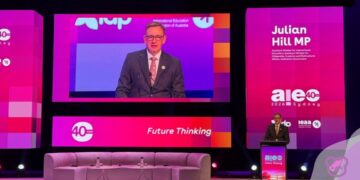






Earlier this month, I was invited to speak at the Principal’s Academy 7th Asia-Pacific Educational Assessment Conference (APAEC) 2025 held by the Principal’s Academy for the Ministry of Education in Singapore.
With scores consistently leading the PISA data for academic results year on year, the Singaporean education system has long been the envy of the world. I got to see firsthand why they are so successful, and I wanted to share my thoughts. There are lessons to be learned for Australian schools, especially in an election year.
The Singaporean government plans their educational strategy 10-15 years in advance. While Australia is hemmed by politics, as elections dictate which policies are introduced, and while the streamlined efficiency of this small country means that actions can be planned, implemented and executed on the ground.
Like Australia, the Minister for Education is a politician. However, the Permanent Secretary has held his position since 2017. Therefore, despite changes in Minister and government, there is continuity in leadership.
In Australia, our past three ministers for education have been lawyers and businessmen. These men manage portfolios for 2-3 years only and have their own teams they bring them.
It’s also worth noting, that Australia hasn’t a female minister for education since Julia Gillard held the position under the Rudd government, despite women making up more than 70% of the teachers in schools.
As Australia is having such difficulty attracting people to the teaching profession, there are lessons to be learned from our small neighbour to the north.
Singaporean teachers are among the highest-paid people in the city. It is a highly competitive process to study an education degree in Singapore, and the brightest minds seek it out. Singapore, as a small country, has long recognised that it’s premium resource to offer the world is its human resource. When Singapore was created, Lee Kuan Yew’s strategy, he would often remark, was “to develop Singapore’s only available natural resource, its people.” Therefore, culturally and politically, education is seen as one of the most important aspects in Singapore.
From early in their teaching careers, teachers can see clear paths a Teaching Track, a School Leadership Track, or Senior Specialist Track. With clearly developed paths for professional and career development, teachers see progression and support from their mentors and throughout their journey to senior levels.
In Australia, we have a “Future Leaders” program for rural areas, still in a pilot stage and states have their own way of tapping shoulders to realise potential. Teacher development for higher positions and progression lacks the formality, consistency and future-focus that Singapore demonstrates.
The APAEC brought in speakers from Canada, Australia, France the UK and the USA to bring school leaders on board with the Ministry’s strategy for future-facing education and assessment in a world where AI and soft skills need to go together to contribute to success. Singapore is moving away from “exams as everything” philosophies to teach students more about the skills needed for real success in the 21st Century. Accordingly, the “Transforming Education through Technology” Masterplan 2030 is a fantastic read as a guideline for the world as AI consumes our lives.
As an observer who visited schools and met with teachers, the most amazing part of the process is that these are not simply strategy documents and ideas generated from above. They are being put into practice at a rapid, yet measured, pace. Teachers are being trained and supported, and school leaders are required to make the changes that bring their schools in line with the timelines proposed by the Ministry.
Singapore, in efforts to maintain multilingualism, requires all students to study in English and a Mother Tongue language (Chinese, Tamil or Malay). As I mentioned in the Koala News recently, to truly provide students with advantages in a global world, they need to be ready for the global world and have the option of multilingual or bilingual education.
Of course, Singapore benefits from the size of the country and population. They are not trying to educate and find teachers for rural areas or support remote areas. However, there are still lessons to be learnt.
As we go to the polls, let’s find a government that doesn’t use education policies to sway votes, but uses them to prepare our youth for the future ahead of them. Let’s support our teachers better and make the vocation an attractive option for the brightest minds.












