









High-level modelling on the changes in revenue from student visa fees and CARC show the it may be good for government but not good for the sector or students. The increase in student visa fees appears to provide the Government with higher revenue in the short term, largely depending on students appetite to lodge a visa.
The modelling was carried out by Keri Ramirez at Studymove Consultants, who also did a wonderful job looking at visa grant declines across markets published yesterday by The Koala, see here.
The modelling looks at two variables: income from the visa fee and income from the CRICOS Annual Registration Charge. It does not include other sources of government revenue, such as GST and income tax, which would likely experience a reduction.
Revenue
Modelling on pure revenue from the income generated from students paying the increased visa fee of $1600 compared to the previous year is done so with a 40% decline in lodgements factored in. See below.
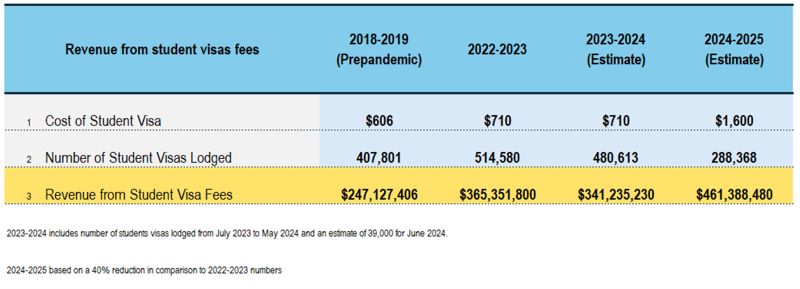
At a 40 per cent decline rate, the government coffers look healthy.
However, when scenario planning, this alters significantly when looking at what lodgements may do. This is the variable factor that all in the industry are talking about. Just how much of an impediment will the 125 per cent increase place? Or, in the Koala’s basic economic vocabulary, just how elastic is Australian International Education when it comes to visa fees?
See below table:

Anything less than a 55 per cent reduction in lodgements will see the government account do well. Anything above this will see the government lose out on revenue.
The question left unanswered, and one often posed to the Koala, is: while visa processing and grants are inconsistent, how likely is a student going to cough up $1600 for a visa they may not get?
This is, quite literally, the multi-million-dollar question.
CARC
While direct visa revenue is one thing, the also receives a CRICOS Annual Registration Charge (CARC) per student (now talking generally visa grants not visa lodgements).
The modelling on this shows with a reduction in student numbers there will also be a reduction in income from this charge, noting it is not anywhere near the scale of the visa fees.
The modelling on this is as follows and takes into account a 20 per cent reduction against 2023 student numbers.

Bad for Sector
As the modelling indicates, the government is marching towards reducing net overseas migration, and this fee increase, along with other levers pulled recently, will no doubt act as a retractionary measure for the sector, with fewer students.
English Australia CEO Ian Aird summarises this well.
He says:
This represents a 125% increase of a non-refundable fee for a service that is not being delivered in good faith – applications are being refused at record levels and often without just cause. Visa applications are being delayed, meaning students can’t make course start dates. And for this service, this government wants to charge a fee that is 10 times that of our closest competing nation, Canada.
The Ministers’ comments about it being related to sector integrity are a cynical attempt to cover their true reasons. This government wants to crush one of the great economic and social success stories of the last 30 years – the establishment of our largest service export and Australia becoming one of the most popular study destinations in the world. They want to crush it, not because it’s bad, but purely so they don’t have to deal with the housing crisis honestly and so they can avoid the LNP making immigration a major issue in the coming election which Labour polls poorly on. They are willing to put tens of thousands of Australians out of work, destroy 100s of businesses, and drive Australia into a recession, purely to have an easier run at the coming election. It’s cynical, populist politics at its worst.
The view of our members is that it’s the quality and integrity of this government’s decision making that is at question here, not the quality and integrity of the education sector.
Australians need to be warned. This government’s agenda of killing international education just so they can achieve and arbitrary Net Overseas Migration metric is going to lead to domestic students having to pay a lot more for their degrees because those universities won’t have the funding from international students. That means degrees will double and triple in cost and university facilities and research will lose their funding and rapidly fall in quality and quantity.
If this government had any care for international students or for the 10s of thousands employed in ELICOS they would have made the effort to separate the student visa into a short and a long course visa with proportionate fees. As it stands this visa fee represents a totally disproportionate impost on students who come for a 6-month English language course. Canada charges $165AUD for these students, we now charge $1,600.
CEO of the Independent Tertiary Education Council of Australia (IECTA), Troy Williams further compounds Airds words, saying:
The Australian Government’s decision, one that was largely expected, to significantly raise the application fee for student visas is yet another attack on the international education sector.
It’s a policy decision that not only tarnishes Australia’s reputation as a welcoming destination for international students, but it’s also one that will contribute to the losses of thousands of jobs across the international education sector.
What’s becoming clear is that the Australian Government lacks a clear and coherent strategy for international education. We’ve seen in recent months a series of policy decisions that appear to have been made on the fly without any understanding of what the long-term implications will be. The businesses that will be impacted and the thousands of working Australians that look set to lose their jobs deserve better.
Bad for Students
In a statement received by the Koala from Nishi Borra, President of the Association of Australian Education Representatives in India, he makes the following point, an astute one.
The increase in student visa fee by 125% (from $710 to $1600), totally unfair with no logic. From this move, it is very clear that international students are seen as “cash cows” for the Australian education sector. International students pay a higher fee than domestic students, providing a steady income to institutes in the country and contributing to the economy. The Grattan Institute report has not looked into many factors or examine the other economic contributions of international students or linkages between international education and other industries
One cannot squeeze more from international students. Now Australia has become the most expensive destination for international students. Instead of looking for simple solutions they have made a huge blunder. Not sure how this increase will help to restore integrity of the international student sector and how it is fairer? Genuine students wanting to study in world-class universities in Australia will now think twice.
Once a student visa is declined, students will lose $1600, and there is no right to review. A better methodology could have been adopted. The same fee can be divided into two segments: one for the pre-visa assessment and the balance after the assessment if the visa is to be granted.
There is a disappointment in the industry
A learned reader’s view
A quote received by a learned reader of the Koala summarised the sectors current sentiment well. They say:
Two weeks ago, Minister Jason Clare attempted to reassure a room full of international education sector leaders that, despite appearances otherwise, the sector did have friends in Parliament. The Minister might want to remember that the government serves the people, not the other way around. The Minister can be reassured that this government no longer has friends in the education sector. Unless they urgently and dramatically change the way in which they treat international education, they are likely to tank the country’s economy and end up with no friends in tourism, hospitality, retail, aged care, or construction either.
The Koala believes a circuit breaker is needed to avoid a looming economic catastrophe.












