










A new global survey of universities has laid bare the extent to which visa settings and political uncertainty are reshaping international education, with the traditional “Big Four” destinations all reporting enrolment declines while parts of Europe and Asia Pacific moved in the opposite direction.
The H1 2026 Global Enrolment Benchmark Report, produced by Studyportals in partnership with NAFSA: Association of International Educators and Oxford Test of English, surveyed 254 institutions across 36 countries and paints a picture of a sector caught between policy disruption and institutional adaptation.
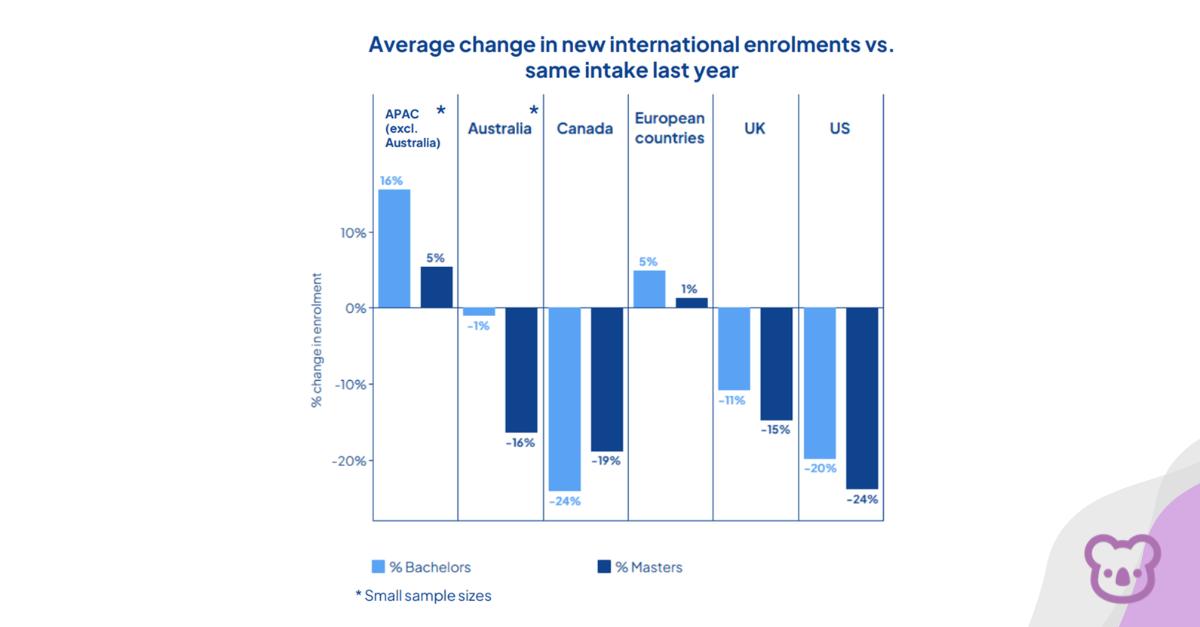
Half of all universities surveyed reported lower international enrolments for the January to March 2026 intake compared with the same period last year, with postgraduate enrolments particularly hard hit.
The United States recorded the sharpest contraction, including an average 24 per cent fall in postgraduate enrolments, while Australia, Canada and the UK also saw widespread declines across both undergraduate and postgraduate levels.
The report lands at a time when governments across several major destination countries continue to tighten migration settings, increase scrutiny on student visas and recalibrate post-study work rights. While each market has its own political context, the survey suggests institutions increasingly see policy volatility itself as the problem.
Globally, 73 per cent of universities said restrictive government policies and visa issues were a significant challenge, up from 62 per cent a year earlier. Two-thirds of respondents identified policy and visa settings as the single biggest negative influence on enrolments.
Australian institutions stood out even within that broader trend. Every Australian university surveyed identified restrictive government policy as a significant obstacle, while 56 per cent also pointed to affordability pressures.
That finding reflects a wider shift underway across international education. For much of the past decade, institutions competed primarily on brand, rankings and employability outcomes. Increasingly, however, students are weighing predictability, affordability and perceived welcome alongside academic reputation.
The report suggests universities that managed to grow enrolments despite the turbulence did so largely through actions within their own control.
Launching new programmes was the most commonly cited driver of growth, followed by market diversification, strategic marketing and targeted financial support. Some institutions also reported success through the introduction of January intakes designed to reduce exposure to visa delays and disrupted recruitment cycles.
That may offer an important lesson for Australia, where the conversation over the past year has often focused on caps, migration numbers and compliance settings, rather than on how institutions themselves might redesign recruitment models in response to changing student behaviour.
The report also hints at a growing divergence in the global market. While the traditional English speaking destinations struggled, universities in parts of Europe and Asia Pacific reported enrolment growth, particularly at undergraduate level.
For institutions facing softer demand and tighter finances, the next phase appears likely to involve both expansion and retrenchment at the same time.
Diversification into new markets was the most anticipated strategic move over the next 12 months, while budget cuts ranked second globally. Australian universities, meanwhile, were among the most likely to flag both budget cuts and increased use of artificial intelligence as part of their future planning.
Studyportals CEO Edwin van Rest said universities that remain agile are better positioned to absorb policy shocks.
“Policy pressures are intensifying. But while external conditions set the context, they don’t fully determine outcomes. Universities that are agile, proactive and supportive of students are much better positioned to absorb visa disruption and sustain enrolment,” he said.
The report ultimately argues that while policy settings can slow mobility, they have not weakened underlying student demand for international education. Instead, the competitive advantage may increasingly belong to institutions and countries that can offer consistency in an increasingly unpredictable environment.
The report can be downloaded, in full, here.