












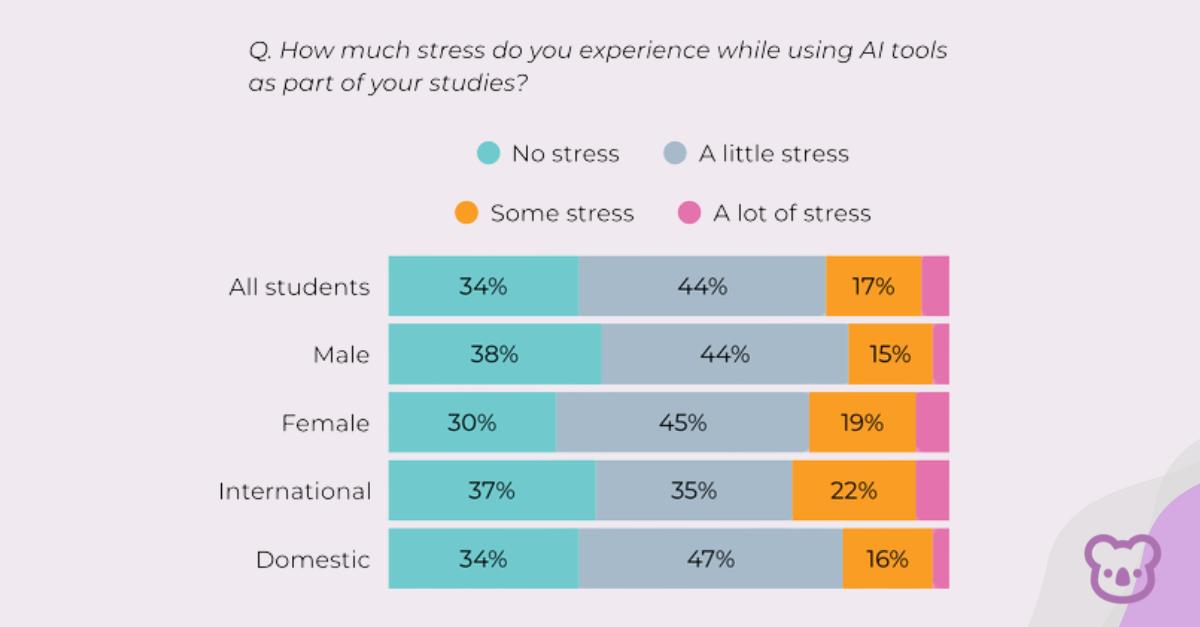
For international students in Australia, navigating language, culture, and the immense pressure of overseas study has always been challenging. But the findings of the 2026 Australian Student Wellbeing Report (n=1,234 with 16% international) highlight a new and insidious weight being added to the balancing act: AI anxiety.
Generative AI use in study has reached 84% among Australian students. Yet, university responses are still largely based in a punitive environment. The report reveals a massive stress factor surrounding AI, with 78% of students who use AI reporting anxiety over being wrongly accused of cheating by detection tools. For international students, this hostile environment is particularly damaging. The anxiety about being wrongly flagged by AI detection tools peaks at 88% for international students at the point of submission. Furthermore, over half (52%) of surveyed students ranked “being accused of cheating when I did nothing wrong” as one of their top three AI-related stressors, with a quarter of students ranking it as their number one cause of stress.
This indicates that instead of focusing on their studies, international students are scared that flawed detection algorithms might derail their degrees. When students are stressed just submitting their work, the university environment has shifted from one of learning to one of suspicion.
Another way genAI impacts the student experience is the fear it is eroding critical thinking. The report shows that nearly half (46%) of Australian students are concerned that using AI for written assignments is reducing their critical thinking and communication skills. The pervasive fear of being flagged – coupled with a “speed-first” approach to assignments – means that without proper scaffolding, students are at risk of becoming dependent operators rather than independent thinkers.
The 2026 report makes one thing abundantly clear: the current approach is not working. Australian universities must pivot away from the punitive “police and punish” model of AI detection, as many are already doing. Professor Judyth Sachs, Chief Academic Officer at Studiosity, says that educators must show courageous leadership by shifting from “AI policing” to a model of “learning validation”.
In practice, a supportive strategy of validation of learning means moving away from opaque AI detection and toward formative support. Institutions can empower students to advocate for their own learning by helping them self-validate that they have actually done the thinking, confirming evidence of authorship rather than simply trying to catch them.
By validating the educational journey rather than policing the output, universities can relieve the heavy burden of AI anxiety and ensure international students return to what they came here to do: learn, think critically, and thrive.