












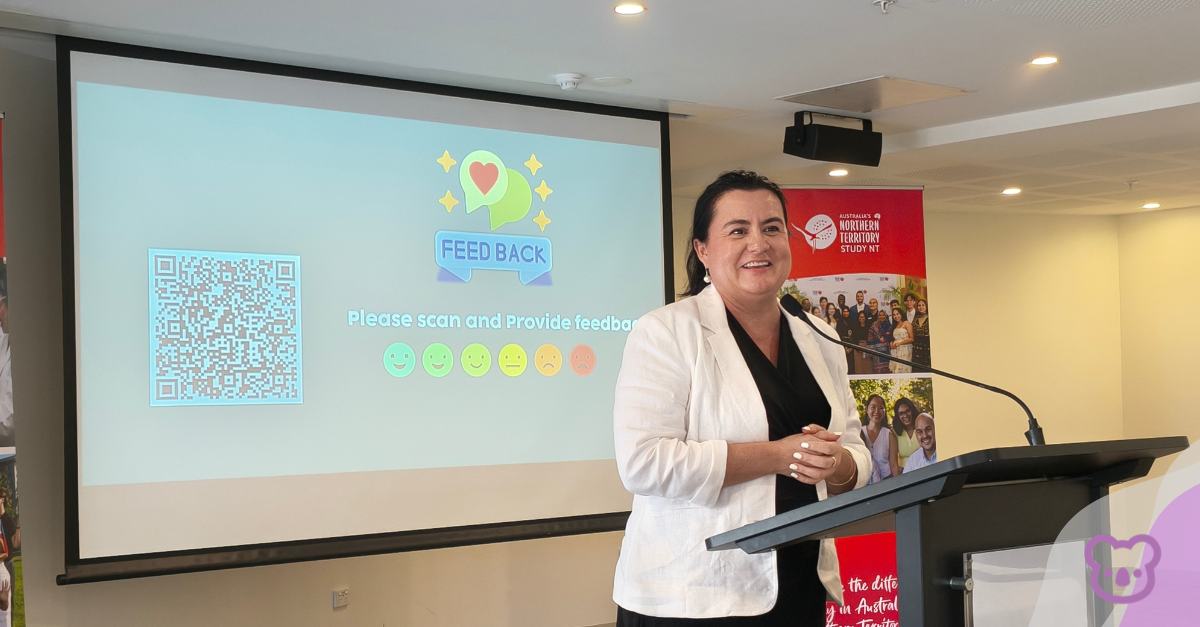
Leaders from across the international education and training sector gathered in Darwin today for the 2026 Study NT Industry Forum, where a clear message emerged: adaptability, advocacy and innovation will be critical if Australia is to remain competitive in an increasingly complex global education landscape.
Held at the Oaks Darwin Elan Hotel under the theme Adapting for Tomorrow: International Education in a Changing Landscape, the forum brought together government representatives, education providers, industry experts and student support specialists to examine the challenges and opportunities confronting the sector.
The day opened with a welcome from Assistant Minister for International Education Khoda Patel MLA, followed by remarks from Department of Trade, Business and Asian Relations Deputy Chief Executive Officer Kelly Ralston. Both highlighted the importance of international education to the Northern Territory economy and the need for ongoing collaboration between government and industry.
A recurring theme throughout the forum was the impact of recent Australian Government policy settings on international education. International Education Association Australia CEO Phil Honeywood provided delegates with an overview of the national policy environment, outlining the implications of recent reforms and the need for providers to remain agile as regulatory settings continue to evolve.
Industry advocacy was front and centre with a presentation delivered by myself. Discussions focusing on the importance of ensuring the sector’s voice is heard during a period of significant change. Delegates heard that strong advocacy will be essential to maintain Australia’s reputation as a destination of choice while navigating policy uncertainty and heightened global competition.
Strategic planning featured heavily during the morning sessions, with education consultant Claire Field encouraging providers to take a long-term approach to institutional sustainability. Speakers stressed that organisations must look beyond short-term enrolment fluctuations and position themselves for future growth by diversifying markets, strengthening partnerships and embracing innovation.
Marketing and student recruitment strategies were another major focus. Insider Studios Managing Director James Martin explored emerging trends in student decision-making and digital engagement, while discussions around user-generated content highlighted the growing influence of authentic student voices in recruitment campaigns.
The afternoon turned attention to market intelligence and regional opportunities. Voyage’s Keith Lim examined the role of social listening in understanding student sentiment and identifying emerging trends, while Acumen’s Ellen Tan provided insights into Southeast Asian markets and the growing potential for transnational education partnerships across the region.
Student wellbeing was also identified as a key priority. Headspace’s Himanshu Rai highlighted the increasing importance of mental health support for international students and outlined practical measures institutions can take to improve student outcomes and foster a stronger sense of belonging.
Throughout the day, delegates repeatedly returned to the idea that international education is undergoing a significant transformation. Rising competition from alternative study destinations, changing student expectations, evolving government policy and rapid technological advances are reshaping the sector at every level.
Despite these challenges, the mood among participants remained optimistic. Many speakers pointed to Australia’s strong education reputation, growing opportunities in Southeast Asia and the resilience demonstrated by providers in recent years as reasons for confidence.
Closing the forum, Study NT Director Renée Tennent reinforced the importance of collaboration across the sector and encouraged stakeholders to continue working together to ensure the Northern Territory remains an attractive destination for international students.
As delegates moved into the networking session that concluded the event, the consensus was clear: success in the years ahead will depend on the sector’s ability to adapt, advocate and innovate in response to a rapidly changing global environment.
The learn more about studying in NT, see here.